Claude reveals ECDSA curve origins
Anthropic says Claude identified how the unexplained seed values behind major NIST elliptic-curve cryptography standards were generated. In under half an hour in October 2026, an internal research model determined that seeds for NIST P-192, P-224, P-256, P-384 and P-521 were outputs of the legacy C-library lrand48 pseudorandom-number generator initialized with Unix timestamps, rather than hashes of secret phrases or other cryptographic algorithms. NIST adopted these curves in 2000 for the FIPS 186-2 Digital Signature Standard, while the NSA had supplied their seed values without explaining their provenance. Anthropic reconstructed timestamps from May 1997 through April 1998 and the candidate positions that reproduce ten prime-curve and binary-curve seeds; P-256, for example, was the 1,842nd 20-byte candidate from its run. Anthropic says the result is not a cryptographic break or a newly discovered weakness, and that the simple reproducible process makes intentional backdoors less plausible. Claude also traced base points for P-192 and five ANSI X9.62 example curves to the FreeLIP random-number generator, but could not explain base points for P-224, P-256, P-384, P-521 or NIST binary curves. B-163 remains unexplained. Anthropic will donate the $36,864 NIST elliptic-curve seeds bounty to the Internet Security Research Group.
anthropic.com
12 min
10h ago

90% of US working hours are spent on tasks not covered well by AI benchmarks
Mercor has published a Benchmark Map that measures how well 29 selected AI benchmarks cover tasks across the US labor force. The map uses the Department of Labor’s O*NET taxonomy, which divides the workforce into 923 occupations, 22 job families, and 18,797 tasks. A task is counted as covered when an LLM judge maps at least five benchmark prompts to it; one prompt can map to multiple tasks. Only 208 of 923 occupations have at least one task meeting that threshold, while six of 22 job families have none. Mercor estimates that 90% of US working hours are spent on tasks with little or no coverage in its initial benchmark set, making economy-wide assessments of AI capability difficult. The organization says benchmark coverage disproportionately favors AI-exposed tasks, with O*NET tasks rated exposed to AI about six times more likely to appear than unexposed tasks. Tasks in occupations with larger wage bills and tasks rated most important are also overrepresented. Mercor found that reweighting APEX benchmark scores so each O*NET task counts equally changed model results little for investment banking, law, accounting, and software engineering. Less than one-third of relevant tasks in those four occupations had sufficient APEX coverage. Mercor characterizes its estimates as provisional because its benchmark list is incomplete, selection criteria involve judgment, and excluding saturated benchmarks can understate coverage.
mercor.com
9 min
12h ago

Apple ML Research: Muse Spark Open with MLX on Mac Studio
MLX on Macs with Apple silicon lets AI researchers and developers experiment locally with the latest models and methods in a private environment. The source identifies local experimentation as a use case for MLX on Mac hardware but provides no further details about distributed inference, RDMA, model support, performance, or availability.
machinelearning.apple.com
1 min
15h ago

JPEG XL vs. AVIF for web use-cases
JPEG XL is now supported by all major browsers, but benchmarks run on a 2024 MacBook Pro with an M4 Pro found AVIF generally more efficient for lossy web images. Across tested photos, the best JPEG XL files were typically 15–25% larger than equivalent AVIF files at default encoder settings and 6–20% larger at maximum effort, although some images—including a weasel photo—favored JPEG XL. The newer jixel JPEG XL encoder generally outperformed libjxl, except on detailed transparency. AVIF produced substantially smaller files for screenshots, illustrations, and images with alpha channels, while also usually decoding two to three times faster at medium quality. AVIF 4:4:4 is recommended as the default over 4:2:0, whose reduced color resolution rarely cut file size and could limit quality. Higher effort settings improved AVIF and jixel results, whereas libjxl’s higher efforts often added large time and memory costs for little benefit. JPEG XL remains stronger for lossless compression and can transcode existing JPEGs without further quality loss, reducing their size by 9–20%. It can also provide progressive previews in Chrome and Firefox, while progressive AVIF currently renders only in Chrome. AVIF supports HDR gain maps in browsers; JPEG XL’s format supports gain maps, but browser decoders do not. For typical web delivery, AVIF 4:4:4 at a practical high-effort setting was the recommended default, with jixel worth testing for unusually large AVIF results.
jakearchibald.com
49 min
13h ago
Big Fish: Exploiting a 37-Year-Old Kernel Bug in OpenBSD
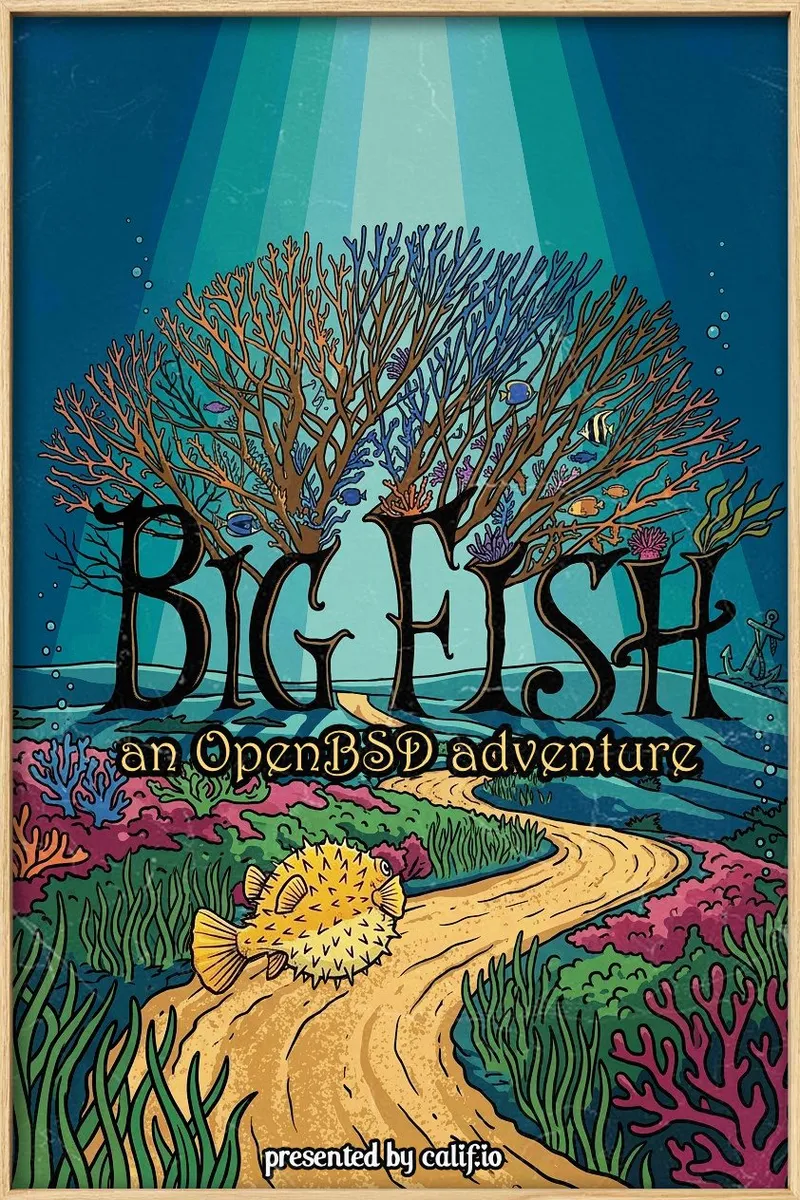
Calif disclosed an OpenBSD local privilege-escalation exploit that combines two kernel flaws to obtain a root shell despite KARL, SMAP and SMEP protections. One flaw originates in original BSD code from roughly 37 years ago: a System V shared-memory attachment counter was stored as a signed 16-bit value. Repeated process forks could overflow the counter past 32,767 and wrap it to a negative value, enabling a race condition that produced a use-after-free. The exploit paired that bug with a separate kernel out-of-bounds write. It mapped 127 shared-memory segments, forked 259 processes to wrap the attachment count to -32,643, then used heap grooming and an IPC_RMID race to create a size-confused shared-memory segment. A conditional -1 write modified IP multicast-membership fields, and subsequent socket cleanup altered page-table mappings so user memory became supervisor-accessible. Calif then overwrote a predictable kernel function pointer to execute kernel code and restored it after obtaining root access. OpenBSD addressed the flaws in errata 026 and 018. Calif said OpenBSD's kernel address randomization does not randomize allocator base addresses or allocation order, leaving some early-boot kernel objects predictable on the same hardware. It proposed safe-unlinking checks, randomizing the self-referential page-table mapping, and making kernel allocation less deterministic. Calif also cited compiler-based array-bounds sanitization and forthcoming Alloc Tokens as mitigations for out-of-bounds and heap-exploitation techniques.
calif.io
6 min
14h ago
Designing more efficient quantum circuits with Claude
Anthropic says Claude Mythos 5 autonomously optimized eight quantum-circuit primitives after receiving plain-language specifications and feedback from an automated evaluator. The system generated circuit designs for chemistry, optimization, quantum simulation, number theory, and numerical computing that Anthropic says used fewer qubits and gates than previously published designs. The work was led by Andi Gu through Anthropic’s STEM Fellows Program with collaborators including Harvard’s Susanne Yelin and Mikhail Lukin. In a 53-hour run, Claude developed a reversible modular-inversion method for elliptic-curve point addition. It derived a way to recover divsteps branch information from the numerical state rather than storing the full history. Anthropic says one resulting design uses 12% more qubits than the smallest earlier circuit while requiring 17 times fewer gates, expanding the available qubit-runtime trade-offs. Claude also redesigned the Reed–Solomon decoding step in decoded quantum interferometry, replacing an extended-Euclidean construction with Berlekamp–Massey decoding. A simulator tested 403 million sample decodings and found that reserving 19 qubits for one exceptional value was sufficient for nearly all runs; about one in 10,000 runs exceeded that capacity and failed within the allowed error rate. Anthropic says the decoder uses 12 times fewer gates than Google’s prior construction.
anthropic.com
18 min
11h ago
Claude reveals ECDSA curve origins
Anthropic says Claude identified how the unexplained seed values behind major NIST elliptic-curve cryptography standards were generated. In under half an hour in October 2026, an internal research model determined that seeds for NIST P-192, P-224, P-256, P-384 and P-521 were outputs of the legacy C-library lrand48 pseudorandom-number generator initialized with Unix timestamps, rather than hashes of secret phrases or other cryptographic algorithms. NIST adopted these curves in 2000 for the FIPS 186-2 Digital Signature Standard, while the NSA had supplied their seed values without explaining their provenance. Anthropic reconstructed timestamps from May 1997 through April 1998 and the candidate positions that reproduce ten prime-curve and binary-curve seeds; P-256, for example, was the 1,842nd 20-byte candidate from its run. Anthropic says the result is not a cryptographic break or a newly discovered weakness, and that the simple reproducible process makes intentional backdoors less plausible. Claude also traced base points for P-192 and five ANSI X9.62 example curves to the FreeLIP random-number generator, but could not explain base points for P-224, P-256, P-384, P-521 or NIST binary curves. B-163 remains unexplained. Anthropic will donate the $36,864 NIST elliptic-curve seeds bounty to the Internet Security Research Group.
anthropic.com
12 min
10h ago
Apple ML Research: Muse Spark Open with MLX on Mac Studio
MLX on Macs with Apple silicon lets AI researchers and developers experiment locally with the latest models and methods in a private environment. The source identifies local experimentation as a use case for MLX on Mac hardware but provides no further details about distributed inference, RDMA, model support, performance, or availability.
machinelearning.apple.com
1 min
15h ago
Big Fish: Exploiting a 37-Year-Old Kernel Bug in OpenBSD
Calif disclosed an OpenBSD local privilege-escalation exploit that combines two kernel flaws to obtain a root shell despite KARL, SMAP and SMEP protections. One flaw originates in original BSD code from roughly 37 years ago: a System V shared-memory attachment counter was stored as a signed 16-bit value. Repeated process forks could overflow the counter past 32,767 and wrap it to a negative value, enabling a race condition that produced a use-after-free. The exploit paired that bug with a separate kernel out-of-bounds write. It mapped 127 shared-memory segments, forked 259 processes to wrap the attachment count to -32,643, then used heap grooming and an IPC_RMID race to create a size-confused shared-memory segment. A conditional -1 write modified IP multicast-membership fields, and subsequent socket cleanup altered page-table mappings so user memory became supervisor-accessible. Calif then overwrote a predictable kernel function pointer to execute kernel code and restored it after obtaining root access. OpenBSD addressed the flaws in errata 026 and 018. Calif said OpenBSD's kernel address randomization does not randomize allocator base addresses or allocation order, leaving some early-boot kernel objects predictable on the same hardware. It proposed safe-unlinking checks, randomizing the self-referential page-table mapping, and making kernel allocation less deterministic. Calif also cited compiler-based array-bounds sanitization and forthcoming Alloc Tokens as mitigations for out-of-bounds and heap-exploitation techniques.
calif.io
6 min
14h ago
90% of US working hours are spent on tasks not covered well by AI benchmarks
Mercor has published a Benchmark Map that measures how well 29 selected AI benchmarks cover tasks across the US labor force. The map uses the Department of Labor’s O*NET taxonomy, which divides the workforce into 923 occupations, 22 job families, and 18,797 tasks. A task is counted as covered when an LLM judge maps at least five benchmark prompts to it; one prompt can map to multiple tasks. Only 208 of 923 occupations have at least one task meeting that threshold, while six of 22 job families have none. Mercor estimates that 90% of US working hours are spent on tasks with little or no coverage in its initial benchmark set, making economy-wide assessments of AI capability difficult. The organization says benchmark coverage disproportionately favors AI-exposed tasks, with O*NET tasks rated exposed to AI about six times more likely to appear than unexposed tasks. Tasks in occupations with larger wage bills and tasks rated most important are also overrepresented. Mercor found that reweighting APEX benchmark scores so each O*NET task counts equally changed model results little for investment banking, law, accounting, and software engineering. Less than one-third of relevant tasks in those four occupations had sufficient APEX coverage. Mercor characterizes its estimates as provisional because its benchmark list is incomplete, selection criteria involve judgment, and excluding saturated benchmarks can understate coverage.
mercor.com
9 min
12h ago
JPEG XL vs. AVIF for web use-cases
JPEG XL is now supported by all major browsers, but benchmarks run on a 2024 MacBook Pro with an M4 Pro found AVIF generally more efficient for lossy web images. Across tested photos, the best JPEG XL files were typically 15–25% larger than equivalent AVIF files at default encoder settings and 6–20% larger at maximum effort, although some images—including a weasel photo—favored JPEG XL. The newer jixel JPEG XL encoder generally outperformed libjxl, except on detailed transparency. AVIF produced substantially smaller files for screenshots, illustrations, and images with alpha channels, while also usually decoding two to three times faster at medium quality. AVIF 4:4:4 is recommended as the default over 4:2:0, whose reduced color resolution rarely cut file size and could limit quality. Higher effort settings improved AVIF and jixel results, whereas libjxl’s higher efforts often added large time and memory costs for little benefit. JPEG XL remains stronger for lossless compression and can transcode existing JPEGs without further quality loss, reducing their size by 9–20%. It can also provide progressive previews in Chrome and Firefox, while progressive AVIF currently renders only in Chrome. AVIF supports HDR gain maps in browsers; JPEG XL’s format supports gain maps, but browser decoders do not. For typical web delivery, AVIF 4:4:4 at a practical high-effort setting was the recommended default, with jixel worth testing for unusually large AVIF results.
jakearchibald.com
49 min
13h ago
Designing more efficient quantum circuits with Claude
Anthropic says Claude Mythos 5 autonomously optimized eight quantum-circuit primitives after receiving plain-language specifications and feedback from an automated evaluator. The system generated circuit designs for chemistry, optimization, quantum simulation, number theory, and numerical computing that Anthropic says used fewer qubits and gates than previously published designs. The work was led by Andi Gu through Anthropic’s STEM Fellows Program with collaborators including Harvard’s Susanne Yelin and Mikhail Lukin. In a 53-hour run, Claude developed a reversible modular-inversion method for elliptic-curve point addition. It derived a way to recover divsteps branch information from the numerical state rather than storing the full history. Anthropic says one resulting design uses 12% more qubits than the smallest earlier circuit while requiring 17 times fewer gates, expanding the available qubit-runtime trade-offs. Claude also redesigned the Reed–Solomon decoding step in decoded quantum interferometry, replacing an extended-Euclidean construction with Berlekamp–Massey decoding. A simulator tested 403 million sample decodings and found that reserving 19 qubits for one exceptional value was sufficient for nearly all runs; about one in 10,000 runs exceeded that capacity and failed within the allowed error rate. Anthropic says the decoder uses 12 times fewer gates than Google’s prior construction.
anthropic.com
18 min
11h ago
Claude reveals ECDSA curve origins
Anthropic says Claude identified how the unexplained seed values behind major NIST elliptic-curve cryptography standards were generated. In under half an hour in October 2026, an internal research model determined that seeds for NIST P-192, P-224, P-256, P-384 and P-521 were outputs of the legacy C-library lrand48 pseudorandom-number generator initialized with Unix timestamps, rather than hashes of secret phrases or other cryptographic algorithms. NIST adopted these curves in 2000 for the FIPS 186-2 Digital Signature Standard, while the NSA had supplied their seed values without explaining their provenance. Anthropic reconstructed timestamps from May 1997 through April 1998 and the candidate positions that reproduce ten prime-curve and binary-curve seeds; P-256, for example, was the 1,842nd 20-byte candidate from its run. Anthropic says the result is not a cryptographic break or a newly discovered weakness, and that the simple reproducible process makes intentional backdoors less plausible. Claude also traced base points for P-192 and five ANSI X9.62 example curves to the FreeLIP random-number generator, but could not explain base points for P-224, P-256, P-384, P-521 or NIST binary curves. B-163 remains unexplained. Anthropic will donate the $36,864 NIST elliptic-curve seeds bounty to the Internet Security Research Group.
anthropic.com
12 min
10h ago
JPEG XL vs. AVIF for web use-cases
JPEG XL is now supported by all major browsers, but benchmarks run on a 2024 MacBook Pro with an M4 Pro found AVIF generally more efficient for lossy web images. Across tested photos, the best JPEG XL files were typically 15–25% larger than equivalent AVIF files at default encoder settings and 6–20% larger at maximum effort, although some images—including a weasel photo—favored JPEG XL. The newer jixel JPEG XL encoder generally outperformed libjxl, except on detailed transparency. AVIF produced substantially smaller files for screenshots, illustrations, and images with alpha channels, while also usually decoding two to three times faster at medium quality. AVIF 4:4:4 is recommended as the default over 4:2:0, whose reduced color resolution rarely cut file size and could limit quality. Higher effort settings improved AVIF and jixel results, whereas libjxl’s higher efforts often added large time and memory costs for little benefit. JPEG XL remains stronger for lossless compression and can transcode existing JPEGs without further quality loss, reducing their size by 9–20%. It can also provide progressive previews in Chrome and Firefox, while progressive AVIF currently renders only in Chrome. AVIF supports HDR gain maps in browsers; JPEG XL’s format supports gain maps, but browser decoders do not. For typical web delivery, AVIF 4:4:4 at a practical high-effort setting was the recommended default, with jixel worth testing for unusually large AVIF results.
jakearchibald.com
49 min
13h ago
90% of US working hours are spent on tasks not covered well by AI benchmarks
Mercor has published a Benchmark Map that measures how well 29 selected AI benchmarks cover tasks across the US labor force. The map uses the Department of Labor’s O*NET taxonomy, which divides the workforce into 923 occupations, 22 job families, and 18,797 tasks. A task is counted as covered when an LLM judge maps at least five benchmark prompts to it; one prompt can map to multiple tasks. Only 208 of 923 occupations have at least one task meeting that threshold, while six of 22 job families have none. Mercor estimates that 90% of US working hours are spent on tasks with little or no coverage in its initial benchmark set, making economy-wide assessments of AI capability difficult. The organization says benchmark coverage disproportionately favors AI-exposed tasks, with O*NET tasks rated exposed to AI about six times more likely to appear than unexposed tasks. Tasks in occupations with larger wage bills and tasks rated most important are also overrepresented. Mercor found that reweighting APEX benchmark scores so each O*NET task counts equally changed model results little for investment banking, law, accounting, and software engineering. Less than one-third of relevant tasks in those four occupations had sufficient APEX coverage. Mercor characterizes its estimates as provisional because its benchmark list is incomplete, selection criteria involve judgment, and excluding saturated benchmarks can understate coverage.
mercor.com
9 min
12h ago
Big Fish: Exploiting a 37-Year-Old Kernel Bug in OpenBSD
Calif disclosed an OpenBSD local privilege-escalation exploit that combines two kernel flaws to obtain a root shell despite KARL, SMAP and SMEP protections. One flaw originates in original BSD code from roughly 37 years ago: a System V shared-memory attachment counter was stored as a signed 16-bit value. Repeated process forks could overflow the counter past 32,767 and wrap it to a negative value, enabling a race condition that produced a use-after-free. The exploit paired that bug with a separate kernel out-of-bounds write. It mapped 127 shared-memory segments, forked 259 processes to wrap the attachment count to -32,643, then used heap grooming and an IPC_RMID race to create a size-confused shared-memory segment. A conditional -1 write modified IP multicast-membership fields, and subsequent socket cleanup altered page-table mappings so user memory became supervisor-accessible. Calif then overwrote a predictable kernel function pointer to execute kernel code and restored it after obtaining root access. OpenBSD addressed the flaws in errata 026 and 018. Calif said OpenBSD's kernel address randomization does not randomize allocator base addresses or allocation order, leaving some early-boot kernel objects predictable on the same hardware. It proposed safe-unlinking checks, randomizing the self-referential page-table mapping, and making kernel allocation less deterministic. Calif also cited compiler-based array-bounds sanitization and forthcoming Alloc Tokens as mitigations for out-of-bounds and heap-exploitation techniques.
calif.io
6 min
14h ago
Apple ML Research: Muse Spark Open with MLX on Mac Studio
MLX on Macs with Apple silicon lets AI researchers and developers experiment locally with the latest models and methods in a private environment. The source identifies local experimentation as a use case for MLX on Mac hardware but provides no further details about distributed inference, RDMA, model support, performance, or availability.
machinelearning.apple.com
1 min
15h ago
Designing more efficient quantum circuits with Claude
Anthropic says Claude Mythos 5 autonomously optimized eight quantum-circuit primitives after receiving plain-language specifications and feedback from an automated evaluator. The system generated circuit designs for chemistry, optimization, quantum simulation, number theory, and numerical computing that Anthropic says used fewer qubits and gates than previously published designs. The work was led by Andi Gu through Anthropic’s STEM Fellows Program with collaborators including Harvard’s Susanne Yelin and Mikhail Lukin. In a 53-hour run, Claude developed a reversible modular-inversion method for elliptic-curve point addition. It derived a way to recover divsteps branch information from the numerical state rather than storing the full history. Anthropic says one resulting design uses 12% more qubits than the smallest earlier circuit while requiring 17 times fewer gates, expanding the available qubit-runtime trade-offs. Claude also redesigned the Reed–Solomon decoding step in decoded quantum interferometry, replacing an extended-Euclidean construction with Berlekamp–Massey decoding. A simulator tested 403 million sample decodings and found that reserving 19 qubits for one exceptional value was sufficient for nearly all runs; about one in 10,000 runs exceeded that capacity and failed within the allowed error rate. Anthropic says the decoder uses 12 times fewer gates than Google’s prior construction.
anthropic.com
18 min
11h ago
No more articles to load