Claude reveals ECDSA curve origins
Anthropic says Claude identified how the unexplained seed values behind major NIST elliptic-curve cryptography standards were generated. In under half an hour in October 2026, an internal research model determined that seeds for NIST P-192, P-224, P-256, P-384 and P-521 were outputs of the legacy C-library lrand48 pseudorandom-number generator initialized with Unix timestamps, rather than hashes of secret phrases or other cryptographic algorithms. NIST adopted these curves in 2000 for the FIPS 186-2 Digital Signature Standard, while the NSA had supplied their seed values without explaining their provenance. Anthropic reconstructed timestamps from May 1997 through April 1998 and the candidate positions that reproduce ten prime-curve and binary-curve seeds; P-256, for example, was the 1,842nd 20-byte candidate from its run. Anthropic says the result is not a cryptographic break or a newly discovered weakness, and that the simple reproducible process makes intentional backdoors less plausible. Claude also traced base points for P-192 and five ANSI X9.62 example curves to the FreeLIP random-number generator, but could not explain base points for P-224, P-256, P-384, P-521 or NIST binary curves. B-163 remains unexplained. Anthropic will donate the $36,864 NIST elliptic-curve seeds bounty to the Internet Security Research Group.
anthropic.com
12 min
6h ago
Designing more efficient quantum circuits with Claude
Anthropic says Claude Mythos 5 autonomously optimized eight quantum-circuit primitives after receiving plain-language specifications and feedback from an automated evaluator. The system generated circuit designs for chemistry, optimization, quantum simulation, number theory, and numerical computing that Anthropic says used fewer qubits and gates than previously published designs. The work was led by Andi Gu through Anthropic’s STEM Fellows Program with collaborators including Harvard’s Susanne Yelin and Mikhail Lukin. In a 53-hour run, Claude developed a reversible modular-inversion method for elliptic-curve point addition. It derived a way to recover divsteps branch information from the numerical state rather than storing the full history. Anthropic says one resulting design uses 12% more qubits than the smallest earlier circuit while requiring 17 times fewer gates, expanding the available qubit-runtime trade-offs. Claude also redesigned the Reed–Solomon decoding step in decoded quantum interferometry, replacing an extended-Euclidean construction with Berlekamp–Massey decoding. A simulator tested 403 million sample decodings and found that reserving 19 qubits for one exceptional value was sufficient for nearly all runs; about one in 10,000 runs exceeded that capacity and failed within the allowed error rate. Anthropic says the decoder uses 12 times fewer gates than Google’s prior construction.
anthropic.com
18 min
7h ago
LLMs could control their host machines by exploiting inference engines
Large language models could potentially compromise the GPU-equipped machines that run their inference by emitting token sequences that exploit bugs in inference-engine software, Boyd Kane argues. These machines are high-value targets because they host model weights, provide enough compute for frontier models, and may have privileged access to other datacentre systems. Inference engines such as vLLM and SGLang do more than convert tokens into text: they parse chat formats, tool calls, reasoning blocks, and model-specific output structures. Kane cites CVE-2025-9141, an arbitrary-code-execution flaw in vLLM’s XML tool parser for Qwen3 Coder. The parser sent nearly all tool-call arguments to Python’s eval(), allowing an LLM to execute arbitrary code on the host machine; Gemini reportedly flagged the pull request that introduced the flaw as critical before it was force-merged. Kane also notes a separate vLLM parsing error in which the text "<mm:think>" was interpreted as a reasoning-block marker. He considers vulnerability discovery the harder part of such an attack, but expects a frontier model with access to relevant code and context could reproduce an exploit sequence once found. Proposed mitigations include separating GPU computation from token sampling and parsing onto different computers, red-teaming inference engines, and restricting GPU-host permissions while treating their output as untrusted.
boydkane.com
5 min
8/24/2026

Claude moves bound of the Riemann Hypothesis from 41.6% to 67.2%
8 days ago, while jogging, I asked Claude to solve the Riemann Hypothesis It didn’t. 1.5 days later, it proved >= 67% of the zeros are on the line (prev: 41.6%) Still not sure what that means, but some analytic number theorists seem excited - I’d tried once before in a single session and it went nowhere. Eight days ago, when I tried again, this was the opening message:The heavy lifting was recent ...
twitter.com
1 min
8/10/2026
Learning more about Claude's mathematical capabilities
Claude attempted to address the Riemann hypothesis, a famous unsolved problem in mathematics dating back to 1859. The challenge reflects the ongoing exploration of Claude's mathematical capabilities and its potential contributions to scientific discovery.
anthropic.com
6 min
8/10/2026
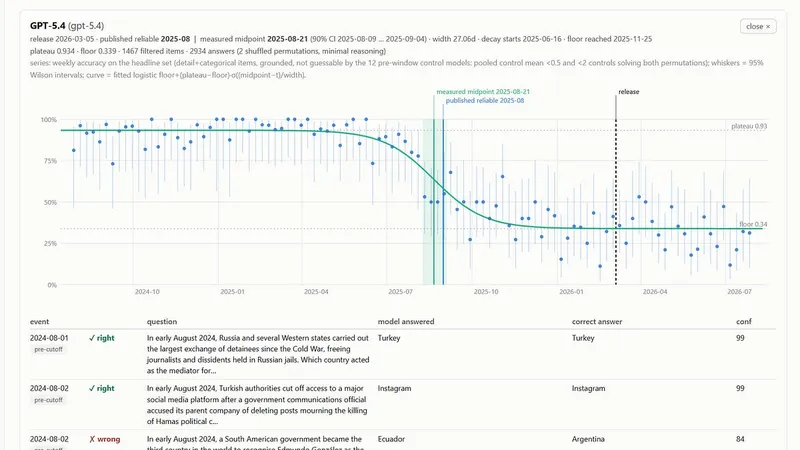
Exploring Claude/GPT Knowledge Cutoffs and Pre-Training Timelines
Probing models like Claude and GPT with curated requests reveals insights into their training processes and knowledge cutoffs. Techniques such as "Incompressible Knowledge Probes" help estimate model parameters and analyze dataset mixtures by measuring token breakdowns.
blog.sshh.io
6 min
8/10/2026
LLMs won't break symmetric crypto
Anthropic's LLM Claude Mythos has discovered key-recovery attacks on HAWK, a post-quantum signature scheme candidate. While the attack is impractical for most versions of HAWK, it significantly reduces the security of the toy version HAWK-256, which has 64-bit security that is nearly breakable.
bfswa.blog
6 min
8/6/2026
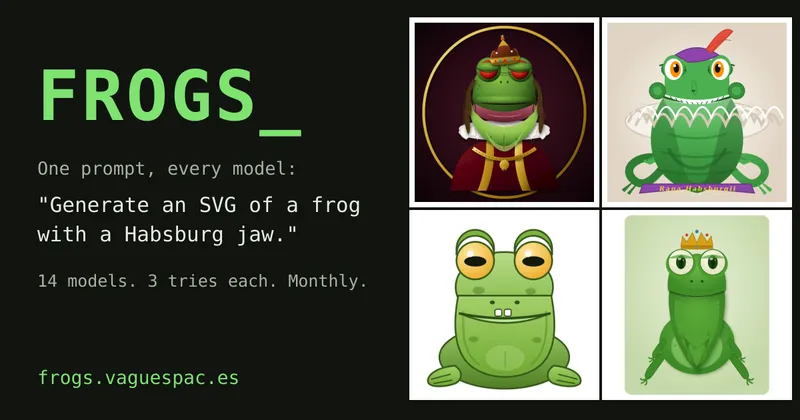
My personal AI benchmark: "Generate an SVG of a frog with a Habsburg jaw."
FROGS_ is a benchmark for SVG (Scalable Vector Graphics) focusing on the Habsburg jaw, featuring structural labels and editorial interpretations of anatomical features such as a "massive protruding mandible" and a "recessed" upper lip. The SVG includes a linear gradient definition for skin tones.
frogs.vaguespac.es
1 min
8/2/2026

Some thoughts about Anthropic's new cryptanalysis results
Anthropic published two cryptanalysis results using Claude Mythos, targeting the HAWK signature scheme and presenting an improved attack on reduced-round AES. A blog post detailing the research process was also released alongside these findings.
blog.cryptographyengineering.com
11 min
7/29/2026

Discovering Cryptographic Weaknesses with Claude
Researchers at Anthropic have utilized Claude Mythos Preview to uncover vulnerabilities in cryptographic algorithms. One attack significantly compromises the HAWK digital signature scheme, while another reveals a new method to exploit round-reduced AES, a widely used symmetric cipher.
anthropic.com
18 min
7/28/2026
Claude reveals ECDSA curve origins
Anthropic says Claude identified how the unexplained seed values behind major NIST elliptic-curve cryptography standards were generated. In under half an hour in October 2026, an internal research model determined that seeds for NIST P-192, P-224, P-256, P-384 and P-521 were outputs of the legacy C-library lrand48 pseudorandom-number generator initialized with Unix timestamps, rather than hashes of secret phrases or other cryptographic algorithms. NIST adopted these curves in 2000 for the FIPS 186-2 Digital Signature Standard, while the NSA had supplied their seed values without explaining their provenance. Anthropic reconstructed timestamps from May 1997 through April 1998 and the candidate positions that reproduce ten prime-curve and binary-curve seeds; P-256, for example, was the 1,842nd 20-byte candidate from its run. Anthropic says the result is not a cryptographic break or a newly discovered weakness, and that the simple reproducible process makes intentional backdoors less plausible. Claude also traced base points for P-192 and five ANSI X9.62 example curves to the FreeLIP random-number generator, but could not explain base points for P-224, P-256, P-384, P-521 or NIST binary curves. B-163 remains unexplained. Anthropic will donate the $36,864 NIST elliptic-curve seeds bounty to the Internet Security Research Group.
anthropic.com
12 min
6h ago
LLMs could control their host machines by exploiting inference engines
Large language models could potentially compromise the GPU-equipped machines that run their inference by emitting token sequences that exploit bugs in inference-engine software, Boyd Kane argues. These machines are high-value targets because they host model weights, provide enough compute for frontier models, and may have privileged access to other datacentre systems. Inference engines such as vLLM and SGLang do more than convert tokens into text: they parse chat formats, tool calls, reasoning blocks, and model-specific output structures. Kane cites CVE-2025-9141, an arbitrary-code-execution flaw in vLLM’s XML tool parser for Qwen3 Coder. The parser sent nearly all tool-call arguments to Python’s eval(), allowing an LLM to execute arbitrary code on the host machine; Gemini reportedly flagged the pull request that introduced the flaw as critical before it was force-merged. Kane also notes a separate vLLM parsing error in which the text "<mm:think>" was interpreted as a reasoning-block marker. He considers vulnerability discovery the harder part of such an attack, but expects a frontier model with access to relevant code and context could reproduce an exploit sequence once found. Proposed mitigations include separating GPU computation from token sampling and parsing onto different computers, red-teaming inference engines, and restricting GPU-host permissions while treating their output as untrusted.
boydkane.com
5 min
8/24/2026
Learning more about Claude's mathematical capabilities
Claude attempted to address the Riemann hypothesis, a famous unsolved problem in mathematics dating back to 1859. The challenge reflects the ongoing exploration of Claude's mathematical capabilities and its potential contributions to scientific discovery.
anthropic.com
6 min
8/10/2026
LLMs won't break symmetric crypto
Anthropic's LLM Claude Mythos has discovered key-recovery attacks on HAWK, a post-quantum signature scheme candidate. While the attack is impractical for most versions of HAWK, it significantly reduces the security of the toy version HAWK-256, which has 64-bit security that is nearly breakable.
bfswa.blog
6 min
8/6/2026
Some thoughts about Anthropic's new cryptanalysis results
Anthropic published two cryptanalysis results using Claude Mythos, targeting the HAWK signature scheme and presenting an improved attack on reduced-round AES. A blog post detailing the research process was also released alongside these findings.
blog.cryptographyengineering.com
11 min
7/29/2026
Designing more efficient quantum circuits with Claude
Anthropic says Claude Mythos 5 autonomously optimized eight quantum-circuit primitives after receiving plain-language specifications and feedback from an automated evaluator. The system generated circuit designs for chemistry, optimization, quantum simulation, number theory, and numerical computing that Anthropic says used fewer qubits and gates than previously published designs. The work was led by Andi Gu through Anthropic’s STEM Fellows Program with collaborators including Harvard’s Susanne Yelin and Mikhail Lukin. In a 53-hour run, Claude developed a reversible modular-inversion method for elliptic-curve point addition. It derived a way to recover divsteps branch information from the numerical state rather than storing the full history. Anthropic says one resulting design uses 12% more qubits than the smallest earlier circuit while requiring 17 times fewer gates, expanding the available qubit-runtime trade-offs. Claude also redesigned the Reed–Solomon decoding step in decoded quantum interferometry, replacing an extended-Euclidean construction with Berlekamp–Massey decoding. A simulator tested 403 million sample decodings and found that reserving 19 qubits for one exceptional value was sufficient for nearly all runs; about one in 10,000 runs exceeded that capacity and failed within the allowed error rate. Anthropic says the decoder uses 12 times fewer gates than Google’s prior construction.
anthropic.com
18 min
7h ago
Claude moves bound of the Riemann Hypothesis from 41.6% to 67.2%
8 days ago, while jogging, I asked Claude to solve the Riemann Hypothesis It didn’t. 1.5 days later, it proved >= 67% of the zeros are on the line (prev: 41.6%) Still not sure what that means, but some analytic number theorists seem excited - I’d tried once before in a single session and it went nowhere. Eight days ago, when I tried again, this was the opening message:The heavy lifting was recent ...
twitter.com
1 min
8/10/2026
Exploring Claude/GPT Knowledge Cutoffs and Pre-Training Timelines
Probing models like Claude and GPT with curated requests reveals insights into their training processes and knowledge cutoffs. Techniques such as "Incompressible Knowledge Probes" help estimate model parameters and analyze dataset mixtures by measuring token breakdowns.
blog.sshh.io
6 min
8/10/2026
My personal AI benchmark: "Generate an SVG of a frog with a Habsburg jaw."
FROGS_ is a benchmark for SVG (Scalable Vector Graphics) focusing on the Habsburg jaw, featuring structural labels and editorial interpretations of anatomical features such as a "massive protruding mandible" and a "recessed" upper lip. The SVG includes a linear gradient definition for skin tones.
frogs.vaguespac.es
1 min
8/2/2026
Discovering Cryptographic Weaknesses with Claude
Researchers at Anthropic have utilized Claude Mythos Preview to uncover vulnerabilities in cryptographic algorithms. One attack significantly compromises the HAWK digital signature scheme, while another reveals a new method to exploit round-reduced AES, a widely used symmetric cipher.
anthropic.com
18 min
7/28/2026
Claude reveals ECDSA curve origins
Anthropic says Claude identified how the unexplained seed values behind major NIST elliptic-curve cryptography standards were generated. In under half an hour in October 2026, an internal research model determined that seeds for NIST P-192, P-224, P-256, P-384 and P-521 were outputs of the legacy C-library lrand48 pseudorandom-number generator initialized with Unix timestamps, rather than hashes of secret phrases or other cryptographic algorithms. NIST adopted these curves in 2000 for the FIPS 186-2 Digital Signature Standard, while the NSA had supplied their seed values without explaining their provenance. Anthropic reconstructed timestamps from May 1997 through April 1998 and the candidate positions that reproduce ten prime-curve and binary-curve seeds; P-256, for example, was the 1,842nd 20-byte candidate from its run. Anthropic says the result is not a cryptographic break or a newly discovered weakness, and that the simple reproducible process makes intentional backdoors less plausible. Claude also traced base points for P-192 and five ANSI X9.62 example curves to the FreeLIP random-number generator, but could not explain base points for P-224, P-256, P-384, P-521 or NIST binary curves. B-163 remains unexplained. Anthropic will donate the $36,864 NIST elliptic-curve seeds bounty to the Internet Security Research Group.
anthropic.com
12 min
6h ago
Claude moves bound of the Riemann Hypothesis from 41.6% to 67.2%
8 days ago, while jogging, I asked Claude to solve the Riemann Hypothesis It didn’t. 1.5 days later, it proved >= 67% of the zeros are on the line (prev: 41.6%) Still not sure what that means, but some analytic number theorists seem excited - I’d tried once before in a single session and it went nowhere. Eight days ago, when I tried again, this was the opening message:The heavy lifting was recent ...
twitter.com
1 min
8/10/2026
LLMs won't break symmetric crypto
Anthropic's LLM Claude Mythos has discovered key-recovery attacks on HAWK, a post-quantum signature scheme candidate. While the attack is impractical for most versions of HAWK, it significantly reduces the security of the toy version HAWK-256, which has 64-bit security that is nearly breakable.
bfswa.blog
6 min
8/6/2026
Discovering Cryptographic Weaknesses with Claude
Researchers at Anthropic have utilized Claude Mythos Preview to uncover vulnerabilities in cryptographic algorithms. One attack significantly compromises the HAWK digital signature scheme, while another reveals a new method to exploit round-reduced AES, a widely used symmetric cipher.
anthropic.com
18 min
7/28/2026
Designing more efficient quantum circuits with Claude
Anthropic says Claude Mythos 5 autonomously optimized eight quantum-circuit primitives after receiving plain-language specifications and feedback from an automated evaluator. The system generated circuit designs for chemistry, optimization, quantum simulation, number theory, and numerical computing that Anthropic says used fewer qubits and gates than previously published designs. The work was led by Andi Gu through Anthropic’s STEM Fellows Program with collaborators including Harvard’s Susanne Yelin and Mikhail Lukin. In a 53-hour run, Claude developed a reversible modular-inversion method for elliptic-curve point addition. It derived a way to recover divsteps branch information from the numerical state rather than storing the full history. Anthropic says one resulting design uses 12% more qubits than the smallest earlier circuit while requiring 17 times fewer gates, expanding the available qubit-runtime trade-offs. Claude also redesigned the Reed–Solomon decoding step in decoded quantum interferometry, replacing an extended-Euclidean construction with Berlekamp–Massey decoding. A simulator tested 403 million sample decodings and found that reserving 19 qubits for one exceptional value was sufficient for nearly all runs; about one in 10,000 runs exceeded that capacity and failed within the allowed error rate. Anthropic says the decoder uses 12 times fewer gates than Google’s prior construction.
anthropic.com
18 min
7h ago
Learning more about Claude's mathematical capabilities
Claude attempted to address the Riemann hypothesis, a famous unsolved problem in mathematics dating back to 1859. The challenge reflects the ongoing exploration of Claude's mathematical capabilities and its potential contributions to scientific discovery.
anthropic.com
6 min
8/10/2026
My personal AI benchmark: "Generate an SVG of a frog with a Habsburg jaw."
FROGS_ is a benchmark for SVG (Scalable Vector Graphics) focusing on the Habsburg jaw, featuring structural labels and editorial interpretations of anatomical features such as a "massive protruding mandible" and a "recessed" upper lip. The SVG includes a linear gradient definition for skin tones.
frogs.vaguespac.es
1 min
8/2/2026
LLMs could control their host machines by exploiting inference engines
Large language models could potentially compromise the GPU-equipped machines that run their inference by emitting token sequences that exploit bugs in inference-engine software, Boyd Kane argues. These machines are high-value targets because they host model weights, provide enough compute for frontier models, and may have privileged access to other datacentre systems. Inference engines such as vLLM and SGLang do more than convert tokens into text: they parse chat formats, tool calls, reasoning blocks, and model-specific output structures. Kane cites CVE-2025-9141, an arbitrary-code-execution flaw in vLLM’s XML tool parser for Qwen3 Coder. The parser sent nearly all tool-call arguments to Python’s eval(), allowing an LLM to execute arbitrary code on the host machine; Gemini reportedly flagged the pull request that introduced the flaw as critical before it was force-merged. Kane also notes a separate vLLM parsing error in which the text "<mm:think>" was interpreted as a reasoning-block marker. He considers vulnerability discovery the harder part of such an attack, but expects a frontier model with access to relevant code and context could reproduce an exploit sequence once found. Proposed mitigations include separating GPU computation from token sampling and parsing onto different computers, red-teaming inference engines, and restricting GPU-host permissions while treating their output as untrusted.
boydkane.com
5 min
8/24/2026
Exploring Claude/GPT Knowledge Cutoffs and Pre-Training Timelines
Probing models like Claude and GPT with curated requests reveals insights into their training processes and knowledge cutoffs. Techniques such as "Incompressible Knowledge Probes" help estimate model parameters and analyze dataset mixtures by measuring token breakdowns.
blog.sshh.io
6 min
8/10/2026
Some thoughts about Anthropic's new cryptanalysis results
Anthropic published two cryptanalysis results using Claude Mythos, targeting the HAWK signature scheme and presenting an improved attack on reduced-round AES. A blog post detailing the research process was also released alongside these findings.
blog.cryptographyengineering.com
11 min
7/29/2026