AI usage patterns in software teams
Linear’s aggregated data from paid workspaces shows AI use spreading across software-team functions and correlating with higher software-development activity through 2026. From January to June 2026, the share of users active on Linear AI features more than doubled in every measured function: product rose from 12% to 34%, engineering from 12% to 30%, design from 6% to 22%, and go-to-market from 5% to 18%. Adoption was similar across company sizes, while CEOs at companies with 201 or more employees increased from 9% to 36%. These figures cover AI interactions inside Linear, including in-app and Slack conversations and agent sessions, rather than all AI use. AI agents and MCP created 2.435 million Linear issues in the week of August 3, 2026, compared with 2.481 million created by people and integrations. Pull requests opened per workspace were 111% above the June 2024 baseline by June 2026. In a fixed cohort, workspaces connected to coding agents rose from 21 to 65 pull requests per team per week over two years, while teams without a connected agent rose from 8 to 10. The share of product users attaching pull requests increased from 3% in June 2024 to 10% in June 2026, and designers rose from 1% to 8%. Linear found that time spent on existing coordination work generally increased or held steady, while AI chat and agent work added new activity; it does not measure whether the added output produced positive business outcomes.
linear.app
25 min
8/18/2026

Agent swarms and the new model economics
Experiments with agent swarms demonstrated the potential for cooperative task execution at larger scales and complexities. A flagship project involved a swarm successfully building a web browser from scratch, serving as a proof of concept despite not achieving polished software.
cursor.com
14 min
7/20/2026
![A Report on Burnout in Open Source Software Communities (2025) [pdf]](https://pub-90f0ac00d93c47daac3e1d2cdd28d496.r2.dev/articles/b5362a99cc77fe6cfd93b60cde4cbb39.webp)
A Report on Burnout in Open Source Software Communities (2025) [pdf]
A report on burnout in open source software communities analyzes the prevalence and impact of burnout among contributors. It provides insights into potential causes and suggests strategies for improving community well-being.
mirandaheath.website
1 min
5/1/2026

Who Writes the Bugs? A Deeper Look at 125,000 Kernel Vulnerabilities
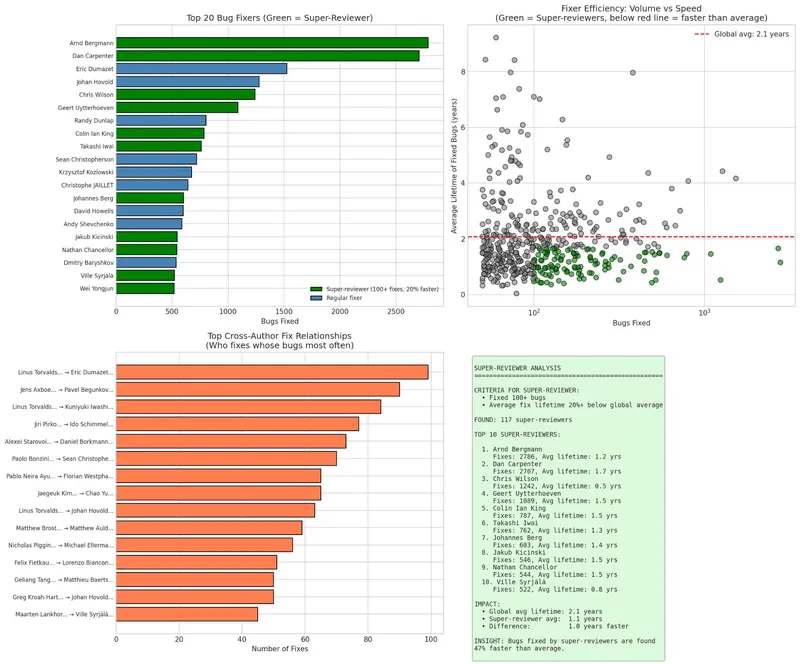
An analysis of 125,000 kernel vulnerabilities reveals that bugs remain undetected for an average of 2.1 years, with race conditions lasting over twice as long as other types. VulnBERT has been developed to identify these vulnerabilities at the commit stage.
pebblebed.com
17 min
3/4/2026

Evaluating AGENTS.md: are they helpful for coding agents?
Repository-level context files are commonly used to customize coding agents for specific software repositories. There is a lack of rigorous investigation into the effectiveness of these context files in enhancing coding agent performance.
arxiv.org
2 min
2/16/2026
AI usage patterns in software teams
Linear’s aggregated data from paid workspaces shows AI use spreading across software-team functions and correlating with higher software-development activity through 2026. From January to June 2026, the share of users active on Linear AI features more than doubled in every measured function: product rose from 12% to 34%, engineering from 12% to 30%, design from 6% to 22%, and go-to-market from 5% to 18%. Adoption was similar across company sizes, while CEOs at companies with 201 or more employees increased from 9% to 36%. These figures cover AI interactions inside Linear, including in-app and Slack conversations and agent sessions, rather than all AI use. AI agents and MCP created 2.435 million Linear issues in the week of August 3, 2026, compared with 2.481 million created by people and integrations. Pull requests opened per workspace were 111% above the June 2024 baseline by June 2026. In a fixed cohort, workspaces connected to coding agents rose from 21 to 65 pull requests per team per week over two years, while teams without a connected agent rose from 8 to 10. The share of product users attaching pull requests increased from 3% in June 2024 to 10% in June 2026, and designers rose from 1% to 8%. Linear found that time spent on existing coordination work generally increased or held steady, while AI chat and agent work added new activity; it does not measure whether the added output produced positive business outcomes.
linear.app
25 min
8/18/2026
A Report on Burnout in Open Source Software Communities (2025) [pdf]
A report on burnout in open source software communities analyzes the prevalence and impact of burnout among contributors. It provides insights into potential causes and suggests strategies for improving community well-being.
mirandaheath.website
1 min
5/1/2026
Who Writes the Bugs? A Deeper Look at 125,000 Kernel Vulnerabilities
An analysis of 125,000 kernel vulnerabilities reveals that bugs remain undetected for an average of 2.1 years, with race conditions lasting over twice as long as other types. VulnBERT has been developed to identify these vulnerabilities at the commit stage.
pebblebed.com
17 min
3/4/2026
Agent swarms and the new model economics
Experiments with agent swarms demonstrated the potential for cooperative task execution at larger scales and complexities. A flagship project involved a swarm successfully building a web browser from scratch, serving as a proof of concept despite not achieving polished software.
cursor.com
14 min
7/20/2026
GitHub's Historic Uptime
GitHub's historical uptime charts display monthly uptime statistics from 2016 to 2026. Users can visualize the platform's reliability trends over the specified period.
damrnelson.github.io
1 min
3/31/2026
Evaluating AGENTS.md: are they helpful for coding agents?
Repository-level context files are commonly used to customize coding agents for specific software repositories. There is a lack of rigorous investigation into the effectiveness of these context files in enhancing coding agent performance.
arxiv.org
2 min
2/16/2026
AI usage patterns in software teams
Linear’s aggregated data from paid workspaces shows AI use spreading across software-team functions and correlating with higher software-development activity through 2026. From January to June 2026, the share of users active on Linear AI features more than doubled in every measured function: product rose from 12% to 34%, engineering from 12% to 30%, design from 6% to 22%, and go-to-market from 5% to 18%. Adoption was similar across company sizes, while CEOs at companies with 201 or more employees increased from 9% to 36%. These figures cover AI interactions inside Linear, including in-app and Slack conversations and agent sessions, rather than all AI use. AI agents and MCP created 2.435 million Linear issues in the week of August 3, 2026, compared with 2.481 million created by people and integrations. Pull requests opened per workspace were 111% above the June 2024 baseline by June 2026. In a fixed cohort, workspaces connected to coding agents rose from 21 to 65 pull requests per team per week over two years, while teams without a connected agent rose from 8 to 10. The share of product users attaching pull requests increased from 3% in June 2024 to 10% in June 2026, and designers rose from 1% to 8%. Linear found that time spent on existing coordination work generally increased or held steady, while AI chat and agent work added new activity; it does not measure whether the added output produced positive business outcomes.
linear.app
25 min
8/18/2026
Agent swarms and the new model economics
Experiments with agent swarms demonstrated the potential for cooperative task execution at larger scales and complexities. A flagship project involved a swarm successfully building a web browser from scratch, serving as a proof of concept despite not achieving polished software.
cursor.com
14 min
7/20/2026
Who Writes the Bugs? A Deeper Look at 125,000 Kernel Vulnerabilities
An analysis of 125,000 kernel vulnerabilities reveals that bugs remain undetected for an average of 2.1 years, with race conditions lasting over twice as long as other types. VulnBERT has been developed to identify these vulnerabilities at the commit stage.
pebblebed.com
17 min
3/4/2026
A Report on Burnout in Open Source Software Communities (2025) [pdf]
A report on burnout in open source software communities analyzes the prevalence and impact of burnout among contributors. It provides insights into potential causes and suggests strategies for improving community well-being.
mirandaheath.website
1 min
5/1/2026
Evaluating AGENTS.md: are they helpful for coding agents?
Repository-level context files are commonly used to customize coding agents for specific software repositories. There is a lack of rigorous investigation into the effectiveness of these context files in enhancing coding agent performance.
arxiv.org
2 min
2/16/2026
No more articles to load