Top stories
Story · 1 report
We're releasing the weights of Mistral Large 4
Mistral has released the weights for Mistral Large 4, also called Le Chonk, a 1-trillion-parameter natively multimodal mixture-of-experts model that had entered public preview earlier in the month. The open-weight model is designed for coding, agentic workflows, defensive cybersecurity and enterprise tasks, and offers low, medium and high reasoning modes to balance cost and performance. Mistral says the model was trained from scratch on European infrastructure and can be inspected, customized and self-hosted. Mistral reports that three additional weeks of reinforcement learning raised its FrontierCode 2.0 score to 19.7% and its Terminal-Bench 4.0 result by 13 percentage points to 41%. On the Artificial Analysis Coding Agent Index, it scored 48% while using 47% fewer tokens per task on average than GLM-5.3, according to Mistral. The company also reports a 51% score on the Artificial Analysis Cyber Index and a 96.6% average refusal rate for malicious cybersecurity requests. A specialized cybersecurity version is being previewed with vetted enterprise partners for authorized testing. Mistral Large 4 is available through Mistral Studio, the Mistral API, OpenRouter, Hugging Face, Microsoft Foundry and NVIDIA-hosted endpoints. API pricing starts at $0.70 per million input tokens and $2.10 per million output tokens. Its modified MIT-style license permits use, modification, fine-tuning and commercialization, except Model-as-a-Service providers require a separate commercial license.
mistral.ai
🔥🔥🔥🔥🔥2 min summary
10/29/2026
Story · 1 report
Gemini 4 Carbon
Google has announced Gemini 4 Carbon, a frontier AI model focused on long-horizon engineering, coding and cybersecurity defense. Google says Carbon leads version 5.0 of the Artificial Analysis Intelligence Index with a score of 59 and will initially be available this week to a subset of cyber defenders, with broader access phased through its Fairwind Program. Google is participating in the U.S. government’s voluntary pre-release model-testing process before extending access to developers, businesses and consumers. Carbon is priced at $2 per million input tokens and $10 per million output tokens, matching Gemini 4 Argon’s introductory pricing; cached input tokens receive a 95% discount. Google says the model can sustain agentic engineering workflows for days, including diagnosing and patching subtle defects in large codebases. It scored 88.2% on SEC-bench Pro for vulnerability discovery, 54.8% on ExploitGym for exploitation, and 71.0% on CWE-bench for patching, all evaluated without guardrails. Google reports that Carbon reduced high-severity misalignment alerts by almost 80% in internal live coding environments, cut unsupported claims by about half relative to Argon, and achieved a 0.0% attack-success rate on Gray Swan’s Indirect Prompt Injection benchmark. It also scored 1768 on WebDev Arena, ranking fourth after an 89-point increase.
blog.google
🔥🔥🔥🔥🔥1 min summary
10/28/2026
Story · 1 report
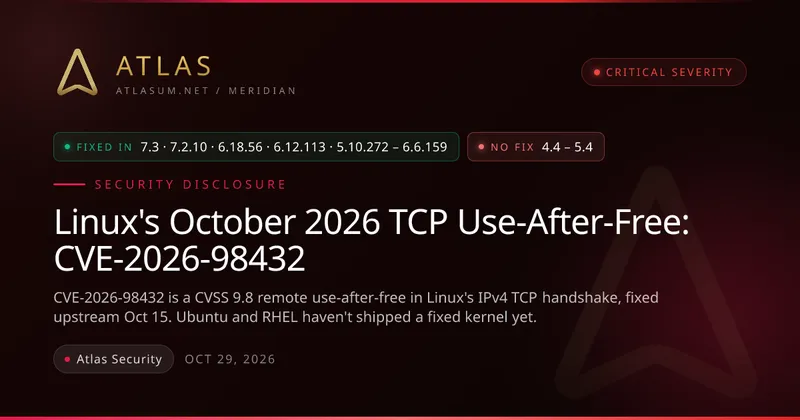
TCP Use-After-Free: CVE-2026-98432 / CVSS 9.8
Linux stable kernels released fixes in October 2026 for CVE-2026-98432, a critical use-after-free vulnerability in IPv4 TCP connection handling. The flaw affects kernels from Linux 4.4 onward that lack a distributor backport or an upstream fix, and can be reached remotely without authentication during the TCP handshake, before an application processes the connection. The Linux kernel CNA assigned a CVSS 3.1 score of 9.8; potential consequences include kernel-memory disclosure, memory corruption, crashes, and possible remote code execution. Fixed upstream versions include 5.10.272, 5.15.223, 6.1.190, 6.6.159, 6.12.113, 6.18.56, 7.2.10, and 7.3. The patch replaces immediate memory freeing with RCU-delayed freeing so concurrent kernel readers cannot access released IPv4 option data. As of October 31, Ubuntu listed all releases as vulnerable and RHEL 8, 9, and 10 had no fix, while Debian, specified SUSE releases, Oracle UEK, and Amazon Linux had released fixes. Anthropic says its Claude model produced an unpublished proof-of-concept that executes commands as root on Linux servers with MPTCP listeners. Go programs running on Linux enable MPTCP by default for listen sockets from Go 1.24 where the kernel permits it. Administrators can reduce exposure by installing a vendor-fixed kernel and rebooting; temporary mitigations include filtering IPv4 TCP packets with IP options and disabling unused MPTCP listeners.
atlasum.net
🔥🔥🔥🔥🔥2 min summary
10/31/2026
Story · 1 report
Anthropic hacked to deliver remote access trojan
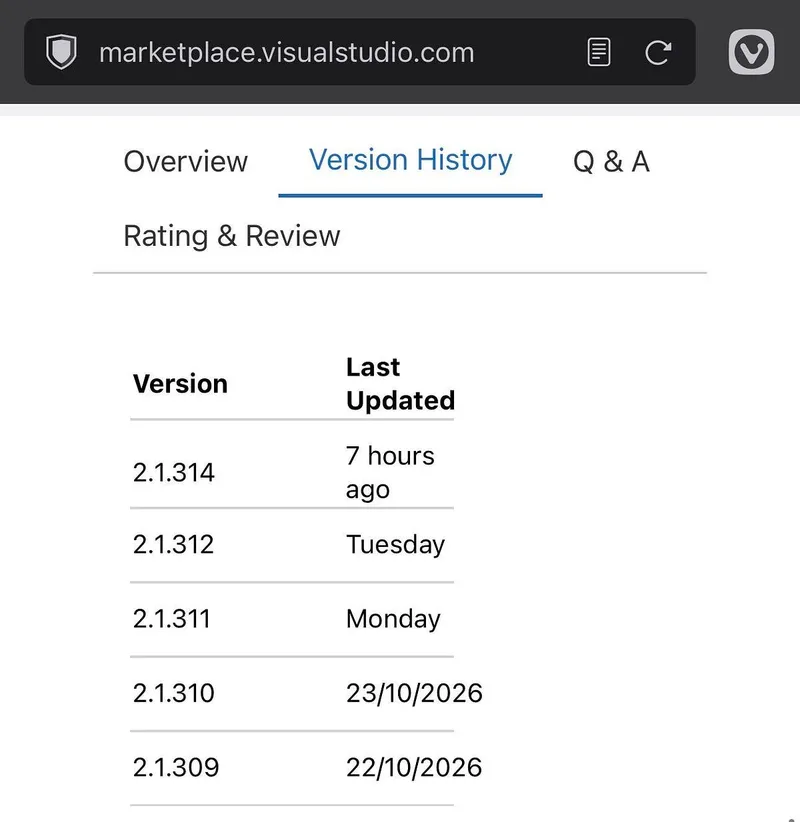
Cursor said a maliciously modified version of Anthropic’s Claude Code extension was published in its VS Code extension marketplace and attempted to install a persistent SSH backdoor on developer computers. Cursor estimated that about 5,000 developer systems were affected. The compromised extension version, 2.1.313, was replaced by version 2.1.314 roughly eight hours later, according to the report; version 2.1.313 is no longer listed on OpenVSX, Visual Studio Marketplace, or Cursor. Cursor said the malicious code collected host and user details including hostname, username, operating system, architecture, home-directory path, environment-variable names, working directories, configured Git email, and public IP address. It attempted to add an attacker-controlled SSH key to authorized_keys, enable local SSH access, and establish a reverse SSH tunnel. Cursor said coding errors meant those steps would generally fail unless Cursor had been launched with administrator privileges. The malware also tried to persist through macOS LaunchAgents or Windows scheduled tasks and sent host details and backdoor status to an HTTP beacon endpoint. The report identified 134.209.82.225 as the reverse-tunnel and command-and-control address and published hashes for affected macOS and Windows VSIX packages.
doublepulsar.com
🔥🔥🔥🔥🔥1 min summary
10/30/2026
Story · 1 report
What's Getting Pwned
pwn.watch is a live security-incident tracker listing 236 incidents from the previous 12 months, including 37 current incidents, 16 rated critical and 18 not fully patched. Its tracker showed no incident-free days as of Oct. 22, 2026; its longest quiet period was 11 days, from Jan. 2 through Jan. 12. The latest entries include patches for an actively exploited CVSS 9.9 SQL-injection flaw in on-premises Arista VeloCloud Orchestrator and a CVSS 10.0 unauthenticated remote-code-execution flaw affecting self-managed GitLab CE/EE versions since 7.0. Linux kernel vulnerability reports containing technical reproduction details were inadvertently sent to public mailing lists before fixes were available, including two ksmbd remote-code-execution bugs rated CVSS 9.0 by Trend Micro’s Zero Day Initiative. LiteLLM’s release pipeline was compromised on Oct. 21, briefly publishing a malicious PyPI package and compromised container tags designed to steal credentials and install a remote-code loader. The tracker also reports alleged third-party AI agents operating in U.S. bank customer accounts, a Railway incident that may have exposed customer environment variables, and a Zeabur breach exposing about 3.22 million environment-variable records. Other listed incidents include actively exploited PHP, Plex, Ivanti, FortiMail and BeyondTrust vulnerabilities, plus a Capcom ID breach affecting 11.77 million email-address records.
pwn.watch
🔥🔥🔥🔥🔥1 min summary
10/22/2026
Story · 1 report
Chained PHP2Shell Exploit Roots 25 Servers, Including US Government Servers
Dream researchers said they uncovered a campaign that used a custom PHP2Shell exploit chain and the Fragnesia Linux kernel privilege-escalation flaw to root 25 Palo Alto Networks PAN-OS firewall and management servers. The campaign targeted internet-exposed PAN-OS management interfaces, including the GlobalProtect portal, and affected systems in the United States, Japan, Taiwan and South Korea. Palo Alto Networks’ Unit 42 independently verified the tooling and results and is releasing fixed PAN-OS versions for affected branches. The attackers reportedly scanned about 19,000 exposed devices, identified 5,000 responsive systems, narrowed the list to 240 targets matching tested PAN-OS versions, and rooted 24 firewalls. The exploit chain combined unauthenticated remote code execution in PHP2Shell, identified as CVE-2026-109618 and CVE-2026-109619, with Fragnesia, CVE-2026-46300, to obtain persistent root access in under 15 minutes. Dream said the attackers planted webshells and later used a compromised firewall at a US government-affiliated organization to establish a reverse SSH tunnel, compromise an internal firewall management server, decrypt LDAP credentials, and enumerate Active Directory users and groups. Dream found Claude Code, the aiscan offensive-security platform configured with DeepSeek and Kimi, and FOFA API keys in the attack infrastructure. It found no direct evidence that AI wrote the exploit or scripts, though it said the consistency of roughly 40 custom scripts suggested AI-assisted development. Unit 42 tracks the activity as CL-UNK-1280 and attributes it to a Chinese-speaking attacker in the UTC+8 time zone.
dreamgroup.com
🔥🔥🔥🔥🔥2 min summary
10/29/2026
Story · 1 report
Malware uses LLMs to rank victims by how much they're worth
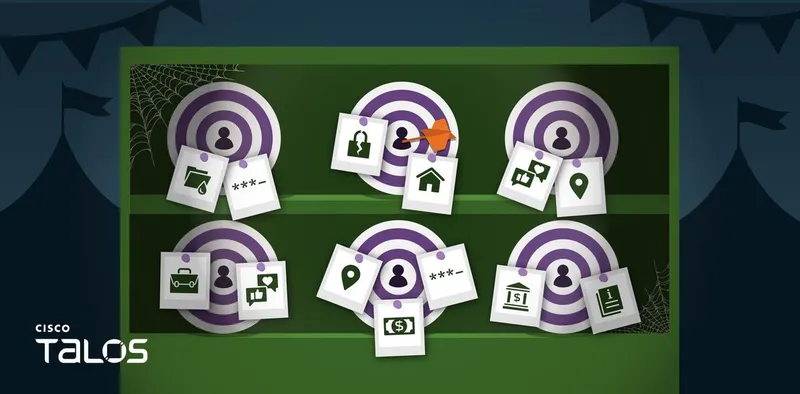
VOLTA-AUTODOXER is a self-deleting Windows infostealer that uses large language models to turn stolen credentials and personal data into ranked assessments of victims’ monetizable assets. Identified through the CAIRN research effort, the malware steals browser passwords, cookies, payment cards, cryptocurrency wallet seed phrases, messaging and gaming sessions, Microsoft OAuth tokens, SSH and cloud-provider keys, Wi-Fi profiles, and screenshots. VOLTA further exploits stolen sessions to search Gmail for purchase receipts, retrieve Uber Eats and DoorDash order histories, enrich Discord profiles, and value Roblox inventories. It assembles data including addresses, employers, inferred birth years, Slack workspaces, document metadata, and card last four digits into Identity_Report.txt, then sends it through the victim’s network connection to OpenRouter. Its prompt requests a forensic-style target assessment, including “WHAT THEY’RE WORTH” rankings and an evaluation of the victim’s security practices. The default model is Anthropic’s Claude Opus 4.6, with Moonshot AI’s Kimi K2 and Google’s Gemini 2.5 Flash configured as fallbacks if responses contain refusal language. Results are saved as AI_Analysis.txt and exfiltrated with collected data in volta_dox.zip. The sample was first seen on October 11, 2026, and has a PE timestamp of August 17, 2026.
blog.talosintelligence.com
🔥🔥🔥🔥🔥1 min summary
10/31/2026
Story · 1 report
Plex vulnerabilities being exploited in the wild to drop a cryptominer
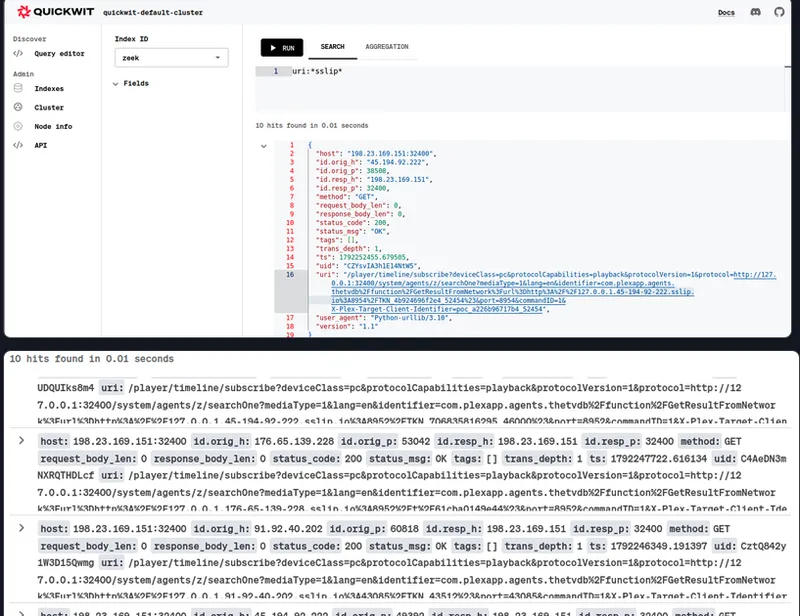
Attackers began exploiting unpatched Plex Media Server instances in October 2026 after Plex disclosed important security updates on September 1 for version 1.43.2 and earlier. Four vulnerabilities—CVE-2026-96652, CVE-2026-96654, CVE-2026-96655, and CVE-2026-96656—can be chained to achieve remote code execution, according to the researcher behind the Plex2Shell proof of concept released October 16. A vulnerable Plex honeypot recorded exploitation attempts from 45.194.92.222, 91.92.40.202, and 176.65.139.228 on October 17. After outbound network access was enabled, the honeypot logged a file download from 217.60.194.116. Observed payloads included a Docker file and an UPX-packed executable identified as a cryptominer. Subsequent activity also deployed XMRig and a program named myawesomeproxy. The proxy program states that running it permits external use of the device’s internet traffic, and observed network traffic was associated with proxystream.st. Detection packet captures and artifacts are available through the Plex2Shell and BoredHackerBlog GitHub repositories. Plex server operators running affected older versions should apply Plex’s security updates and investigate the listed indicators of compromise.
boredhackerblog.info
🔥🔥🔥🔥🔥1 min summary
10/19/2026
Story · 1 report
Is this the new cyber normal?
A cluster of critical security disclosures in October 2026 highlighted how quickly vulnerabilities can move from discovery to attempted exploitation, particularly when AI models help researchers and attackers analyze code and develop proofs of concept. PHP2Shell, comprising CVE-2026-109618 and CVE-2026-109619, involved remote-code-execution flaws in PHP reportedly found by Calif and Wiz using GPT-5.6 Sol and Gemini 4 Argon. A leak accelerated public awareness before patches were available, and AWS reported observing attempts to exploit the flaws from October 17. Wiz estimated that affected PHP deployments could cover more than 70% of the internet. Other incidents included Mozilla’s October 20 blocking of eight eMudhra intermediate certificates after weak private keys were reported; eMudhra later said it would exit the global SSL/TLS certificate business. Railway disclosed possible access to and decryption of customer environment variables, while GitLab issued critical patches for multiple CVSS 10.0 code-execution flaws in October. LiteLLM said its compromised version 1.107.0 PyPI release and Docker images contained credential-stealing malware after an attacker used GitHub CLI credentials to run CI jobs. PingCAP disclosed unauthorized access to cloud resources as FulcrumSec claimed to have exfiltrated 10.6 TB of data. The incidents do not all have confirmed AI involvement, but they underscore shrinking response windows and the importance of patching, secret management, and coordinated vulnerability disclosure.
drew.silcock.dev
🔥🔥🔥🔥🔥2 min summary
10/23/2026
Story · 1 report
Hacker leaks 281 GB of data from Germany's far-right AfD party
Germany’s far-right Alternative für Deutschland (AfD) party has confirmed a security breach after a hacker published data described as appearing to contain hundreds of thousands of the party’s internal emails. The reported leak totals 281 GB of data. The published material is presented as internal AfD communications, though the available information does not specify the breach method, the identities of those affected, or the contents and authenticity of individual messages.
bitdefender.com
🔥🔥🔥🔥🔥1 min summary
10/23/2026