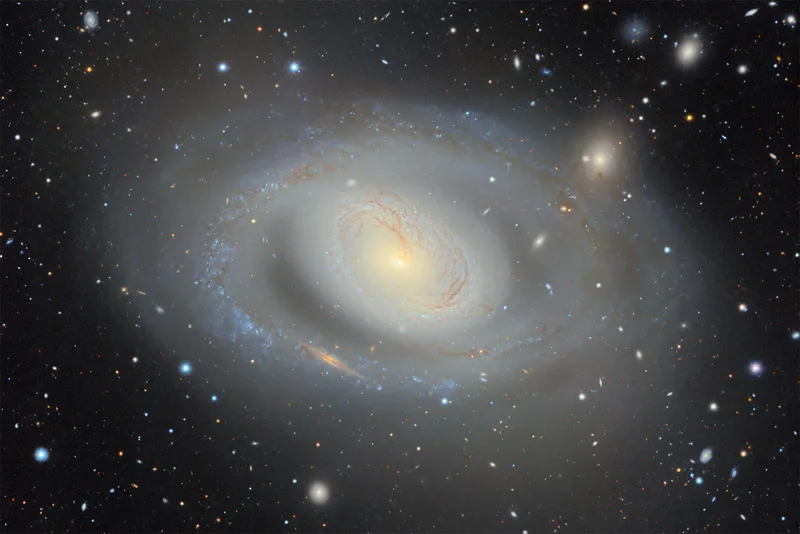
Scientists release biggest 2D map of the universe
The DESI Legacy Imaging Surveys have released a 5.6-trillion-pixel, publicly accessible 2D color map of the universe containing nearly 4 billion celestial objects, mainly stars and galaxies. The map combines 263,407 telescope exposures from three ground-based surveys, along with NASA WISE satellite and other public data, and covers about 75% of the sky in visible and near-infrared light. More than 160 scientists contributed to data collection, while a 20-person team produced the final dataset. Processing images captured across 2,285 nights took eight weeks on the Perlmutter supercomputer at Berkeley Lab’s National Energy Research Scientific Computing Center. The map provides positions and brightness measurements that let the Dark Energy Spectroscopic Instrument select targets for distance measurements and construct a 3D map of the universe. DESI began using the updated map for target selection in June 2026. DESI completed its original five-year survey in April 2026 and continues observing through 2028; early results have indicated that dark energy’s influence may be weakening over time, according to the collaboration. The data can also support searches for gravitational lenses and supernovae, comparisons with future Rubin Observatory and Nancy Grace Roman Space Telescope observations, and AI tools trained to analyze petabytes of astronomical data.
newscenter.lbl.gov
6 min
8/21/2026
Scientists release biggest 2D map of the universe
The DESI Legacy Imaging Surveys have released a 5.6-trillion-pixel, publicly accessible 2D color map of the universe containing nearly 4 billion celestial objects, mainly stars and galaxies. The map combines 263,407 telescope exposures from three ground-based surveys, along with NASA WISE satellite and other public data, and covers about 75% of the sky in visible and near-infrared light. More than 160 scientists contributed to data collection, while a 20-person team produced the final dataset. Processing images captured across 2,285 nights took eight weeks on the Perlmutter supercomputer at Berkeley Lab’s National Energy Research Scientific Computing Center. The map provides positions and brightness measurements that let the Dark Energy Spectroscopic Instrument select targets for distance measurements and construct a 3D map of the universe. DESI began using the updated map for target selection in June 2026. DESI completed its original five-year survey in April 2026 and continues observing through 2028; early results have indicated that dark energy’s influence may be weakening over time, according to the collaboration. The data can also support searches for gravitational lenses and supernovae, comparisons with future Rubin Observatory and Nancy Grace Roman Space Telescope observations, and AI tools trained to analyze petabytes of astronomical data.
newscenter.lbl.gov
6 min
8/21/2026
Scientists release biggest 2D map of the universe
The DESI Legacy Imaging Surveys have released a 5.6-trillion-pixel, publicly accessible 2D color map of the universe containing nearly 4 billion celestial objects, mainly stars and galaxies. The map combines 263,407 telescope exposures from three ground-based surveys, along with NASA WISE satellite and other public data, and covers about 75% of the sky in visible and near-infrared light. More than 160 scientists contributed to data collection, while a 20-person team produced the final dataset. Processing images captured across 2,285 nights took eight weeks on the Perlmutter supercomputer at Berkeley Lab’s National Energy Research Scientific Computing Center. The map provides positions and brightness measurements that let the Dark Energy Spectroscopic Instrument select targets for distance measurements and construct a 3D map of the universe. DESI began using the updated map for target selection in June 2026. DESI completed its original five-year survey in April 2026 and continues observing through 2028; early results have indicated that dark energy’s influence may be weakening over time, according to the collaboration. The data can also support searches for gravitational lenses and supernovae, comparisons with future Rubin Observatory and Nancy Grace Roman Space Telescope observations, and AI tools trained to analyze petabytes of astronomical data.
newscenter.lbl.gov
6 min
8/21/2026
No more articles to load