
What's new in Emacs 31.1
Emacs 31.1 has been released with incremental usability, completion, window-management and terminal improvements rather than a single flagship feature. The release permanently removes the legacy unexec dumper, deprecated since Emacs 27, leaving the portable dumper as the supported mechanism for preloading Emacs Lisp state. It also stops building and installing Emacs’s old ctags program, directing users to Universal Ctags or to `etags --ctags` for compatible behavior. A planned new garbage collector was postponed to Emacs 32. A new User Lisp Directory feature automatically processes Lisp files under `user-lisp/` in an Emacs configuration directory, including recursive byte compilation, autoload generation and load-path setup. Tree-sitter modes can now offer to install their required language grammars. Completion gains configurable eager display and live updating of the *Completions* buffer, while the rewritten flex completion style is intended to be faster and rank matches more accurately. New commands rotate, flip and transpose window layouts, and a setting controls preferred split direction. Compatible terminals now enable `xterm-mouse-mode` by default, and TTY frames gain child-frame support. Emacs 31.1 also adds built-in controls for collapsing minor-mode indicators, hiding a buffer’s mode line, extending selections with Shift-click, and preventing asynchronous native compilation on battery power. It includes Org 9.8 and supports Unicode Standard 17.0.
masteringemacs.org
181 min
8/24/2026
Emacs 31.1 will release on 8/24
GNU Emacs’ HISTORY file records the editor’s evolution from EMACS, a set of macros for the TECO text editor that became operational in late 1976, to the GNU implementation begun in 1984. EMACS drew inspiration from earlier work including Stanford’s E editor and older TECO macro sets. Early GNU Emacs development occurred without version-control systems and was distributed on half-inch, nine-track, 1600-bpi magnetic tape reels; documentation describes surviving details from that period as sketchy. GNU Emacs was rebuilt for GNU and GNU-like systems with a full-featured Lisp at its core. Versions 1.0 through 1.12 were released in early 1985, while version 13 became the initial public release and was announced on Usenet on March 20, 1985. The release record lists stable versions from Emacs 13 through Emacs 31.1, dated August 24, 2026. Recent releases include Emacs 29.1 on July 30, 2023; 29.4 on June 22, 2024; 30.1 on February 23, 2025; and 30.2 on August 14, 2025. Emacs 28.3 is dated February 17, 2023 but marked as not actually released. GNU Emacs is free software under version 3 or later of the GNU General Public License.
github.com
6 min
8/21/2026
Two Years of Emacs Solo: 35 Modules, Zero External Packages, and a Full Refactor
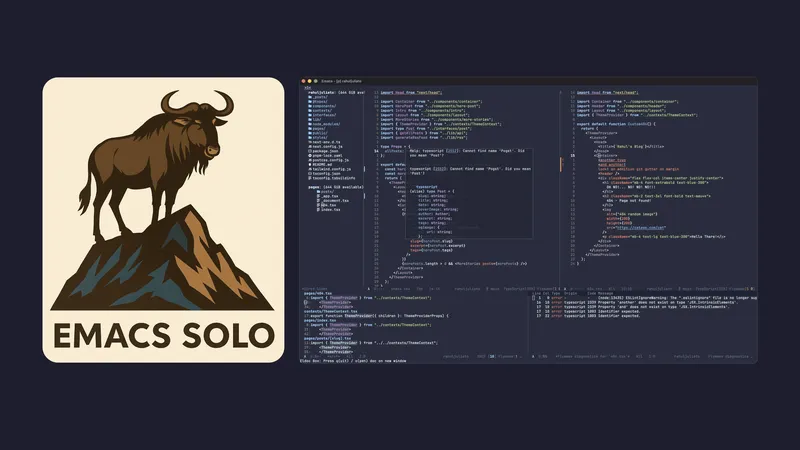
Emacs Solo has been maintained for two years with a focus on using 35 modules without any external packages. All components are either built into Emacs or custom-written in the lisp/ directory.
rahuljuliato.com
20 min
3/10/2026
What's new in Emacs 31.1
Emacs 31.1 has been released with incremental usability, completion, window-management and terminal improvements rather than a single flagship feature. The release permanently removes the legacy unexec dumper, deprecated since Emacs 27, leaving the portable dumper as the supported mechanism for preloading Emacs Lisp state. It also stops building and installing Emacs’s old ctags program, directing users to Universal Ctags or to `etags --ctags` for compatible behavior. A planned new garbage collector was postponed to Emacs 32. A new User Lisp Directory feature automatically processes Lisp files under `user-lisp/` in an Emacs configuration directory, including recursive byte compilation, autoload generation and load-path setup. Tree-sitter modes can now offer to install their required language grammars. Completion gains configurable eager display and live updating of the *Completions* buffer, while the rewritten flex completion style is intended to be faster and rank matches more accurately. New commands rotate, flip and transpose window layouts, and a setting controls preferred split direction. Compatible terminals now enable `xterm-mouse-mode` by default, and TTY frames gain child-frame support. Emacs 31.1 also adds built-in controls for collapsing minor-mode indicators, hiding a buffer’s mode line, extending selections with Shift-click, and preventing asynchronous native compilation on battery power. It includes Org 9.8 and supports Unicode Standard 17.0.
masteringemacs.org
181 min
8/24/2026
Emacs 31.1 will release on 8/24
GNU Emacs’ HISTORY file records the editor’s evolution from EMACS, a set of macros for the TECO text editor that became operational in late 1976, to the GNU implementation begun in 1984. EMACS drew inspiration from earlier work including Stanford’s E editor and older TECO macro sets. Early GNU Emacs development occurred without version-control systems and was distributed on half-inch, nine-track, 1600-bpi magnetic tape reels; documentation describes surviving details from that period as sketchy. GNU Emacs was rebuilt for GNU and GNU-like systems with a full-featured Lisp at its core. Versions 1.0 through 1.12 were released in early 1985, while version 13 became the initial public release and was announced on Usenet on March 20, 1985. The release record lists stable versions from Emacs 13 through Emacs 31.1, dated August 24, 2026. Recent releases include Emacs 29.1 on July 30, 2023; 29.4 on June 22, 2024; 30.1 on February 23, 2025; and 30.2 on August 14, 2025. Emacs 28.3 is dated February 17, 2023 but marked as not actually released. GNU Emacs is free software under version 3 or later of the GNU General Public License.
github.com
6 min
8/21/2026
Two Years of Emacs Solo: 35 Modules, Zero External Packages, and a Full Refactor
Emacs Solo has been maintained for two years with a focus on using 35 modules without any external packages. All components are either built into Emacs or custom-written in the lisp/ directory.
rahuljuliato.com
20 min
3/10/2026
What's new in Emacs 31.1
Emacs 31.1 has been released with incremental usability, completion, window-management and terminal improvements rather than a single flagship feature. The release permanently removes the legacy unexec dumper, deprecated since Emacs 27, leaving the portable dumper as the supported mechanism for preloading Emacs Lisp state. It also stops building and installing Emacs’s old ctags program, directing users to Universal Ctags or to `etags --ctags` for compatible behavior. A planned new garbage collector was postponed to Emacs 32. A new User Lisp Directory feature automatically processes Lisp files under `user-lisp/` in an Emacs configuration directory, including recursive byte compilation, autoload generation and load-path setup. Tree-sitter modes can now offer to install their required language grammars. Completion gains configurable eager display and live updating of the *Completions* buffer, while the rewritten flex completion style is intended to be faster and rank matches more accurately. New commands rotate, flip and transpose window layouts, and a setting controls preferred split direction. Compatible terminals now enable `xterm-mouse-mode` by default, and TTY frames gain child-frame support. Emacs 31.1 also adds built-in controls for collapsing minor-mode indicators, hiding a buffer’s mode line, extending selections with Shift-click, and preventing asynchronous native compilation on battery power. It includes Org 9.8 and supports Unicode Standard 17.0.
masteringemacs.org
181 min
8/24/2026
Two Years of Emacs Solo: 35 Modules, Zero External Packages, and a Full Refactor
Emacs Solo has been maintained for two years with a focus on using 35 modules without any external packages. All components are either built into Emacs or custom-written in the lisp/ directory.
rahuljuliato.com
20 min
3/10/2026
Emacs 31.1 will release on 8/24
GNU Emacs’ HISTORY file records the editor’s evolution from EMACS, a set of macros for the TECO text editor that became operational in late 1976, to the GNU implementation begun in 1984. EMACS drew inspiration from earlier work including Stanford’s E editor and older TECO macro sets. Early GNU Emacs development occurred without version-control systems and was distributed on half-inch, nine-track, 1600-bpi magnetic tape reels; documentation describes surviving details from that period as sketchy. GNU Emacs was rebuilt for GNU and GNU-like systems with a full-featured Lisp at its core. Versions 1.0 through 1.12 were released in early 1985, while version 13 became the initial public release and was announced on Usenet on March 20, 1985. The release record lists stable versions from Emacs 13 through Emacs 31.1, dated August 24, 2026. Recent releases include Emacs 29.1 on July 30, 2023; 29.4 on June 22, 2024; 30.1 on February 23, 2025; and 30.2 on August 14, 2025. Emacs 28.3 is dated February 17, 2023 but marked as not actually released. GNU Emacs is free software under version 3 or later of the GNU General Public License.
github.com
6 min
8/21/2026
No more articles to load