Go 1.27
The Go team released Go 1.27, adding language features, toolchain updates, runtime profiling, performance work, and new standard-library packages. The release supports generic methods, allowing methods such as math/rand/v2.Rand.N to work across integer types. Struct literals can now initialize nested or embedded fields through valid field selectors, and generalized function type inference now covers all assignment contexts, including composite literals, type conversions, and channel sends. Go 1.27 adds go fix modernizers for atomic types, embedded literals, backward slices, and unsafe functions. The go doc command supports package@version queries, while go mod tidy consolidates multiple require blocks into direct and indirect blocks. Size-specialized allocation reduces costs for objects smaller than 80 bytes by up to 30%, with roughly 1% overall improvement claimed for allocation-heavy programs. The runtime/pprof goroutineleak profile is generally available for detecting permanently blocked goroutines. Standard-library additions include encoding/json/v2, post-quantum ML-DSA signatures through crypto/mldsa, UUID support, experimental SIMD packages, and an in-memory HTTP test server for testing/synctest.
go.dev
3 min
8/19/2026
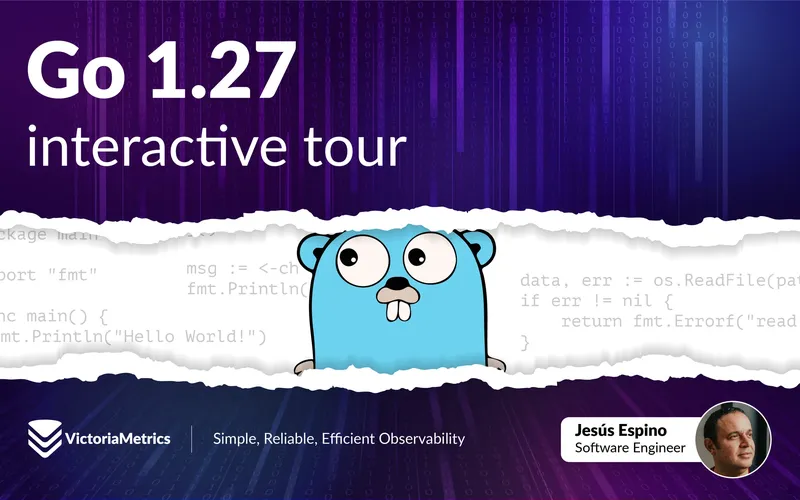
Go 1.27 Interactive Tour
Go 1.27 introduces new features with an interactive tour that includes runnable examples to demonstrate changes and updated behaviors. The initiative continues from previous interactive tours created by Anton Zhiyanov for Go versions 1.22 through 1.26.
victoriametrics.com
15 min
8/2/2026

A case for Go as the best language for AI agents
Go is identified as the best programming language for developing AI agents due to its performance, efficiency, and strong concurrency support. Bruin, an open-source ETL tool primarily written in Go, exemplifies its capabilities in building robust web services.
getbruin.com
10 min
3/2/2026
Using go fix to modernize Go code
The Go 1.26 release features a completely rewritten go fix subcommand that uses algorithms to identify and implement improvements in Go code. This tool helps developers modernize their codebases by leveraging newer language and library features.
go.dev
20 min
2/17/2026
Go 1.27
The Go team released Go 1.27, adding language features, toolchain updates, runtime profiling, performance work, and new standard-library packages. The release supports generic methods, allowing methods such as math/rand/v2.Rand.N to work across integer types. Struct literals can now initialize nested or embedded fields through valid field selectors, and generalized function type inference now covers all assignment contexts, including composite literals, type conversions, and channel sends. Go 1.27 adds go fix modernizers for atomic types, embedded literals, backward slices, and unsafe functions. The go doc command supports package@version queries, while go mod tidy consolidates multiple require blocks into direct and indirect blocks. Size-specialized allocation reduces costs for objects smaller than 80 bytes by up to 30%, with roughly 1% overall improvement claimed for allocation-heavy programs. The runtime/pprof goroutineleak profile is generally available for detecting permanently blocked goroutines. Standard-library additions include encoding/json/v2, post-quantum ML-DSA signatures through crypto/mldsa, UUID support, experimental SIMD packages, and an in-memory HTTP test server for testing/synctest.
go.dev
3 min
8/19/2026
A case for Go as the best language for AI agents
Go is identified as the best programming language for developing AI agents due to its performance, efficiency, and strong concurrency support. Bruin, an open-source ETL tool primarily written in Go, exemplifies its capabilities in building robust web services.
getbruin.com
10 min
3/2/2026
Go 1.27 Interactive Tour
Go 1.27 introduces new features with an interactive tour that includes runnable examples to demonstrate changes and updated behaviors. The initiative continues from previous interactive tours created by Anton Zhiyanov for Go versions 1.22 through 1.26.
victoriametrics.com
15 min
8/2/2026
Using go fix to modernize Go code
The Go 1.26 release features a completely rewritten go fix subcommand that uses algorithms to identify and implement improvements in Go code. This tool helps developers modernize their codebases by leveraging newer language and library features.
go.dev
20 min
2/17/2026
Go 1.27
The Go team released Go 1.27, adding language features, toolchain updates, runtime profiling, performance work, and new standard-library packages. The release supports generic methods, allowing methods such as math/rand/v2.Rand.N to work across integer types. Struct literals can now initialize nested or embedded fields through valid field selectors, and generalized function type inference now covers all assignment contexts, including composite literals, type conversions, and channel sends. Go 1.27 adds go fix modernizers for atomic types, embedded literals, backward slices, and unsafe functions. The go doc command supports package@version queries, while go mod tidy consolidates multiple require blocks into direct and indirect blocks. Size-specialized allocation reduces costs for objects smaller than 80 bytes by up to 30%, with roughly 1% overall improvement claimed for allocation-heavy programs. The runtime/pprof goroutineleak profile is generally available for detecting permanently blocked goroutines. Standard-library additions include encoding/json/v2, post-quantum ML-DSA signatures through crypto/mldsa, UUID support, experimental SIMD packages, and an in-memory HTTP test server for testing/synctest.
go.dev
3 min
8/19/2026
Using go fix to modernize Go code
The Go 1.26 release features a completely rewritten go fix subcommand that uses algorithms to identify and implement improvements in Go code. This tool helps developers modernize their codebases by leveraging newer language and library features.
go.dev
20 min
2/17/2026
Go 1.27 Interactive Tour
Go 1.27 introduces new features with an interactive tour that includes runnable examples to demonstrate changes and updated behaviors. The initiative continues from previous interactive tours created by Anton Zhiyanov for Go versions 1.22 through 1.26.
victoriametrics.com
15 min
8/2/2026
A case for Go as the best language for AI agents
Go is identified as the best programming language for developing AI agents due to its performance, efficiency, and strong concurrency support. Bruin, an open-source ETL tool primarily written in Go, exemplifies its capabilities in building robust web services.
getbruin.com
10 min
3/2/2026
No more articles to load