Adults Lose Skills to AI. Children Never Build Them

psychologytoday.com
March 28, 2026
6 min read
🔥🔥🔥🔥🔥
50/100
Summary
AI-driven cognitive atrophy affects adults who rely on AI for thinking, leading to a loss of previously acquired skills. Children may not develop these skills at all, as processing information through AI can result in uniform thinking patterns and hinder their ability to critically evaluate AI outputs.
Key Takeaways
- Adults who rely on AI for cognitive tasks experience skill atrophy, while children may never develop these skills at all.
- A study found that younger participants who offloaded tasks to AI showed lower critical thinking scores, indicating they lacked foundational skills that older participants retained.
- Auditing AI output requires domain knowledge that children are still in the process of developing, making them less capable of evaluating AI-generated information.
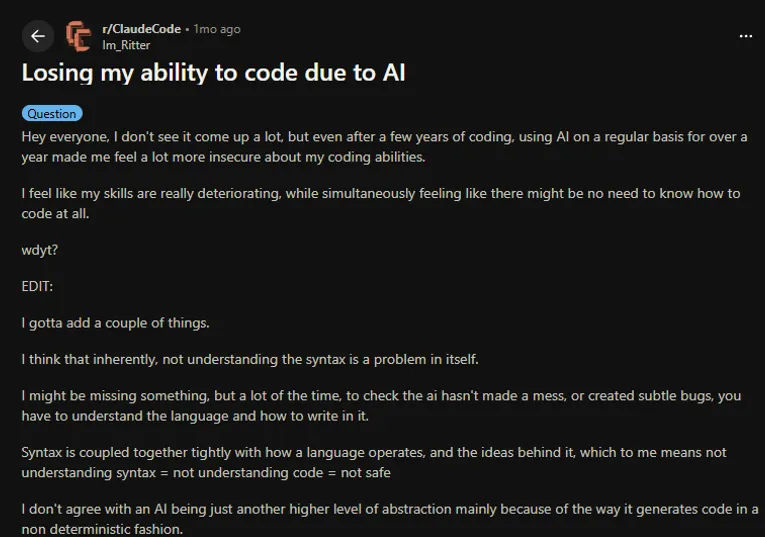
- Developers who delegated coding tasks to AI produced functional code but lacked the conceptual understanding necessary to debug or explain their work.
Coverage & discussions
Hacker News · psychologytoday.com
Community discussions
Community Sentiment
Positives
- AI serves as a valuable tool for learning, akin to a tutor, enabling users to ask questions and gain skills in a more interactive manner.
- The evolution of skills is natural; as technology changes, so do the skills we prioritize, allowing us to focus on more relevant competencies.
Concerns
- Concerns about lost skills due to AI may stem from an overestimation of the necessity of traditional skills in a rapidly changing technological landscape.
- The argument that AI leads to skill loss overlooks the potential for new forms of learning and adaptation that technology can foster.