AI Coding Without the Vibes

peterbloem.nl
August 16, 2026
32 min read
🔥🔥🔥🔥🔥
50/100
Summary
Efforts to prevent cheating with AI in educational settings are ongoing, but many students seeking shortcuts will continue to find ways around learning. A focus on supporting students who genuinely want to learn and are willing to invest time in their education is essential.
Key Takeaways
- Students must develop skills to navigate a world where AI is a major presence, rather than ignoring its existence or fully deferring to it.
- Relying entirely on AI for tasks can lead to a false sense of mastery and a lack of genuine understanding of the material.
- Effective use of AI in projects involves a two-stage process: doing the work yourself and then using AI to check it, or vice versa.
- Current AI is not reliable enough to perform both tasks effectively, making it essential for users to actively engage in the process to ensure quality and understanding.
Coverage & discussions
Hacker News · peterbloem.nl
Community discussions
Community Sentiment
Positives
- Using AI as a natural language interface to programming could demystify complex syntax, making coding more accessible and less intimidating for newcomers.
- AI-driven code reviews can enhance understanding by addressing deeper concerns like data security and performance, transforming how developers approach pull requests.
- The idea of AI assisting in feature planning and logic consolidation is a game-changer, allowing for more efficient and thoughtful code development.
Concerns
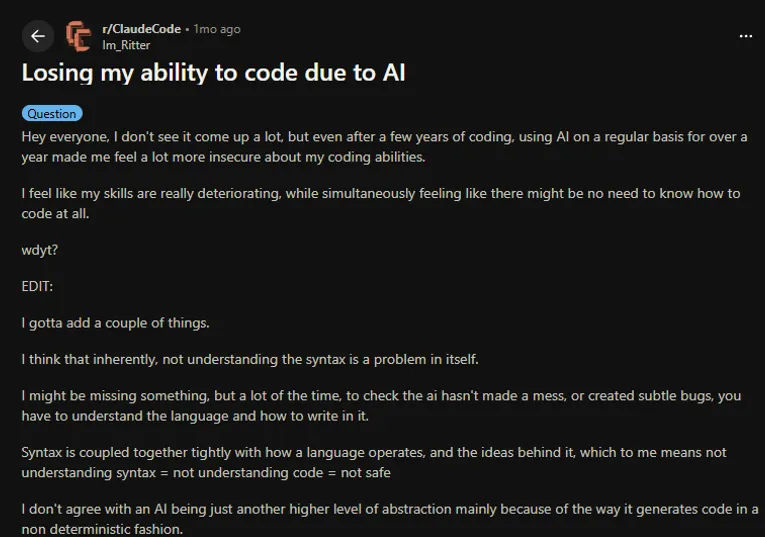
- Relying too much on AI can lead to 'vibe-coding,' where developers neglect the details of their code, risking quality and introducing bugs in production.
- Natural language processing for coding has historically failed because it lacks the precision required for programming, raising doubts about its effectiveness in real-world applications.