Amazon uses AI to monitor union risk in UK warehouses
opendemocracy.net
October 17, 2026
6 min read
54/100
Summary
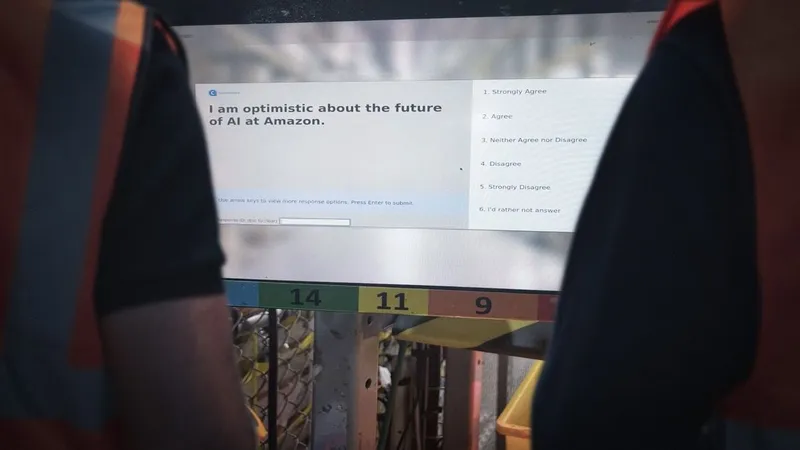
Internal Amazon documents disclosed in a Canadian labour case describe Atlas, an in-house AI tool that scores warehouses in the US, Canada and UK for the likelihood of unionisation, sit-ins and other “disruptive labour events.” Atlas draws on hundreds of data points, including Reddit posts, employee survey responses, workplace information and previous industrial action, assigning sites scores from 100 to 900. Lower scores indicate higher perceived labour-organising risk, while Amazon’s documents describe higher scores as better. The documents classify sites into five tiers, from Tier 5, with no immediate perceived risk, to Tier 1, where future activity is considered imminent. Sixteen warehouses were listed as Tier 1, including Amazon’s BHX4 facility near Coventry and its EMA4 robotic fulfilment centre in Sutton Coldfield. The documents say the ratings can inform staffing, resource planning and actions intended to mitigate risks to Amazon’s labour structure. Amazon said Atlas is not currently used in the UK and rejected claims that it conducts individual employee surveillance. The company said the framework assesses activity at site or building level, does not track workers’ opinions, affiliations, union membership or personal data, and is intended to identify issues requiring support. GMB, Foxglove and Leigh Day said the disclosures raise concerns about workers’ organising rights and Amazon’s use of workplace surveillance.
Key Takeaways
- Amazon’s Atlas tool reportedly assigns warehouse-level scores measuring the perceived risk of union activity and other labour disruption using hundreds of data points.
- Amazon documents listed 16 Tier 1 warehouses across the US, Canada and UK; Coventry’s BHX4 and Sutton Coldfield’s EMA4 were the two UK sites named.
- Amazon said Atlas is not currently used in the UK and said it does not monitor individual employees, union membership or personal data.
- The Atlas documents emerged during a Canadian legal challenge in which the British Columbia Labour Board found Amazon had violated multiple local labour laws.
What the discussion said
The thread treated Amazon’s reported AI use less as a clever analytics deployment than as a warning about algorithmic labor control. Commenters broadly saw a system that can infer union risk from workplace behavior, surveys, churn, complaints, or badge data as a way to chill a protected right before workers can organize. Several argued that the real danger is not a dashboard literally labeled union-busting: firms can package the same signals as engagement, retention, or attrition analysis, making discriminatory intent harder to prove and enforcement easier to evade. AI skepticism centered on both power and reliability. One reader questioned whether monitoring data can support accurate predictions at all; others worried that even crude models are damaging when workers know a dissenting survey response may mark them as suspicious. The discussion widened into a condemnation of workplace surveillance generally, with a smaller pushback that surveillance is not inherently illegitimate when narrowly tied to public enforcement such as traffic policing. Participants also linked corporate monitoring to weak labor-law enforcement and, for some, to the broader UK surveillance environment. The only practically positive note was an implied recognition that AI can detect operational patterns, but nobody presented that capability as a worker benefit here.
Where opinion split
The sharpest dispute was whether surveillance is categorically corrosive or can be justified in bounded settings. Critics argued that systems built to continuously classify people inevitably produce a coercive, dystopian power imbalance, especially at work; opponents challenged the absolutism, pointing to limited monitoring for concrete public-safety enforcement. In this case, however, the thread overwhelmingly regarded AI-driven employee profiling as an illegitimate use.
Community Sentiment
Positives
- Workforce models can surface patterns in turnover, complaints, schedules, and access behavior, showing why employers see predictive analytics as operationally valuable.
- One commenter defended narrowly scoped surveillance for enforceable public-safety rules, arguing that observation is not automatically abusive when its purpose and limits are clear.
Concerns
- Predicting union risk from employee signals turns AI into a preemptive pressure tool, threatening workers before collective action can become visible.
- Rebranding union detection as engagement or attrition analytics lets the same model-driven targeting hide behind bland HR language and frustrate accountability.
- Even an imperfect classifier can coerce workers: if a survey answer may trigger suspicion, people learn to perform loyalty rather than speak honestly.
- Training-data quality was questioned directly, raising the prospect that opaque workplace scores could punish people on weak or misleading correlations.
- AI workplace surveillance was framed as part of a wider machinery of control, amplified by weak labor-law enforcement and difficult-to-prove corporate misconduct.
Related Articles

Amazon investigating engineers who criticized AI data center expansion
Jun 18, 2026

Everything you do is being recorded
Aug 9, 2026

Flock's CEO Faced Me After Its Cameras Led to My Wrongful Stop
Aug 3, 2026

Software Engineer's Firing Ruled Illegal in a Rare Win for a Tech Worker
Jul 10, 2026

Amazon scraps AI leaderboard to stop workers chasing usage scores
May 28, 2026