Report · apricitas.io
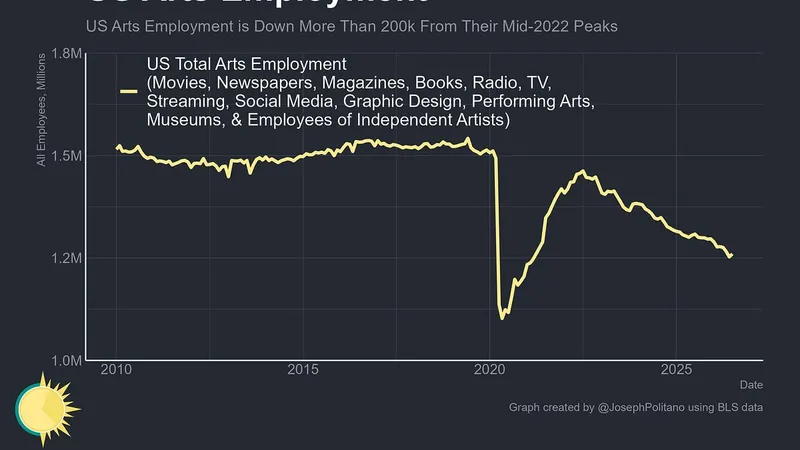
America has lost 200k of jobs in media, film and the arts. How much is AI?
apricitas.io
Source published October 24, 2026
Summary: 2 min read
68/100
Summary
Apricitas links a four-year decline of more than 200,000 U.S. jobs in creative industries, including roughly 50,000 lost in the most recent year, to mounting pressure on digital-media business models as generative AI spreads. The publication says movie and sound recording lost more than 100,000 jobs, nearly one-third of its workforce, while written publishing lost more than 70,000 jobs. It says in-person entertainment continues to grow, contrasting with declines across digital creative sectors, but acknowledges that AI’s role is difficult to separate from consolidation, offshoring, streaming and competition from social platforms. The analysis compares generative AI’s potential effects with the internet’s disruption of music, video and publishing. It argues that piracy and streaming reduced recorded-music revenue and shifted musicians toward concerts and merchandise, while newspapers lost advertising and readership as information moved online. It says Hollywood faces falling ticket and cable revenue alongside competition from free user-generated and AI-generated content, without a live-performance equivalent to offset losses. About 32% of arts, entertainment and recreation workers use generative AI to some extent, according to the publication. Apricitas also notes that book sales rose 70% over the past six years amid BookTok’s influence, underscoring that technology can create unpredictable demand. It argues creative-sector losses could foreshadow broader disruption in tech and other creative-adjacent work.
Key Takeaways
- Apricitas says U.S. creative industries lost more than 200,000 jobs over four years, including about 50,000 in the latest year.
- Movie and sound recording reportedly lost more than 100,000 jobs over four years, while written publishing lost more than 70,000.
- The publication says generative AI use is difficult to isolate from other pressures on media employment, including consolidation, offshoring, streaming and social-media competition.
- Apricitas reports that roughly 32% of workers in arts, entertainment and recreation use generative AI to some extent.
- Book sales rose 70% during the past six years, according to the publication, which attributes part of the resurgence to BookTok communities on TikTok.
What the discussion said
Commenters mostly resisted turning a broad creative-sector contraction into a clean AI story. The strongest consensus was that the jobs figure sits inside older, heavier forces: streaming wrecked the blockbuster economics that once funded film and television, expensive subscriptions and consumer pressure suppress spending, post-COVID hiring unwound, and an attention market flooded with free video, games, music, and creator content has more supply than anyone can consume. Several readers also questioned whether selected employment graphs show a historic collapse rather than a reversion after an unusual pandemic-era surge. That did not absolve AI. Some saw generative tools as an obvious direct threat to commercial illustrators and catalog-ad production, with the timing of visual-art declines lining up with image-generation adoption. Others argued that AI-assisted content further diverts attention from traditional media, while the rush to make games and video faster is pointless in a market already drowning in good-enough entertainment. A smaller optimistic strand framed AI assistants as practical relief from administrative overload and predicted higher creative output rather than fewer workers. The thread’s real conclusion was that AI is likely an accelerant and a concentrated source of harm in particular roles, not a sufficient explanation for all 200,000 losses.
Where opinion split
The sharp dispute was whether AI is already the main engine of creative-job losses or merely a visible addition to an industry already hollowed out by streaming, oversupply, and weak consumer demand. AI skeptics pointed to layoffs beginning before the current generative-AI boom and to pandemic and financing cycles; those sounding the alarm argued that commercial art is already being automated and that ignoring the trajectory delays a necessary response.
Coverage & discussions
Hacker News · apricitas.io
Community discussions
Community Sentiment
Positives
- AI assistants can strip away enough personal administrative clutter that users feel more present offline, a concrete productivity gain rather than another screen-bound distraction.
- Some commenters expect AI to raise creative output and reshape television and film work before it broadly eliminates employment, making it a production multiplier rather than a simple headcount cutter.
Concerns
- Generative image tools appear to have made commercial illustration and product-ad imagery prime targets for automation, removing paid work that once supported working artists and models.
- AI-assisted and AI-generated content compounds an already brutal attention glut, so producing games or video faster does not create new audiences or sustainable creative jobs.
- Viewers frustrated by low-effort synthetic video want platforms to filter fully AI-made uploads, seeing the format as noise that makes quality work harder to find.
- Warnings about AI displacement stress that treating current losses as an abstraction risks sleepwalking from thousands of affected workers to vastly larger layoffs.