Building reliable agentic AI systems
martinfowler.com
June 21, 2026
36 min read
🔥🔥🔥🔥🔥
57/100
Summary
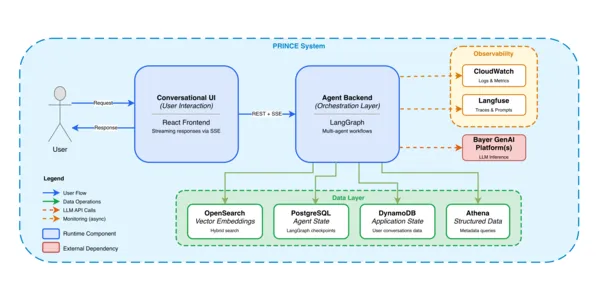
The Preclinical Information Center (PRINCE) is a cloud-hosted platform developed by Bayer AG and Thoughtworks to enhance drug development in the pharmaceutical industry. PRINCE utilizes Agentic Retrieval-Augmented Generation and Text-to-SQL to integrate and analyze decades of safety study reports, evolving from a keyword-based search to an intelligent research assistant.
Key Takeaways
- Bayer AG developed the Preclinical Information Center (PRINCE) in collaboration with Thoughtworks to enhance drug development processes in the pharmaceutical industry.
- PRINCE utilizes Agentic Retrieval-Augmented Generation and Text-to-SQL to improve data accessibility and research efficiency by transforming traditional keyword-based searches into an intelligent research assistant.
- The system emphasizes trust through transparency, explainability, and human-in-the-loop integration, while also focusing on engineering resilience through error handling and recovery mechanisms.
- PRINCE showcases the potential of AI to revolutionize preclinical data access, allowing researchers to ask complex questions in natural language and receive accurate, context-rich answers.
Coverage & discussions
Hacker News · martinfowler.com
Community discussions
Community Sentiment
Positives
- The emphasis on clean and structured data is crucial for agentic AI systems, as it significantly accelerates the alignment process and enhances overall performance.
- Integrating high-quality evaluation datasets into the CI/CD process is becoming a key differentiator for building effective AI solutions, especially in specialized fields like pharmaceuticals.
- AI's capability to retrieve relevant documents with precision in search-focused applications showcases its potential to streamline information access.
Concerns
- Dynamic data fetching complicates the reliability of agentic AI systems, leading to inconsistent performance and limiting the ability to run complex queries.
- Current AI agents often degrade the quality of generated code and written content over time, indicating a significant limitation in their utility for creative tasks.
- The perception that AI can achieve laser precision in document retrieval is misleading, as many users find LLMs to produce fuzzy and imprecise results.