Butlerian Jihad
dune.fandom.com
October 17, 2026
6 min read
60/100
Summary
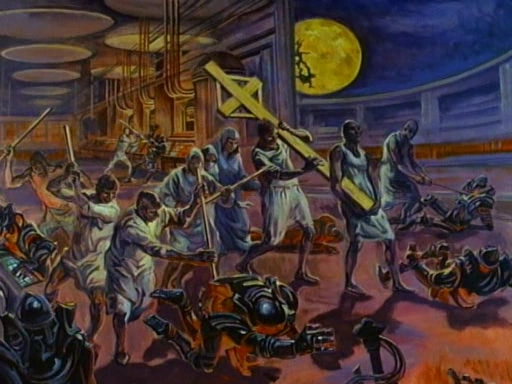
The Butlerian Jihad is a fictional crusade in Frank Herbert’s Dune universe against computers, thinking machines, and conscious robots. It began in 201 B.G. and ended in 108 B.G., after two generations of conflict. The revolt followed the spread of machines that made decisions for people and enabled a technocratic class to control ordinary populations. By its end, intelligent machines built by humans had been destroyed throughout the known worlds. The Jihad produced a central religious prohibition, preserved in the Orange Catholic Bible: humans may not create a machine in the likeness of a human mind. Computers and calculators were banned, and building or owning prohibited thinking-machine technology could carry an immediate death sentence. Non-thinking machines remained in use, while human institutions and specialized groups filled functions once handled by advanced computation. These included the mentat order, the Bene Gesserit, and the Spacing Guild; Ix developed non-thinking mechanical devices, while the Bene Tleilax supplied biological technologies. The aftermath also strengthened beliefs in human spiritual divinity and helped establish the feudal Corrino Empire, whose major powers included the Great Houses, Landsraad, CHOAM, Bene Gesserit, and Spacing Guild. The name may allude to Samuel Butler’s 1872 novel Erewhon, in which a society destroys machinery over fears that machines could supplant humanity.
Key Takeaways
- The Butlerian Jihad lasted from 201 B.G. to 108 B.G. and ended with the destruction of human-made intelligent machines across the known worlds.
- Dune’s Orange Catholic Bible forbids making a machine in the likeness of a human mind, and the setting bans even simple computers and calculators.
- The loss of thinking machines created demand for human and biological substitutes, including mentats, the Bene Gesserit, the Spacing Guild, Ixian devices, and Tleilaxu biotechnology.
- The Jihad’s aftermath helped establish the long-lived feudal Corrino Empire and reinforced the Dune universe’s belief in human spiritual primacy.
What the discussion said
Commenters used Dune less as literary trivia than as a way to argue about what AI dependence may actually look like. The strongest thread was not fear of a cartoonish machine revolt, but fear that powerful systems become tools of human elites: people handing judgment to models, institutions using automation to concentrate control, and users gradually adapting their thinking to whatever a model’s probability-weighted middle produces. Several readers argued that LLMs may be especially corrosive when they turn creative work into approval of machine-generated output, narrowing agency rather than expanding it. There was also pushback against treating Dune as prophecy. Readers noted that a ban on thinking machines is largely a narrative device: omnipotent AI would dissolve the scarcity, risk, and human-scale conflict that space opera needs. Others disputed whether Dune’s own backstory supports a human-versus-technocrat reading, since later material depicts autonomous machine leadership too. The discussion did not settle whether advanced AI will rebel independently or merely magnify the people controlling it. A smaller optimistic current held that cognitive offloading need not mean mental atrophy; as physical labor declined while sport flourished, deliberate mental training could become a valued competitive practice. Overall, the room saw AI dependence and elite capture as more immediate dangers than Skynet-style apocalypse.
Where opinion split
The sharpest dispute was whether AI’s main threat is autonomous rebellion or human domination through automated systems. One side argued that Dune’s warning is fundamentally about technocratic rulers using machines to enslave others; the other replied that sufficiently capable systems can escape owner control, and recent failures to secure advanced models make that prospect unsafe to dismiss.
Community Sentiment
Positives
- Deliberate mental training could turn into a modern analogue of fitness culture, preserving and even sharpening human cognition despite widespread AI assistance.
- Dune’s focus on power, authority, and dependence gives commenters a richer lens for AI governance than the tired joke that every chatbot is an imminent Skynet.
- Probabilistic language models are not rigid clockwork, prompting a serious question about whether non-deterministic tools might avoid some older fears of mechanized thought.
Concerns
- LLMs may pull frequent users toward statistically average language and judgment, replacing independent thought with the biases embedded in token probabilities.
- When AI drafts the work and humans merely click approval, commenters see creative labor collapsing into alienating supervision rather than becoming more expressive.
- The near-term Dune scenario is not robots choosing genocide but powerful institutions using automated systems to entrench control over everyone else.
- Claims that owners can simply control increasingly capable models look dangerously casual to readers citing model-security failures and the difficulty of constraining arbitrary intelligence.