CEO fired developers to make room for AI. Developers create open source AI CEO
github.com
August 27, 2026
13 min read
75/100
Summary
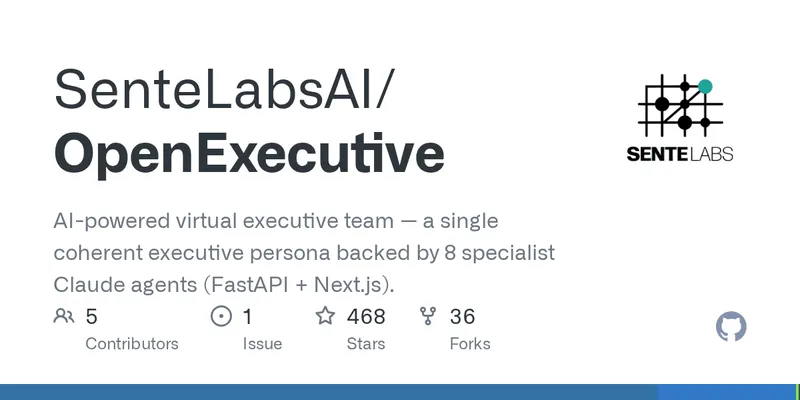
Open Executive is an Apache 2.0-licensed, open-source virtual executive team built by SenteLabsAI. It presents users with one executive persona while an orchestrator routes requests to eight specialists covering strategy, finance, people, legal basics and compliance, operations, marketing, product, and board communications. The system uses Anthropic’s Claude API by default, with claude-sonnet-4-6 for the executive and most specialists and claude-opus-4-7 with extended thinking for strategy, finance, legal, and board work. It can also use OpenRouter or OpenAI-compatible local model servers such as Ollama, LM Studio, vLLM, and llama.cpp. Each specialist retrieves built-in business knowledge and uploaded company documents from separate ChromaDB collections. A background claude-haiku-4-5 process extracts decisions, initiatives, and advice into SQLite after responses, allowing later sessions to receive prior-decision context. A built-in scheduler can surface follow-ups but requires the FastAPI service to run as a single instance to avoid duplicate actions. The stack includes Python 3.11, FastAPI, Next.js 15, Tailwind, ChromaDB, and SQLite. Users can access it through a web interface, CLI, Slack, email, Telegram, Google Chat, or Discord. Local setup requires Python 3.11+, Node 22+, and an API provider configuration; the first start downloads an approximately 90 MB embedding model.
Key Takeaways
- Open Executive combines eight business-domain AI specialists behind a single executive persona rather than exposing separate agents to users.
- The system uses retrieval-augmented generation with separate ChromaDB stores for built-in business knowledge and uploaded company documents.
- SQLite-based episodic memory stores extracted decisions and initiatives after each response for use in later sessions.
- The scheduler is designed for one FastAPI instance only because multiple instances could trigger scheduled actions twice.
- The project supports Claude by default as well as OpenRouter and OpenAI-compatible local model servers, including Ollama, LM Studio, vLLM, and llama.cpp.
What the discussion said
The thread mostly treated the open-source AI CEO as sharp satire aimed at executives who replace technical staff, but it also surfaced a serious question: can agent systems automate management rather than merely imitate a single leader? Several commenters argued that planning, prioritization, reporting, coordination, and data-driven choices are precisely the work AI could absorb. They see multi-agent organizations as the more consequential frontier: models that divide work, deliberate, and execute could become a corporate-level intelligence rather than another chatbot with a job title. Some even frame profitable autonomous operation as a stronger practical test than conversational human-likeness. The enthusiasm is tempered by deep skepticism about what management actually requires. Readers stress that executives sell, cultivate customer and investor relationships, enforce culture and values, and wield real authority; an advisory model cannot compel action or bear responsibility. The promised objectivity also drew pushback, since a model inherits biased data and can produce confident but incoherent directives. A few commenters see AI as a way for technically capable workers to expand into product and strategic work, not as a credible substitute for accountable human leadership. Replacing political authority with AI was especially rejected as a route to hollowing out democratic control rather than improving government.
Where opinion split
The central dispute is whether executive work is a tractable AI workflow or an authority-and-relationships role that cannot be reduced to analysis. Optimists argue that AI can synthesize organizational knowledge, prioritize more consistently, and make faster evidence-based decisions than insulated executives. Skeptics answer that models lack the networks, accountability, cultural judgment, and coercive power that let a real leader close deals and make an organization move.
Community Sentiment
Positives
- Multi-agent systems organized around planning and execution look more significant than a chatbot wearing a CEO label, because coordinated AI labor could tackle whole business processes.
- AI could shift technically minded workers from repetitive implementation toward product strategy and decision-making, breaking the usual divide between builders and managers.
- Fast analysis of operational data, alternatives, and contingency plans could make routine management less arbitrary and less dependent on executive intuition.
- An autonomous venture that repeatedly earns profit would offer a concrete capability test: not persuasive conversation, but sustained performance in a real market.
Concerns
- Management cannot be replaced by polished recommendations alone: executives win customers, raise resources, shape culture, and carry authority that employees may simply ignore from a model.
- Claims of unbiased AI decision-making collapse if the historical data and organizational incentives feeding the system already encode bias.
- An AI manager with firing power could scale the familiar failures of bad leadership into opaque, nonsensical directives and indiscriminate layoffs.
- Handing political or public authority to AI is seen as a direct threat to democratic accountability, not a harmless extension of workplace automation.
Related Articles
Claude Code – Everything You Can Configure That the Docs Don't Tell You
May 29, 2026
Odysseus – self-hosted AI workspace
May 31, 2026
Parallel coding agents with tmux and Markdown specs
Mar 2, 2026
Building a coding agent in Swift from scratch
Mar 25, 2026
Agent skills that bring team coding standards to Claude Code and Codex
Aug 4, 2026