Coding expertise is going to collapse from AI reliance
larsfaye.com
August 24, 2026
13 min read
69/100
Summary
Lars Faye argues that AI coding assistants can weaken the skill formation novice developers need to use those tools safely and effectively. He calls this the “expert novice” problem: developers entering the field alongside large language models are urged to use AI to keep pace, while effective prompting, code review, system design and output verification still require experience developed through repeated problem-solving. Faye says experienced engineers currently gain more from the tools because they can steer and audit their outputs. Faye cites the study “The Widening Gap: The Benefits and Harms of Generative AI for Novice Programmers,” highlighted by JetBrains, which found that participants using heavier AI assistance often skipped planning, developed an “illusion of competence,” and became lost in generated solutions. Participants who limited assistance performed better by rejecting unhelpful suggestions and using AI to accelerate solutions they already understood. He also cites a 2025 University of Pennsylvania study of 1,000 mathematics students, which reported that unrestricted LLM use led to test performance 17% below a textbook-only group, while a tutor-oriented GPT condition improved AI-assisted practice results by 127% but produced test scores similar to the textbook group. Faye recommends using LLMs primarily for interactive documentation, tutorials and Socratic exercises rather than routine code generation when learning. He says developers should verify AI outputs through official documentation, peers and hands-on testing, and distinguish delegating tedious work from delegating judgment.
Key Takeaways
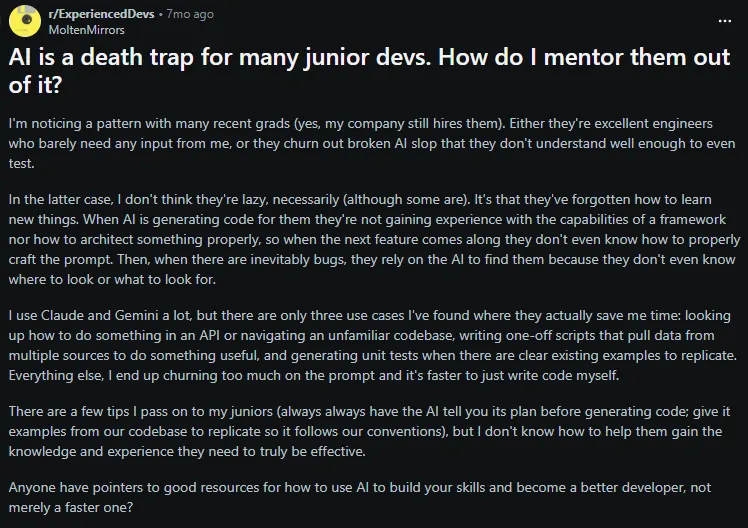
- Lars Faye argues that bypassing programming friction with AI-generated code can prevent novice developers from building the intuition needed to assess and maintain software.
- A study cited by JetBrains found that novice programmers using heavier generative-AI assistance often skipped planning and reported confidence without equivalent understanding.
- A 2025 University of Pennsylvania study cited by Faye found that students using unrestricted LLM assistance in mathematics performed 17% worse than a textbook-only group, despite believing they were doing well.
- Faye recommends using AI coding tools as tutors, documentation aids and Socratic partners, while independently verifying outputs and retaining responsibility for technical judgment.
What the discussion said
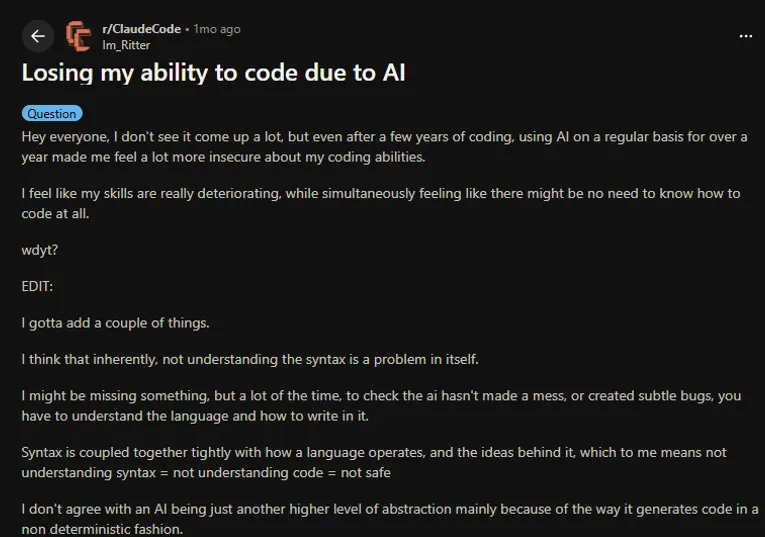
The thread treated AI coding less as a question of whether models can emit working code and more as a question of who can still judge that code. Commenters broadly accepted that LLMs now remove much of the mechanical work of programming, especially boilerplate, documentation digging, syntax recall, and small implementation tasks. For experienced engineers, a fast assistant embedded in the editor can function as a delegation layer: it accelerates work while leaving design choices, review, and accountability with the human. The anxiety centered on headless agents and management mandates to maximize AI-generated output. Several readers described teams producing code faster than anyone can understand or review it, while nontechnical staff try to turn tickets directly into implementation. That shifts work toward filtering large volumes of generated artifacts and risks shipping bloated, patched-together systems whose authors cannot explain them. Readers also worried that bypassing the struggle of learning makes junior developers and future experts dependent on vendors rather than capable engineers. Still, the thread did not conclude that programming expertise simply disappears. Some argued that coding has always been subordinate to requirements, architecture, testing, and validation, and that abstraction has repeatedly displaced low-level skills without ending engineering. The practical consensus was narrower: AI is valuable when it remains guided, inspected, and used to teach; it becomes corrosive when it replaces understanding.
Where opinion split
The sharpest dispute was whether AI-generated code merely raises the abstraction level or destroys the path by which engineers acquire judgment. Optimists argued that implementation was never the core job, and that competent people can redirect attention to design, requirements, and verification. Skeptics replied that those higher-order abilities are built through years of hands-on technical friction, so outsourcing implementation too early leaves people unable to steer or audit the systems they supposedly manage.
Community Sentiment
Positives
- Guided, editor-integrated LLM use strips away repetitive coding and documentation work while keeping experienced engineers in control of architecture and review.
- Some developers say LLMs broaden the tools they can use and speed learning when the model explains unfamiliar systems rather than acting as an opaque agent.
- Cheap, fast models are praised as a practical delegation layer that can improve productivity without the cost or latency of frontier-model workflows.
- Code generation can free engineering attention for requirements, test coverage, validation, and system design, where product failures are often actually decided.
Concerns
- Enterprise demands to avoid manual coding are driving output beyond human review capacity, turning engineers into overwhelmed auditors of machine-produced artifacts.
- Nontechnical users cannot reliably convert a ticket into a viable implementation because they lack the context needed to detect plausible but broken AI output.
- Agentic workflows remove the productive struggle that builds debugging and systems knowledge, risking a thinner future pipeline of genuinely capable engineers.
- Cheap code may create more software that is bloated, improvised, and poorly reasoned, while deep dependence on AI providers erodes teams' ability to recover independently.