Disagreement among frontier LLMs on real-world fact-checks
lenz.io
May 28, 2026
22 min read
🔥🔥🔥🔥🔥
68/100
Summary
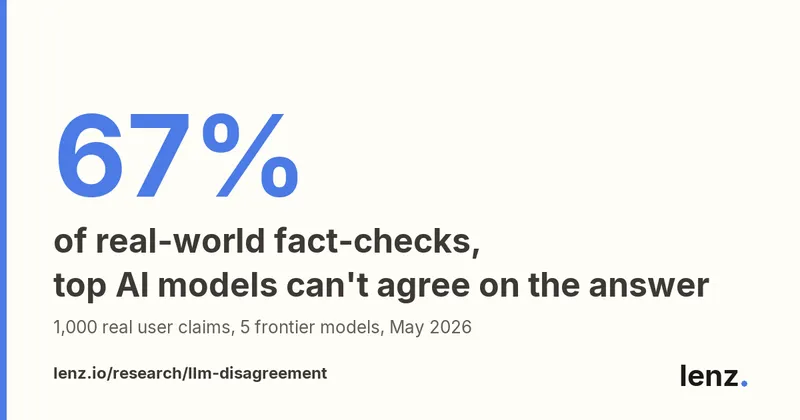
67% of real fact-checks show that top AI models disagree on the answers. Five frontier LLMs evaluated 1,000 user-submitted claims, resulting in significant discrepancies among their verdicts.
Key Takeaways
- 67% of claims evaluated by five frontier LLMs resulted in at least one model dissenting from the majority verdict or no majority forming at all.
- 34% of claims showed a substantive disagreement, with a gap of two or more verdict buckets between the most-disagreeing models.
- The agreement among the models was measured at Krippendorff's α = 0.639, indicating nontrivial but limited consensus.
- Only 33% of claims received unanimous verdicts, with the majority of claims leading to splits or disagreements among the models.
Coverage & discussions
Hacker News · lenz.io
Community discussions
Community Sentiment
Positives
- The diversity of responses among LLMs highlights the complexity of fact-checking, suggesting that even advanced models struggle with nuanced claims, which is a valuable insight for future AI development.
- The discussion around the definitions of 'True', 'Mostly True', 'Misleading', and 'False' emphasizes the need for clearer guidelines in AI models, which could enhance their reliability in real-world applications.
Concerns
- The lack of a category for 'unknown or undecidable' in the fact-checking process indicates a significant limitation in the models' ability to handle ambiguity, which is crucial for accurate information retrieval.
- Excluding Grok from the evaluation limits the understanding of different training philosophies, which could provide important insights into model performance and biases.
- The sentiment that LLMs are not suitable for fact-checking reflects a broader concern about the appropriateness of current AI technologies for critical applications, raising questions about their reliability.