Report · dreamlabs.ai
Dream-1

dreamlabs.ai
Source published October 24, 2026
Summary: 1 min read
56/100
Summary
Dream Labs has launched Dream-1, a World Action Model available through a public API that it says can control previously unseen bimanual robots with parallel grippers without robot-specific fine-tuning or demonstrations. The company emerged from stealth with $90 million in seed funding and positions the system as a way to make newly deployed, lower-cost robots useful before they have accumulated their own training data. Dream-1 predicts end-effector poses—gripper positions, orientations, and open or closed states—rather than only robot-specific joint angles. A robot’s inverse-kinematics solver converts those poses into joint commands. The model uses a head camera and wrist cameras, and Dream Labs says its video-and-action training enables it to generalize across robots whose bodies and grippers differ. The company reported tests on multiple bimanual parallel-gripper systems, including the 18-year-old PR2 robot. Robocurve independently evaluated Dream-1 before launch, according to Dream Labs. Dream Labs says the model costs $3 per hour and Dream-1-flash costs $2 per hour; each API call returns 1.6 seconds of actions. For robots where zero-shot performance is insufficient, its Fine-tuning-as-a-Service adapts the model using robot-specific data. Dream Labs reports five minutes of data improved results for two partner robots, while other configurations required 77 to 98 minutes.
Key Takeaways
- Dream Labs released Dream-1 through a public API and announced $90 million in seed funding after emerging from stealth.
- Dream-1 is designed for bimanual robots with parallel grippers and uses end-effector pose commands that a robot’s inverse-kinematics solver converts into joint commands.
- Dream Labs says Dream-1 can perform zero-shot control on previously unseen robots, tasks, and environments, although performance varies by robot and inverse-kinematics solver.
- Dream Labs prices Dream-1 at $3 per hour and Dream-1-flash at $2 per hour; each call returns 1.6 seconds of robot actions.
- Fine-tuning-as-a-Service adapts Dream-1 with robot-specific data when zero-shot performance is inadequate; Dream Labs reports that required data ranged from five minutes to 98 minutes in cited examples.
What the discussion said
The thread spent less time celebrating Dream-1’s launch than stress-testing whether it is a real robotics breakthrough or a glossy early demo. Several readers tried the playground and found that it can sometimes satisfy the broad spatial relationship in a prompt, but often through an unexpected action sequence, with continued unnecessary motion, idle arms, and trouble handling even simple objects. That made the company’s pitch for a broad robot-learning platform feel premature: commenters saw toy-table tasks and investor-friendly language where they expected evidence of dependable industrial or household automation. Still, the underlying direction drew genuine excitement. A language-driven system that can make dual-arm robots act on new instructions is seen as a plausible route toward affordable assistance with cleaning, meal preparation, and other repetitive work. Some also argued that the lab is pursuing an unusually open hardware-agnostic action-model idea, unlike robotics efforts tightly coupled to a proprietary machine. But optimism was largely conditional on reliability, safety, and real-world transfer improving dramatically. Readers questioned whether a cloud-controlled household robot creates unacceptable autonomy and privacy risks, and whether automation’s gains would liberate people from drudgery or simply erode wages and jobs. The AI-written launch copy and unexpectedly prominent submission amplified suspicion that the presentation is ahead of the product.
Where opinion split
The sharp dispute is whether Dream-1 is an important step toward general-purpose robot control or an ambitious platform pitch built on demos too weak for practical work. Supporters see a promising, potentially hardware-independent way to scale robot learning beyond bespoke systems; skeptics argue that unreliable toy manipulation cannot justify claims about real homes, warehouses, or factories.
Coverage & discussions
Hacker News · dreamlabs.ai
Community discussions
Community Sentiment
Positives
- Natural-language control of two-arm robots makes household help such as cleaning, cooking preparation, and laundry feel less like pure science fiction.
- The platform’s apparent attempt to separate action models from a single robot body could broaden robotics experimentation beyond companies that own every piece of hardware.
- Playground tests showed partial goal completion from ordinary language, enough for some readers to view the system as a rough early-stage capability rather than an empty mockup.
- Cheap, widely available robots could eventually remove people from repetitive physical work instead of reserving automation for heavily capitalized industrial deployments.
Concerns
- Interactive demos look brittle: the robot reaches loose interpretations of requests, mishandles objects, leaves one arm idle, and keeps moving after the task appears complete.
- Toy-table manipulation is a poor stand-in for factory or household reliability, where one bad motion can damage costly equipment or make automation unusable.
- A remotely operated or cloud-dependent robot inside the home raises alarming questions about third-party control, safety, and personal autonomy.
- Automation at scale may suppress wages and eliminate work before society has credible arrangements for sharing the productivity gains.
- The launch material reads like machine-generated investor copy, which made readers doubt that the company can clearly explain a customer-ready robotics product.
Related Articles
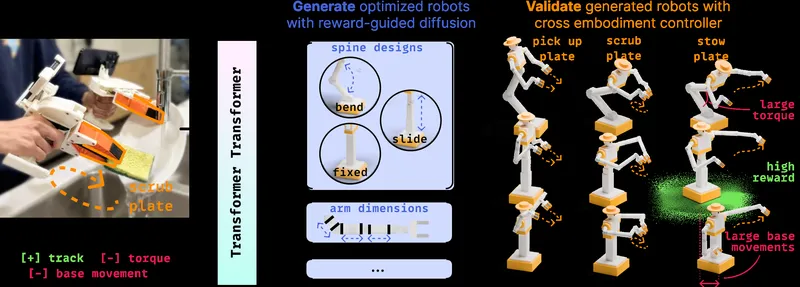
Transformer Transformer: A Unified Model for Motion-Conditioned Robot Co-Design
Jul 29, 2026

Building a robotics research setup that lives next to my desk
Jun 18, 2026

Project Fetch: Phase Two
Jun 21, 2026
Why Software Factories Fail (or: harness engineering is not enough)
Jul 23, 2026

OpenAI should build Slack
Feb 14, 2026