Report · techcrunch.com
Google’s first data center satellite is online and writing poetry
techcrunch.com
Source published October 30, 2026
Summary: 2 min read
0/100
Summary
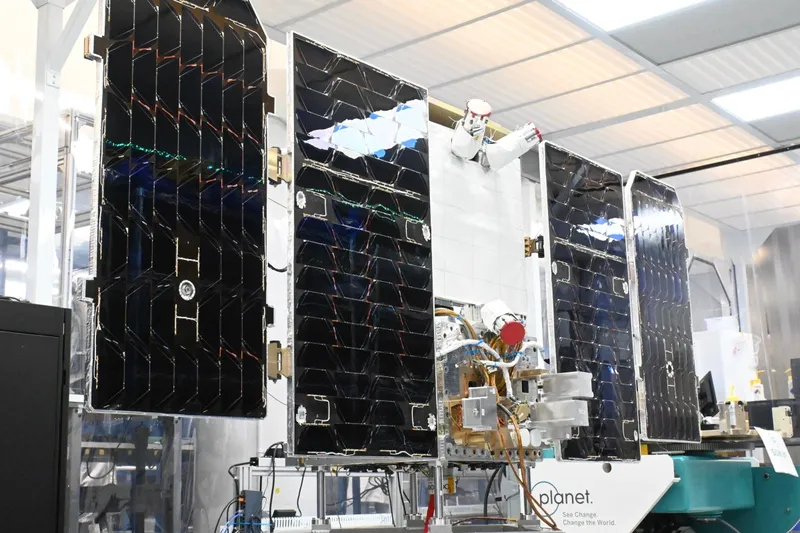
Google’s Suncatcher prototype space data center is operating in orbit after launching earlier in October 2026 on a SpaceX Falcon 9 mission carrying more than 100 spacecraft. The satellite has four Google Tensor Processing Units, although it can run only one at a time for roughly 20 minutes because its power system generates up to 1 kilowatt. Following a three-week commissioning process, engineers used the preloaded Google DeepMind Gemma 4 model to generate a space-themed haiku and to report orbital conditions. Google said the spacecraft was operating nominally. Suncatcher is testing whether TPUs can perform inference workloads under orbital thermal conditions and radiation exposure. Radiation can produce memory bit flips that corrupt data without conventional monitoring alerts. Ground-based particle-accelerator tests indicated radiation should have limited effects on inference but could pose greater problems for model training. If the first satellite validates the hardware, Google plans to launch two higher-power satellites in 2027 with inter-satellite optical links. Google envisions close-flying networks of satellites sharing distributed AI workloads, a model dependent on high-speed laser connections and on fully, rapidly reusable Starship launches. Suncatcher researchers estimated earlier in October that SpaceX would need 1,800 Starship flights to match the learning-driven cost reductions achieved with its earlier vehicles.
Key Takeaways
- Google’s Suncatcher satellite carries four TPUs but can operate only one for about 20 minutes at a time with its current 1-kilowatt power supply.
- The satellite ran Google DeepMind’s Gemma 4 model after a roughly three-week commissioning process and is communicating with ground controllers.
- The orbital test campaign is measuring TPU behavior under space radiation and thermal stress, including radiation-induced memory bit flips.
- Google plans two additional, higher-power Suncatcher satellites in 2027 to demonstrate inter-satellite optical links.
Coverage & discussions
RSS · TechCrunch AI · techcrunch.com
Community discussions
Related Articles

Google to pay SpaceX $920M a month for compute capacity at xAI data centers
Jun 5, 2026

Thermodynamics rules future orbital data centers
Jun 11, 2026
Data centers in space makes no sense
Feb 3, 2026

AWS AI cloud capacity sold out through 2027, 2028 bookings filling fast
Oct 24, 2026

Zitron: The Subprime Datacenter Crisis
Jul 24, 2026