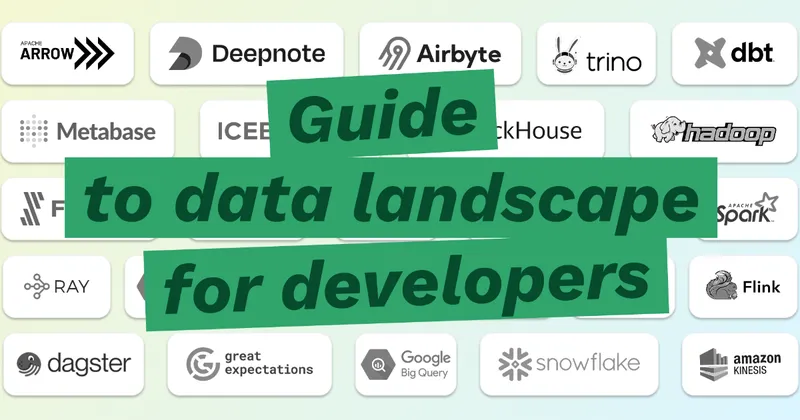
Guide to data tools landscape for developers
sinja.io
July 16, 2026
45 min read
🔥🔥🔥🔥🔥
53/100
Summary
Deepnote is a cloud-based notebook designed for data teams. The data tools landscape includes a variety of tools beyond notebooks, highlighting the complexity of the data field compared to software engineering.
Key Takeaways
- The article provides a guide for software engineers to understand the data tools landscape and the data lifecycle, focusing on how data is sourced, handled, stored, and displayed.
- There are four main types of data professions: analytical, scientific, engineering, and operational, each with distinct roles and skill sets.
- Analytical professionals typically use SQL and BI tools like Tableau to interpret data and present insights, while scientific professionals apply statistics and modeling techniques using languages like Python.
- The author emphasizes the importance of understanding various data tools and workflows to effectively contribute to data-related projects, even for those without a data background.
Community Sentiment
Positives
- This write-up is a fantastic primer — it gives just the right info to grasp the evolving data tools landscape.
- Commenters are buzzing about conversational analytics tools, marking a significant trend that will reshape how we interact with data.
- People are rallying around DuckDB as a game-changer, especially for handling datasets under 1TB — it’s becoming the go-to for many developers.
Concerns
- Pandas is being increasingly abandoned; its complexity leads to messy notebooks that confuse rather than clarify — not a good look for any data engineer.
- Some commenters argue that traditional databases like Postgres struggle with analytical patterns without complex extensions, raising red flags for teams relying on them.
- There’s skepticism about how well DuckDB is actually performing compared to other query engines, with some feeling the hype might be overblown.