How Claude's text watermarking works

anthropic.com
August 14, 2026
11 min read
🔥🔥🔥🔥🔥
47/100
Summary
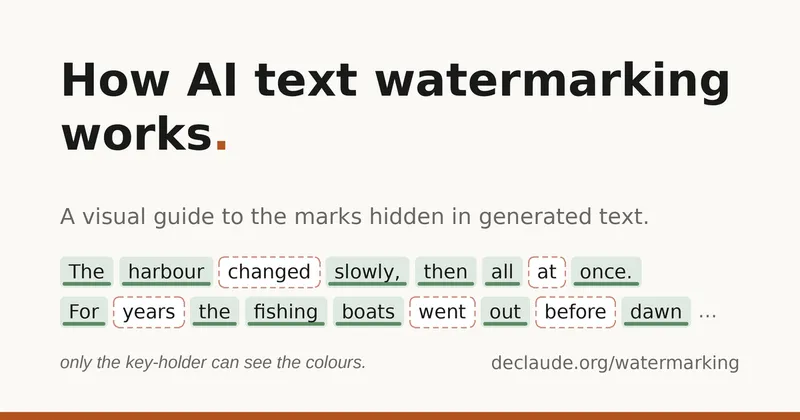
Future Claude models will incorporate a text watermark to indicate the likelihood of AI involvement in text generation. This implementation aligns with compliance requirements of the EU AI Act.
Key Takeaways
- Future Claude models will incorporate a watermarking method to indicate the likelihood of AI involvement in text generation, complying with the EU AI Act.
- The watermarking process does not affect the quality, content, or readability of Claude's outputs, making watermarked text indistinguishable from unwatermarked text to readers.
- Watermarking does not require additional tokens, does not carry identifying information, and cannot be traced to specific individuals or organizations.
- Other major AI providers are also implementing similar watermarking techniques as part of the EU's Code of Practice for AI-generated content.
Coverage & discussions
Hacker News · anthropic.com
Community discussions
Community Sentiment
Positives
- The watermark detection API could enhance transparency, giving the public a tool to identify AI-generated content, which is a step towards accountability.
- Some commenters appreciate that watermarking is better than nothing, suggesting a baseline for identifying AI outputs even if not foolproof.
- Open-source models reaching parity with commercial offerings means more accessibility in AI development, which is a game-changer for innovation.
Concerns
- Many see the watermarking API as easily circumvented, raising doubts about its effectiveness in truly identifying AI-generated text.
- Skeptics highlight that testing methods for watermarking seem simplistic and ineffective, questioning the reliability of the results.
- Concerns about the potential for false positives loom large, with some arguing that the detection system might not provide clear answers.