How employment is changing at Anthropic

anthropic.com
October 18, 2026
25 min read
50/100
Summary
Anthropic reports that intensive use of Claude agents has changed hiring, productivity and daily work inside the company. By August 2026, interactive agents used by employees logged six times as many work hours as their human handlers. The share of junior employees in technical departments fell from 21% in early 2025 to 14%, while junior technical hires declined from 27% to 9%. Engineering and research managers began deemphasizing lower-band technical hiring in April 2026, and around one-third of machine-learning managers and one-fifth of software-engineering managers said AI had reduced their hiring. Code commits per engineer rose to five times their level six months earlier, while sales representatives closed more deals, lawyers processed more contracts and accounts-payable staff handled more invoices. Comparisons of employees before and after coding-agent adoption found sharp increases in code added, although Anthropic notes adoption was not random and more code does not necessarily indicate better outcomes. It found no difference in subsequent removal or reversion rates between agent-written and human-written code in its analysis. Anthropic says human attention has become a central constraint: Claude sessions spend about 80% of their wall-clock time waiting for human input, and reading interactive-agent output would consume more than half of a workweek even for non-technical staff. Employees increasingly manage agents, build monitoring tools and write instructions, while hiring managers place greater emphasis on candidates’ AI use, autonomy and judgment. Anthropic is building an early-warning system for roles affected by AI and prioritizing internal redeployment.
Key Takeaways
- Anthropic’s junior technical hiring share fell from 27% in early 2025 to 9%, while the share of junior employees in technical departments declined from 21% to 14%.
- By August 2026, interactive Claude agents used by Anthropic employees logged six times as many hours as their human handlers.
- Code commits per engineer rose fivefold over six months, and Anthropic recorded higher measurable output in sales, legal and accounts-payable work as agents spread.
- Claude sessions spent roughly 80% of their total elapsed time waiting for human input, making human review, judgment and coordination a bottleneck.
- Anthropic hiring assessments increasingly emphasize candidates’ AI-tool use, autonomy and judgment over narrow domain expertise and execution skills.
- Anthropic is creating role-level monitoring for AI-driven job changes and says it prioritizes redeploying affected employees internally.
What the discussion said
The thread treated Anthropic’s employment report less as labor-market research than as a sales pitch for replacing software engineers with Claude. The dominant worry was the disappearing junior rung: if entry-level implementation work is automated away, companies lose the apprenticeship path that creates experienced engineers able to judge designs, debug failures, and safely supervise AI output. Several readers doubted that agent orchestration is a durable human skill either, arguing that increasingly capable models will absorb that role too. Commenters also objected to the report’s productivity logic. More code, commits, or AI-generated migrations can look impressive while creating maintenance liabilities, pointless churn, and unreviewed defects. The reported revenue uplift was nevertheless useful to some as a reality check: even a frontier lab appears to claim gains in the low single digits rather than miraculous hundredfold output. A minority argued that title and tenure matter less than curiosity, fast learning, communication, and demonstrated ability to direct agents; exceptional recent graduates may outperform experienced engineers who cannot use the tools well. But skeptics saw that framing as a convenient excuse to deskill engineering, hand management a layoff narrative, and sell more subscriptions. Anthropic’s extraordinary funding and privileged access to its own models made readers especially wary of generalizing its experience to ordinary firms.
Where opinion split
The sharpest dispute was whether AI changes hiring from a seniority ladder into a capability test, or simply destroys the training pipeline. Supporters argued that adaptable engineers who can direct agents effectively can outperform conventionally senior peers regardless of age or credentials. Critics countered that eliminating junior work means fewer people learn the technical judgment needed to catch agent mistakes, while agent-direction skills themselves may vanish as models become more autonomous.
Community Sentiment
Positives
- AI-assisted work may reward curiosity, rapid learning, clear communication, and practical agent use more than years spent accumulating conventional titles.
- Anthropic’s modest claimed revenue gain gives readers a useful ceiling on AI productivity claims, puncturing fantasies that every competent user suddenly delivers one hundred times the value.
- For firms facing six-figure engineering costs, substantial token spending can still be economically rational when tools eliminate or defer a hire.
Concerns
- Erasing junior engineering roles risks severing the apprenticeship pipeline that produces the senior staff needed to evaluate architecture, failures, and AI-generated changes.
- Treating generated code volume or commit counts as productivity invites churn-heavy migrations and bloated codebases, turning an apparent AI win into years of maintenance debt.
- Agent coordination may be a short-lived specialty: if models keep improving, they will increasingly choose and manage subagents without a human orchestrator.
- Readers fear employers will use AI hype to deskill engineering, reduce human review, and pursue layoffs rather than reinvesting productivity into better products.
- Anthropic’s results may not transfer to normal companies because a lavishly funded frontier lab has unusual model access, infrastructure, and incentives to market automation.
Related Articles

When AI Builds Itself: Our progress toward recursive self-improvement
Jun 4, 2026

Labor market impacts of AI: A new measure and early evidence
Mar 5, 2026
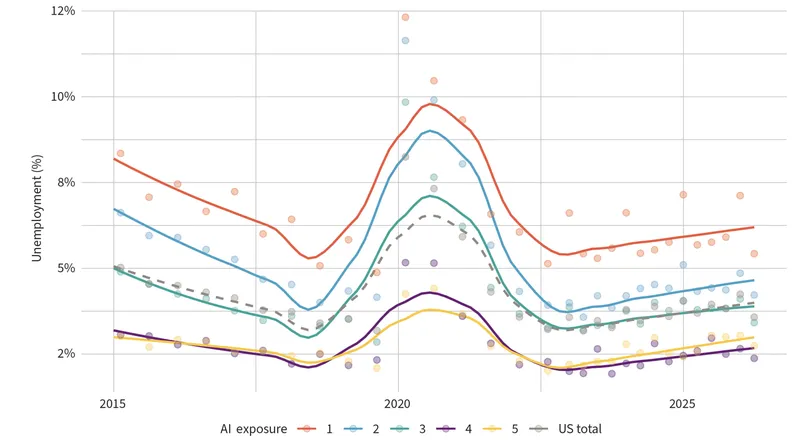
What is happening to jobs? Separating AI hype from reality
Jul 25, 2026
The ladder is missing rungs – Engineering Progression When AI Ate the Middle
Mar 30, 2026
Measuring AI agent autonomy in practice
Feb 19, 2026