Report · privacy.claude.com
Is my data used for model training?
privacy.claude.com
Source published October 27, 2026
Summary: 2 min read
56/100
Summary
Anthropic says it does not use inputs or outputs from its commercial products for model training by default. The policy covers services including Claude for Work, the Anthropic API and Claude Gov, while separate terms apply to consumer offerings such as Claude Free, Pro and Max, including Claude Code use under those plans. Anthropic may use chats and coding sessions for training when users explicitly submit feedback or bug reports through the thumbs-up or thumbs-down controls, or otherwise choose to permit data use. Feedback reports cause Anthropic to store the full related conversation, including content, custom styles, conversation preferences and model settings, in a secured backend for up to five years. Raw content from connectors, including Google Drive and remote or local MCP servers, is excluded unless it is copied directly into a Claude conversation. Before using feedback, Anthropic says it de-links the data from user and customer IDs and does not combine it with a user’s other Claude conversations. The company may use feedback to assess service effectiveness, conduct research, study user behavior and train AI models where applicable law permits. Primary Owners and Owners of Team or Enterprise plans can disable members’ ability to submit thumbs-up or thumbs-down feedback through the Rate chats control in Organization settings under Data and Privacy.
Key Takeaways
- Anthropic says commercial-product inputs and outputs, including those from Claude for Work, the Anthropic API and Claude Gov, are not used for model training by default.
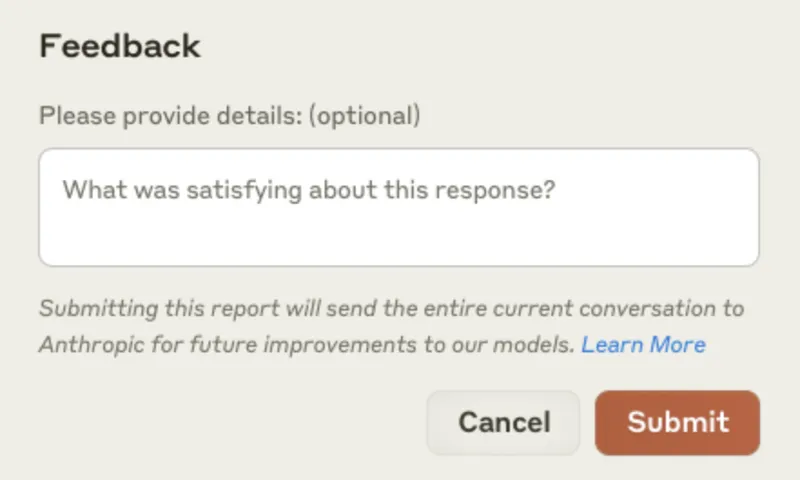
- Submitting thumbs-up or thumbs-down feedback can allow Anthropic to use the associated chat or coding session for research, service analysis and model training.
- Anthropic stores the full conversation associated with feedback for up to five years, but says raw connector content is excluded unless copied into the chat.
- Team and Enterprise Primary Owners or Owners can disable organization members’ feedback submissions through the Rate chats setting.
What the discussion said
The thread focused less on whether feedback can improve Claude and more on whether the consent boundary is clear enough when feedback captures a full coding conversation. Several commenters accepted the basic premise: a model provider cannot meaningfully investigate a rating without some associated context, and the interface reportedly says that submitting a report sends the current conversation for model improvement. Some also treated this as an unsurprising trade-off for consumer AI products, arguing that real usage data is more useful than benchmarks alone. But the room was sharply uneasy about Claude Code’s lightweight, recurring rating prompt. Readers worried that hitting a number merely to dismiss an interruption could be interpreted as consent to upload valuable code and prompts, especially when users signed up expecting stronger data protections. The five-year retention window and possibility of sending an entire thread, rather than only the relevant exchange, made the practice feel far broader than ordinary product feedback. Others stressed that feedback should not quietly become a blanket license to inspect proprietary work; aggregate telemetry, scoped excerpts, or feature experiments could still help diagnose quality. There was also confusion over plan boundaries: consumer Claude Code appears covered by this policy, while API and commercial offerings have different protections. The practical consensus was to disable feedback prompts or avoid them when conversations contain sensitive material, but that is viewed as an inadequate substitute for unmistakable consent.
Where opinion split
The central dispute is whether a feedback click reasonably authorizes Anthropic to retain and use the whole associated conversation for model improvement. Defenders say contextual transcripts are necessary to understand whether a rating reflects a real model failure, and the submission UI discloses the consequence. Critics argue that a nagging one-key rating prompt invites accidental or uninformed consent, while full-thread collection and long retention far exceed what users naturally understand as feedback.
Coverage & discussions
Hacker News · privacy.claude.com
Community discussions
Community Sentiment
Positives
- Feedback tied to conversation context can expose real model failures that sterile benchmarks miss, giving providers material to improve usefulness in actual coding work.
- The policy appears to distinguish consumer Claude Code from API and commercial offerings, giving organizations a route to stronger controls for sensitive AI workloads.
- A configurable option can disable Claude-drafted feedback prompts, letting privacy-conscious users reduce accidental submission risk.
Concerns
- A recurring numeric Claude Code prompt can turn a reflexive dismissal into consent for transcript collection, making an intrusive feedback flow feel like a dark pattern.
- Capturing an entire coding thread for up to five years reaches far beyond a single rating and can expose proprietary designs, niche expertise, or sensitive personal context.
- Users who chose an AI service for stated data protections see broad feedback-based collection as undermining the promise that their chats would not fuel model training.
- Feedback mechanisms could diagnose model quality through aggregate metadata, controlled experiments, or narrowly scoped excerpts instead of treating a full conversation as the default payload.
Related Articles

Anthropic officially bans using subscription auth for third party use
Feb 19, 2026
If I own Claude's outputs why can't I train my own model on them?
Aug 13, 2026
The ways we contain Claude across products
Jun 4, 2026

Anthropic’s IPO filing reveals its strategy for keeping enterprise customers hooked
Oct 26, 2026

Using Claude to reduce the attack surface of code
Oct 21, 2026