It’s so hard to finish an idea that is not yours and is just suggested by AI
ssp.sh
August 26, 2026
8 min read
60/100
Summary
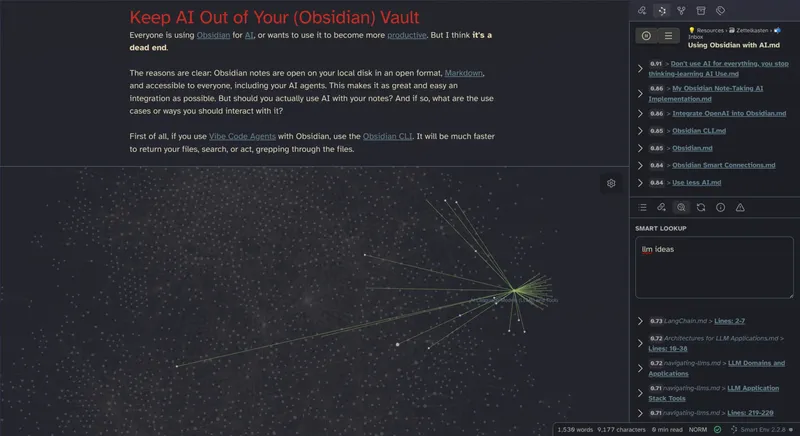
Obsidian’s local, Markdown-based vaults make notes readily accessible to AI agents, but the author argues that AI-generated summaries, tags, links, and organization can weaken a personal knowledge system. Long generated summaries can make it difficult to distinguish a writer’s own ideas from AI text and add noise to later searches. The author sometimes uses Obsidian Web Clipper to create one- or two-sentence summaries, but labels them as AI-generated and removes them after adding personal writing. The author recommends AI primarily for retrieval and research, including finding related notes, vector search, similarity search, clustering, and search across large collections. Obsidian’s CLI can return files, search, and perform actions faster than grepping files when used with coding agents. The author’s single vault contains 25,979 files totaling 3.5 GB and uses the Omnisearch plugin to find material quickly; Obsidian Smart Connections can add vector and similarity search. Sensitive notes create an additional reason to prefer local models over uploads to external services. The author contends that manually writing and linking notes is part of learning and idea formation, while automated connections may produce a knowledge graph that does not reflect the user’s thinking. AI-generated material can instead be isolated in a dedicated PARA-method folder or separate vault, potentially excluded from search. The author also argues that human-curated knowledge remains valuable for both personal learning and future AI training.
Key Takeaways
- Obsidian vaults store notes as local Markdown files, making them accessible to AI tools and agents.
- The author argues that extensive AI-generated summaries and automated note links can obscure personal ideas and reduce the value of a manually curated knowledge graph.
- Obsidian Smart Connections provides vector and similarity search, while the Obsidian CLI can speed file retrieval and search for coding agents.
- The author’s Obsidian vault contains 25,979 files totaling 3.5 GB, and the Omnisearch plugin retrieves material in seconds according to the author.
- The author recommends isolating AI-generated notes in a separate vault or dedicated folder and clearly labeling generated text.
What the discussion said
The thread treats AI-generated ideas less as a creativity problem than an ownership and provenance problem. Several commenters say it is hard to carry an assistant’s proposal through the unglamorous final stages because the initial spark never acquired the personal conviction that makes people revise, defend, and finish their own work. One reader points to research suggesting that believing AI did the creative work drains meaning and effort from the task, while others frame preserving independent ideation as the reason not to use AI for brainstorming at all. The most concrete concern comes from AI-assisted coding: a model can write polished rationale around guesses, then later consume those invented explanations as if they were authoritative project history. Commenters therefore favor sharp boundaries between human notes and agent material, or a maintained canonical specification that can overrule model-generated memory. Still, the room is not uniformly anti-AI. Some find that assistants produce worthwhile angles through synthesis, provided the human judges whether each seed is promising or worthless. Another says AI removes the painful last fifth of execution, making projects more likely to ship. The broader second-brain debate stays secondary: tools can organize thought, but they do not substitute for sustained human thinking or critical filtering.
Where opinion split
The central dispute is whether AI suggestions weaken ownership of a project or unblock its completion. Skeptics argue that borrowed ideas lack the personal commitment needed to develop them and can even pollute the record with confident fiction; supporters argue that human judgment can turn model-generated leads into useful work and that AI is especially valuable for finishing stalled projects.
Community Sentiment
Positives
- AI can surface unexpected angles by synthesizing context, giving a human creator raw material to evaluate rather than a finished answer to obey.
- For some users, assistants eliminate the dreaded final stretch of execution, turning repeatedly stalled work into projects that actually ship.
- Keeping agent-generated material separate while maintaining a canonical specification could make AI assistance useful without letting its invented rationale become project truth.
Concerns
- AI-generated ideas often fail to create the ownership that carries a person through revision and completion, so the work feels disposable before it is finished.
- In codebases, models can confidently invent design intent in comments, then reinforce those hallucinations in later sessions as though they were settled architecture.
- Blending AI notes with human thinking invites a feedback loop where model speculation gains false authority simply because it was saved and retrieved.
- If people believe the model supplied the creative labor, the task can feel less meaningful, reducing the effort they are willing to invest in it.