Kotlin creator's new language: a formal way to talk to LLMs instead of English
codespeak.dev
March 12, 2026
1 min read
🔥🔥🔥🔥🔥
62/100
Summary
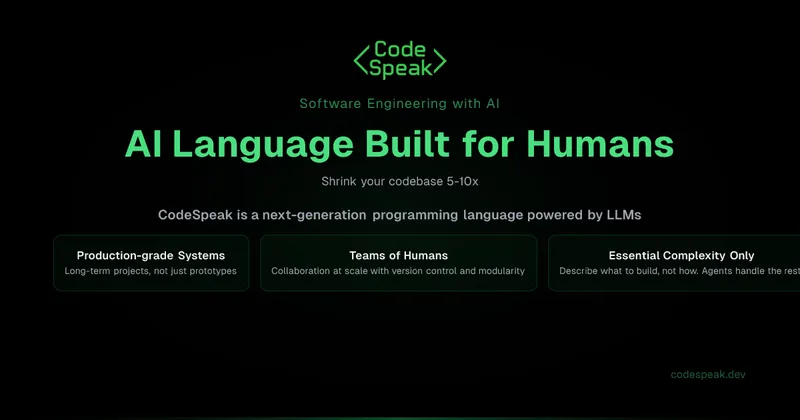
CodeSpeak is a next-generation programming language powered by large language models (LLMs) designed for software engineers. It enables teams to shrink their codebase by 5-10 times and supports the development of production-grade systems through a combination of manually written and generated code.
Key Takeaways
- CodeSpeak is a next-generation programming language powered by large language models (LLMs) that enables software engineers to shrink codebases by 5-10 times.
- CodeSpeak facilitates the maintenance of specifications over code, making it easier for teams to manage long-term projects rather than just prototypes.
- Real-world case studies demonstrate that CodeSpeak can significantly reduce lines of code (LOC) while maintaining functionality, achieving shrink factors of up to 9.9x.
- CodeSpeak supports mixed projects, allowing for a combination of manually written code and code generated from specifications.
Coverage & discussions
Hacker News · codespeak.dev
Community discussions
Community Sentiment
Positives
- The proposed workflow for LLM-based development could streamline the process by saving prompts alongside source code, enhancing traceability and collaboration.
- The idea of using a more precise programming language instead of English could address the verbosity and imprecision often encountered in coding.
Concerns
- The concept appears to be more of a tooling approach rather than a new language, which may limit its effectiveness in improving LLM interactions.
- The non-deterministic nature of models means that re-applying changes could yield inconsistent outputs, undermining the reliability of the proposed method.
- Assuming that a formalized language will simplify interactions with LLMs overlooks the complexities of how these models are structured and function.