Learning athletic humanoid tennis skills from imperfect human motion data

zzk273.github.io
March 15, 2026
1 min read
56/100
Summary
LATENT enables the simulation of highly-dynamic tennis rallies by human athletes, showcasing versatile skills in a competitive environment. Developed by researchers from Tsinghua University, Peking University, and other institutions, it utilizes advanced AI techniques for real-time performance.
Key Takeaways
- LATENT is a system designed to learn tennis skills for humanoid robots using imperfect human motion data, which consists of motion fragments rather than complete sequences.
- The system successfully develops a humanoid policy that allows robots to consistently strike and return tennis balls while maintaining natural motion styles.
- LATENT demonstrates effective sim-to-real transfer, enabling the Unitree G1 humanoid robot to sustain multi-shot rallies with human players.
- The approach significantly reduces the difficulty of data collection by utilizing quasi-realistic data to capture primitive tennis skills.
Coverage & discussions
Hacker News · zzk273.github.io
Community discussions
Community Sentiment
Positives
- The practical use of imitation learning from human demonstrations in humanoids is ramping up, indicating significant advancements in AI training methods.
- There is optimism that general-purpose physical knowledge and capabilities in humanoid robots will be demonstrated within the next year, showcasing rapid progress in AI robotics.
- The potential for robotic AI instructors for children in affluent households highlights the growing applicability of AI in personalized education and training.
Concerns
- The robot's movements are still described as 'robot-like' and hesitant, suggesting that current models have not yet achieved fluidity and naturalness in motion.
- Estimating the robot and ball pose with onboard cameras remains a significant challenge, indicating limitations in current state estimation methods for closed-loop robotics.
Related Articles

US firm's humanoid robot tracks emotions with AI, recalls past conversations
Apr 9, 2026

Bird brains (2023)
Mar 30, 2026

Building a new Flash
Mar 4, 2026
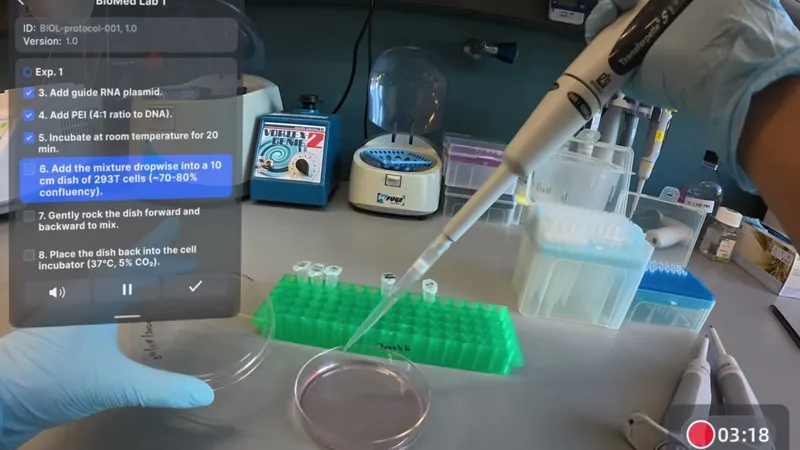
A new wearable AI system watches your hands through smart glasses, guiding experiments and stopping mistakes before they happen
Feb 27, 2026
DeepSeek-v4-flash-vision-exp
Aug 21, 2026