LoGeR – 3D reconstruction from extremely long videos (DeepMind, UC Berkeley)
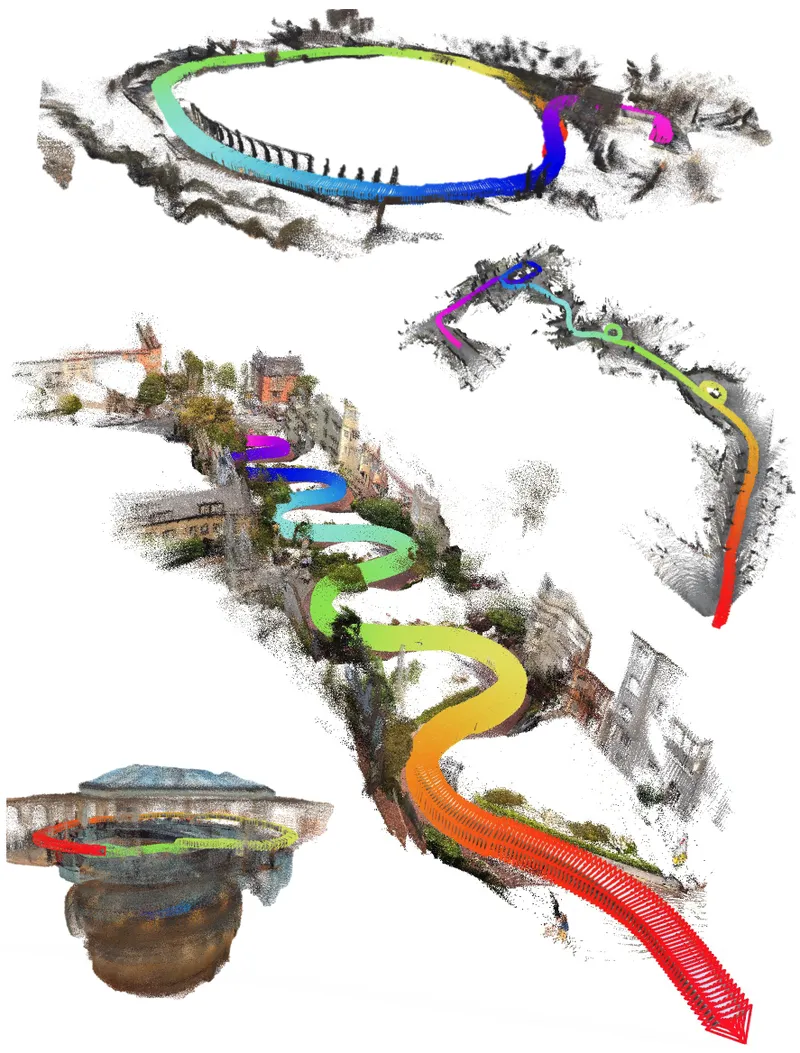
loger-project.github.io
March 10, 2026
4 min read
54/100
Summary
LoGeR enables dense 3D reconstruction of extremely long videos by processing them in chunks with a hybrid memory module, addressing quadratic complexity issues. It utilizes Sliding Window Attention for local alignment and Test-Time Training to maintain global consistency, effectively reducing drift over sequences of up to 19,000 frames.
Key Takeaways
- LoGeR utilizes a hybrid memory module to process long video streams in chunks, overcoming quadratic complexity bottlenecks in 3D reconstruction.
- The model achieves a 30.8% relative improvement over previous feedforward approaches on a 19,000-frame VBR dataset.
- LoGeR maintains strong geometric coherence and reduces scale drift over kilometer-scale trajectories without post-hoc optimization.
- The architecture combines Sliding Window Attention for local alignment and Test-Time Training for long-range consistency, enabling effective long-context reconstruction.
Coverage & discussions
Hacker News · loger-project.github.io
Community discussions
Community Sentiment
Positives
- The potential for 3D reconstruction from long videos could revolutionize applications like street-view mapping, enhancing the accuracy of visual data collection.
- This research represents a significant advancement in video to 3D reconstruction, indicating rapid progress in the field of AI and computer vision.
Concerns
- There are serious concerns about the implications of this technology, particularly regarding its potential use in mass surveillance, which raises ethical questions.
- The accuracy of the model is questionable, as it may replicate lidar systems without providing reliable dimensional data, leading to potential inaccuracies.
Related Articles

FLUX 3 Image Klein
Oct 16, 2026
Krea 3 – Frontier Image Model 4× faster than Nano Banana Pro
Oct 15, 2026
DeepSeek-v4-flash-vision-exp
Aug 21, 2026

Seeing beyond BMI: Estimating cardiometabolic risk with smartphone imagery
Aug 20, 2026

Geolocating a random island using geometry and CUDA programming
Aug 19, 2026