Meta's AI models are powering the first wave of Genesis Mission projects
ai.meta.com
July 21, 2026
5 min read
🔥🔥🔥🔥🔥
50/100
Summary
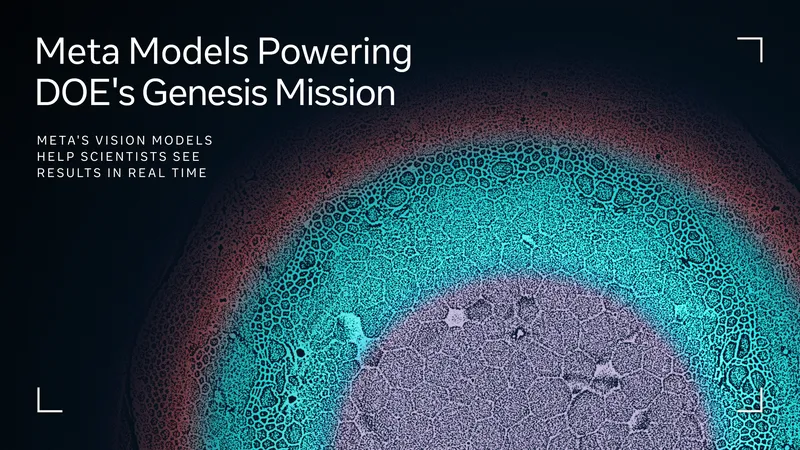
Meta's AI models are being utilized in the Genesis Mission projects at Lawrence Berkeley National Laboratory to enhance research capabilities. The Advanced Light Source (ALS) facility enables researchers to study materials at atomic and molecular scales using intense X-ray beams.
Key Takeaways
- The Advanced Light Source at Lawrence Berkeley National Laboratory produces tens of petabytes of data annually due to upgraded detectors that capture 100,000 images per second.
- The Genesis Mission, launched by the White House in late 2025, aims to accelerate scientific discovery using advanced AI, with the SYNAPS-I project focusing on real-time data analysis in X-ray and neutron science.
- Meta's open-source models, Segment Anything Model 3 (SAM 3) and DINOv3, are being used in the SYNAPS-I project to enhance image segmentation, reducing analysis time from weeks to seconds.
- DINOv3 learns visual patterns from raw images without human labeling, while SAM provides precise boundaries around objects, creating a complementary pipeline for scientific imaging analysis.
Coverage & discussions
Hacker News · ai.meta.com
Community discussions
Community Sentiment
Positives
- Meta's open-source contributions are creating a revolutionary impact in fields like microscopy, enabling biologists to achieve unprecedented levels of analysis with just a laptop.
- The community's recognition of different models' strengths — from Meta's perceptiveness to Claude's superior API ergonomics — highlights a rich diversity in AI capabilities.
Concerns
- The funding for the Genesis Mission, at just $280 million, seems paltry compared to the scale of potential benefits, leading to frustration over public resource allocation.
- There's a clear sentiment that petabytes of data aren't impressive in enterprise contexts, suggesting a disconnect between the hype and practical realities of data handling.