Neural Boids
campedersen.com
March 8, 2026
10 min read
50/100
Summary
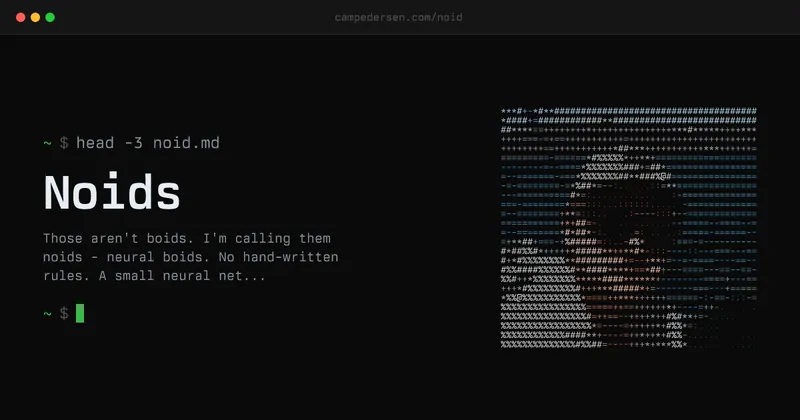
Noids, or neural boids, utilize a small neural network to generate steering forces based on visual input from each agent, comprising 1,922 learned parameters. This system mimics the behavior of real birds in a murmuration, where no leader or predetermined choreography directs the movement of the flock.
Key Takeaways
- Noids, or neural boids, utilize a small neural network with 1,922 learned parameters to determine steering forces based on local perceptions rather than predefined rules.
- Each noid agent tracks approximately 6-7 nearest neighbors, using a topological distance model that allows for consistent interaction regardless of the distance between agents.
- The propagation of reactions within a flock of noids occurs through local interactions, similar to how sound waves travel through air, without any centralized communication.
- The concept of noids eliminates the need for manually defined rules by allowing a neural network to learn the steering behaviors directly from data.
Coverage & discussions
Hacker News · campedersen.com
Community discussions
Community Sentiment
Positives
- The neural-network based approach to modeling the starling phenomenon offers a fresh perspective on emergent behavior, potentially enhancing our understanding of complex systems.
- Visualizations accompanying the concept are impressive, making the intricate dynamics of flocking behavior more accessible and engaging.
Concerns
- The article suffers from LLM-isms that detract from clarity, leading to confusion about the historical context of boid rules and their development.
- The writing style is criticized for being difficult to read, which undermines the communication of important concepts related to the research.
Related Articles
Gemini Robotics 2 brings whole body intelligence to robots
Jul 30, 2026

Unitree As2-W
Jul 24, 2026

DARPA, U.S. Air Force fly AI-controlled F-16
Jul 23, 2026

MIRA: Multiplayer Interactive World Models Trained on Rocket League
Jul 9, 2026

Weave Robotics launches Isaac 1, a $7,999 home robot with Fall 2026 deliveries
Jul 1, 2026