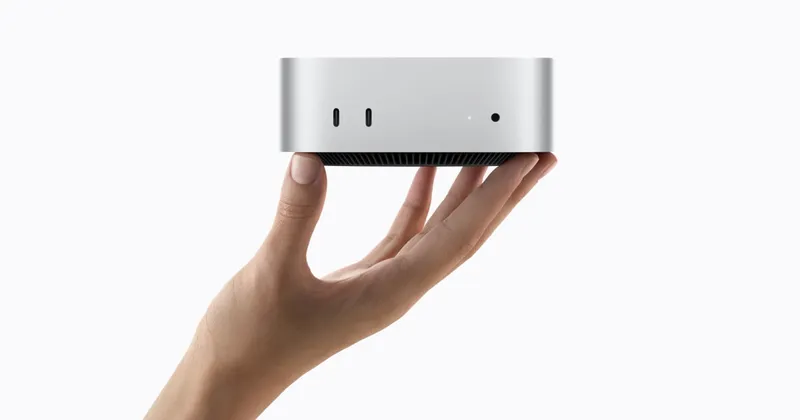
New Mac mini, featuring M6 and M5 Pro
apple.com
August 25, 2026
1 min read
68/100
Summary
Apple has announced a new Mac mini powered by the all-new M6 chip and an M5 Pro option. Apple said the updated supersmall desktop delivers a dramatic performance boost and greater versatility. The announcement positions the M6 and M5 Pro as the central hardware upgrades in the new Mac mini. Apple did not provide performance figures, pricing, availability dates, or further technical specifications in the supplied information.
What the discussion said
The AI-relevant part of the thread quickly moved past Apple’s headline benchmarks and into a practical buying question: which Mac configuration can actually run useful local models. Commenters broadly agreed that unified-memory capacity sets the ceiling for model size, while GPU cores and, especially, memory bandwidth determine how tolerable generation speed will be once a model fits. That made the 64GB M5 Pro Mini attractive despite fewer GPU cores than a 48GB M5 Max Studio: extra memory buys access to larger models, not merely benchmark bragging rights. The mood was far less confident about Apple as a local-inference platform overall. Several readers see the Mini as already excessive for ordinary work and imagine local LLMs as the only compelling future upgrade path, but rising RAM and machine prices are blocking that path. The strongest skeptics argue that Apple’s shared memory remains vastly slower than dedicated Nvidia VRAM, so multi-GPU Nvidia systems deliver far higher token throughput today. Apple’s opaque comparison marketing deepened the distrust: readers want measurements on their actual model stacks, not broad multipliers against old machines. The discussion therefore treats high-memory Macs as compact, convenient options for fitting models, while questioning whether they are competitive tools for fast serious inference.
Where opinion split
The central fight is whether a high-memory Mac Mini is a sensible local-LLM machine. Supporters argue that 64GB unified memory lets a small desktop host models that lower-memory alternatives cannot fit, making capacity the decisive constraint. Critics counter that dedicated Nvidia GPUs, particularly multi-card setups, are so much faster at token generation that Apple hardware is a poor choice unless compactness and memory capacity matter more than inference speed.
Community Sentiment
Positives
- A 64GB unified-memory Mini can accommodate larger local models than a faster-looking 48GB option, making capacity a real capability upgrade rather than a spec-sheet luxury.
- Commenters see memory bandwidth, RAM size, and GPU-core count as a useful three-part framework: fit larger models with memory, then buy bandwidth and cores for responsiveness.
- For owners whose M1-era Macs still handle everyday work effortlessly, local LLMs are viewed as a credible future reason to invest in substantially more capable hardware.
Concerns
- Apple’s broad performance multipliers inspire little confidence because readers need reproducible results on real inference stacks, not selectively framed comparisons with older Macs.
- High RAM and Mac Mini prices are turning local-model experimentation into an expensive hobby, pushing prospective upgraders to keep older machines longer.
- Several commenters argue that unified memory cannot match dedicated Nvidia VRAM for inference throughput, leaving current Macs badly behind multi-GPU systems in tokens per second.
- The promised always-on agent use case drew skepticism because readers doubt current Apple chips deliver compelling local-inference performance for that workload.
Related Articles
MacBook Pro with new M5 Pro and M5 Max
Mar 3, 2026
New Mac Studio with M5 Max and M5 Ultra
Aug 25, 2026

Apple to skip high-end M6 Mac chips in favor of AI-focused M7 line
Jun 25, 2026

I switched from Mac to a Lenovo Chromebook
May 7, 2026

Apple ML Research: Muse Spark Open with MLX on Mac Studio
Oct 16, 2026