Report · niemanlab.org
New York Times adds more AI features to its Cooking app. Users aren't thrilled
niemanlab.org
Source published October 29, 2026
Summary: 2 min read
44/100
Summary
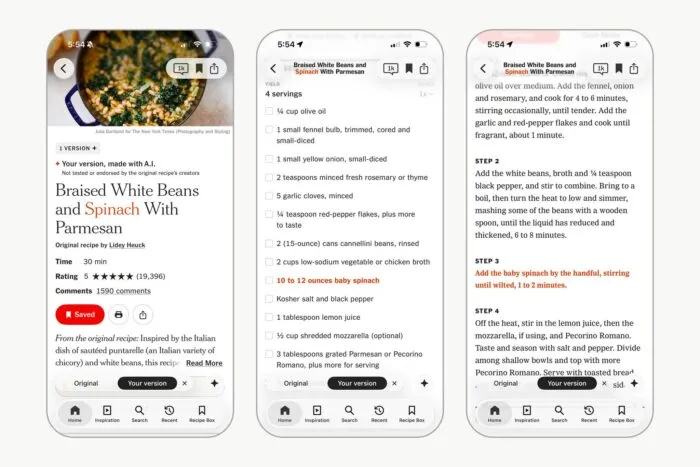
The New York Times has added an AI tool to its Cooking app that lets users request modifications to recipes, including ingredient substitutions. The feature is available to all Cooking subscribers on iOS and is being rolled out gradually while the company evaluates its speed and usage; broader availability is planned. Earlier AI tools in the app converted volume and weight measurements and scaled recipes for different serving sizes. Genevieve Ko, a New York Times Cooking senior editor and columnist, said staff members evaluated many sample responses to align the chatbot’s answers with the publication’s culinary expertise and editorial standards. The tool can account for cooking differences between substitutes, such as adding spinach later than chard because spinach wilts more quickly. Reader response in comments on the Times announcement was largely negative. A Codex sentiment analysis of 159 non-staff comments out of 171 total classified roughly 77% as negative, 14% as positive, and the rest as neutral or mixed. Critics cited concerns about AI’s environmental impact, the value of a human-produced cooking service, answer quality, and the inability to disable the feature. Ko said the feature cannot currently be turned off, but its use is optional. Supportive commenters said it had helped with dietary changes, including gluten-free conversions, and made meal preparation faster.
Key Takeaways
- The New York Times Cooking app now uses AI to modify recipes, with ingredient substitutions as its main new capability.
- The recipe-modification tool is available to all Cooking subscribers on iOS, with a broader rollout planned.
- New York Times Cooking staff evaluated chatbot responses to make them closely match the guidance of its culinary experts, according to Genevieve Ko.
- A Codex analysis classified roughly 77% of 159 non-staff comments on the Times announcement as negative toward the AI features.
- The AI feature cannot currently be disabled, but users must actively use it for it to modify a recipe.
What the discussion said
The thread focused less on whether an app can scale servings and more on what subscribers believe they are buying from NYT Cooking. Supporters see recipe adaptation as a natural, practical use of AI: adjusting ingredient swaps, timing, quantities, equipment, and dietary constraints is exactly the annoying judgment call that arises mid-cook. Several already run that workflow through general models and would rather have it integrated with a vetted recipe, backed by a product team, than manually shuttle context into a chatbot. They also stress that the underlying recipes remain human-created and that vocal commenters are not necessarily representative of the whole customer base. Critics argue that this framing misses the service’s core value: trusted, tested editorial recipes rather than another probabilistic layer offering plausible advice. A bad substitution is not merely awkward prose; it can spoil dinner or, in worse cases, introduce unsafe preparation guidance. More fundamentally, subscribers resent funding AI development they oppose, even if its interface is optional, and treat the lack of a disable switch as a consent and product-choice failure. Experienced AI users also say they prefer using their own chosen model, supplied with their own health, taste, and kitchen context, rather than accepting a generic assistant embedded in every service. The mood is sharply split, though skepticism edges out enthusiasm because trust and subscriber expectations dominate the objections.
Where opinion split
The central fight is whether optional AI recipe modification improves a premium human-curated cooking service or dilutes the very trust people pay for. Supporters call it a useful layer for real-world substitutions and scaling while preserving the editor-tested base recipe; critics say unreliable generated advice and forced financial support for AI undermine a product valued precisely because it is not generic AI cooking content.
Coverage & discussions
Hacker News · niemanlab.org
Community discussions
Community Sentiment
Positives
- AI-guided substitutions can turn an otherwise abandoned dinner into a workable meal by accounting for ingredient behavior, timing, quantities, equipment, and dietary constraints together.
- Keeping the vetted human recipe as the foundation while using AI only for optional modifications looks like a sensible assistant model rather than automated recipe authorship.
- People already paste internet recipes into ChatGPT or Claude for on-the-fly adjustments, so integrating that workflow could save friction and retain recipe-specific context.
- Scaling recipes is not always simple arithmetic; ingredient roles and cooking methods can require non-linear adjustments that a capable system may surface.
Concerns
- Subscribers pay NYT Cooking for tested culinary judgment, and a probabilistic suggestion layer risks collapsing that premium distinction into the same unreliable recipe sludge elsewhere online.
- Generated cooking advice can confidently invent ingredients or mishandle food-safety details, making hallucination materially riskier than a harmless typo in ordinary web copy.
- Optional in the interface does not feel optional to customers who believe their subscription dollars bankroll AI they fundamentally oppose and cannot disable.
- Even frequent AI users prefer their own model and personal context for substitutions, nutrition, and health needs instead of re-establishing trust with each site’s generic assistant.
Related Articles

Everybody's Weirded Out by AI–Except the People Who Foist It on Us
Jul 17, 2026

Almost no skill required to cook a steak
Aug 6, 2026

Now Google says it might use your Gmail and Google Photos data to target ads
Oct 23, 2026

Kagi Changelog (July 2): Heads, tails, and an AI toggle
Jul 3, 2026

Siri AI
Jun 8, 2026