Nobody knows how the whole system works
surfingcomplexity.blog
February 9, 2026
5 min read
🔥🔥🔥🔥🔥
63/100
Summary
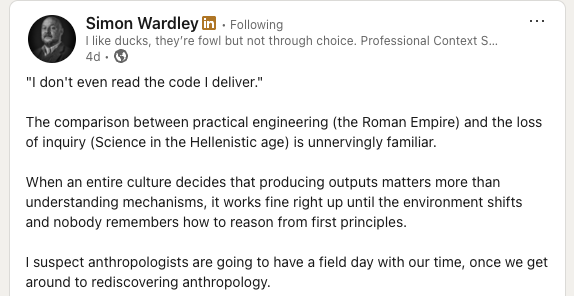
The fall of Twitter has led to a rise in LinkedIn's popularity as a social media platform. Simon Wardley, Adam Jacob, and Bruce Perens have shared insights on building systems without fully understanding their workings, with Louis Bucciarelli contributing to the discussion.
Key Takeaways
- Less than 20% of people understand how their telephone works at a fundamental level, indicating widespread technological illiteracy.
- Many individuals lack knowledge of the complex systems and processes involved in everyday technology, such as internet protocols and telecommunications.
- Technical interviews often assess candidates' limits of knowledge and their willingness to admit when they do not know an answer.
- Understanding technology requires knowledge of various levels, from basic functionality to intricate details of algorithms and hardware.
Coverage & discussions
Hacker News · surfingcomplexity.blog
Community discussions
Community Sentiment
Positives
- AI assistants allow professionals to focus on higher-level reasoning, which mirrors the natural hierarchies found in human organizations, potentially increasing efficiency and productivity.
- The ability to automate tasks with AI means users can solve real-world problems without needing to understand every technical detail, making technology more accessible.
Concerns
- The erosion of understanding about how AI systems work raises concerns about dependency and potential ignorance, which could lead to dangerous outcomes in critical situations.
- As AI coding progresses, there may be a lack of individuals who truly understand the underlying systems, creating risks in accountability and reliability.