Report · occupysaas.com
OccupySaaS
occupysaas.com
Source published November 2, 2026
Summary: 1 min read
68/100
Summary
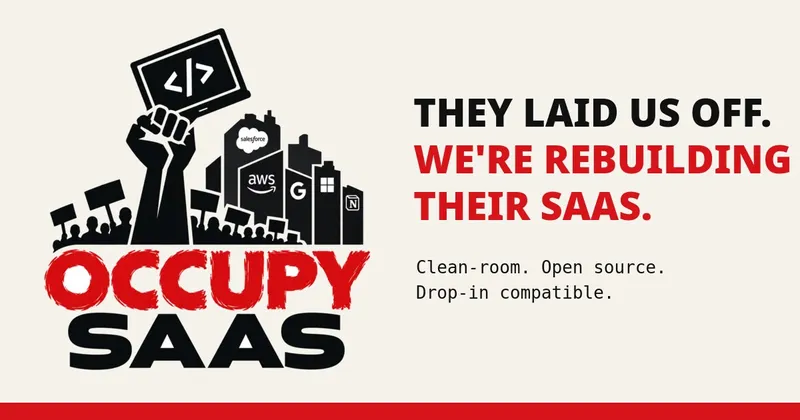
OccupySaaS is an open-source movement building clean-room, self-hostable replacements for subscription software using public documentation, open standards and compatibility testing against vendors’ public SDKs. It says laid-off engineers and AI agents can recreate widely used SaaS APIs without proprietary code, leaked information, decompiled binaries, copied UI assets or trademarks. Projects publish CLEAN_ROOM.md policies and record the provenance of fixtures and references; humans write specifications and review code changes. The first two projects are ZeroAuthy, an identity server intended to work with Auth0 client SDKs without application code changes, and SalesCompel, a Salesforce-compatible CRM under development. ZeroAuthy supports OIDC discovery, JWKS, multi-tenant domains, hosted login, authorization-code flow with PKCE, client credentials, rotating refresh tokens, revocation and logout. It has been tested with auth0-spa-js, auth0-react and nextjs-auth0. SalesCompel has a Go and PostgreSQL backend, a Vue record editor, Account and Contact CRUD, limited queries, external-ID upserts, bearer authentication and an OpenAPI 3.2 REST contract. Both projects are early and not production-ready. They are released under Apache License 2.0, with no required telemetry or seat-based pricing. OccupySaaS says it is independent of Auth0, Okta and Salesforce, and plans to consider further targets including documentation, issue tracking, feature flags, observability and customer support software.
Key Takeaways
- OccupySaaS develops clean-room, open-source SaaS replacements from public API documentation, open standards, public SDK behavior and black-box tests.
- ZeroAuthy is a self-hostable identity server designed for compatibility with the Auth0 Authentication API and selected Auth0 SDKs.
- SalesCompel is an early Salesforce-compatible CRM with tenant isolation, Go/PostgreSQL infrastructure, a Vue editor and REST API compatibility testing.
- Both initial projects are early rather than production-ready and are available under the Apache License 2.0.
- OccupySaaS prohibits proprietary source, leaked material, decompiled binaries, former-employer confidential information and copied UI assets or trademarks in its projects.
What the discussion said
Commenters spent less time on the anti-SaaS manifesto than on its awkward dependence on AI. The central irony landed hard: a project framed as resistance to AI-driven layoffs proposes using coding agents to manufacture replacements for the companies whose workers were displaced. Some saw that as fair retaliation or a pragmatic way to lower the cost of rebuilding entrenched software; others argued it makes the politics incoherent, since the project would bankroll and normalize the same automation blamed for the damage. There was some genuine respect for what AI-assisted development could enable. Participants noted that agents can accelerate broad API and SDK compatibility, and that strong documentation paired with a user-controlled AI assistant could reduce the need for traditional support in smaller businesses. But skepticism dominated around treating generated code as a substitute for the operational competence behind SaaS. Security maintenance, regression testing, backups, performance work, product direction, and accountable human support were repeatedly identified as the hard parts AI code churn does not magically solve. Readers also questioned whether an AI-written manifesto and site convey a serious human-led movement or merely an automated branding exercise. The thread’s practical conclusion was that AI may make copying software cheaper, but it does not establish trust, sustained ownership, or a credible long-term service commitment.
Where opinion split
The sharpest dispute is whether using AI to build open replacements is a coherent response to AI-driven layoffs. Supporters see powerful coding models as a tool that can be turned against incumbent SaaS firms and used to make alternatives affordable; critics argue that funding automation to replace paid software work repeats the same displacement logic and cannot replace accountable human operations.
Coverage & discussions
Hacker News · occupysaas.com
Community discussions
Reported comments: 3 · 1 saved in sample
Too few usable comments or discussion unavailable
Community Sentiment
Positives
- AI coding agents could make near-complete API and SDK compatibility attainable, lowering the switching barrier that has kept customers tied to dominant SaaS vendors.
- Well-maintained documentation plus a locally directed AI assistant could give smaller firms usable self-service support without paying for layers of vendor hand-holding.
- Several readers regard modern LLMs as genuinely transformative tools, capable of making ambitious open software efforts feasible for far smaller teams.
Concerns
- Using AI to answer layoffs caused by AI looks politically self-defeating: the project risks financing the very automation it claims to resist.
- Generated code is the easy slice of SaaS; AI does not by itself supply security patching, tested releases, backups, performance engineering, or someone accountable when production fails.
- An AI-written manifesto and heavily automated presentation weaken the claim that this is a human-centered movement rather than a synthetic marketing exercise.
- AI-assisted cloning may cut development costs, but it does not create the product vision, long-term guarantees, and trusted support enterprises expect before migrating critical systems.