Ontology-Driven Observability: Building an End-to-End Knowledge Graph at Netflix
netflixtechblog.com
October 19, 2026
14 min read
49/100
Summary
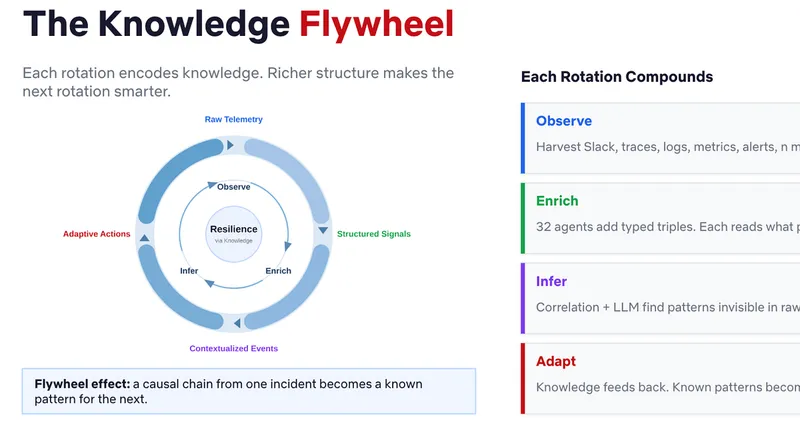
Netflix has built an Observability Ontology, a machine-readable knowledge graph intended to connect operational data that is otherwise split across telemetry, alerting, incident, deployment, on-call and discussion systems. The system targets investigations across infrastructure that processes more than 2 billion daily requests and over 38 million real-time logging events per second; Netflix delivered the November 2024 Jake Paul–Mike Tyson fight to roughly 65 million concurrent streams. Netflix says a home-screen rendering regression can take four hours to diagnose and fix, largely because engineers must reconstruct relationships among disconnected systems. The ontology defines typed entities and relationships for applications, incidents, deployments and other operational domains using RDF, OWL, SHACL and SPARQL. Its knowledge graph is stored in Netflix’s QuipuDB, a distributed RDF quad store built on the Rust-based redb key-value database. Applications are validated against a software catalog with roughly 49,000 entries, and the model uses twelve namespaces for operational domains. Dozens of sequential enrichers convert noisy telemetry and incident Slack discussions into constrained triples. A correlation engine evaluates 13 signal types, scores event chains by timing and severity within a 10-minute window, and discards chains below 0.6 confidence. Netflix’s AutoRCA agent uses graph-backed hypotheses and associated evidence to help engineers investigate incidents, while humans retain responsibility for evaluating diagnoses and implementing fixes.
Key Takeaways
- Netflix’s Observability Ontology links metrics, events, logs, traces, deployments, alerts, incidents and operational discussions in a shared RDF knowledge graph.
- QuipuDB stores the graph, while RDF, OWL, SHACL and SPARQL provide the data model, ontology definition, validation and query layers.
- Netflix’s correlation engine analyzes 13 types of operational signals and retains only event chains with confidence scores of at least 0.6.
- AutoRCA uses the knowledge graph to present ranked, evidence-backed root-cause hypotheses, but Netflix says the hypotheses can be wrong and engineers remain the final decision-makers.
What the discussion said
The thread spent less time celebrating Netflix’s observability stack than arguing over whether formal ontologies and knowledge graphs still deserve a central role in an AI-shaped data environment. Several readers wanted practical ways into the field, sharing standards, books, and modeling tools; one described ontology work as useful precisely because it creates a mental model that can also ground conversations with an LLM. Others saw a plausible business payoff: joining operational telemetry to business systems could finally let teams trace an engineering change to revenue gained or lost. The dominant skepticism was empirical. Long-running enterprise experiments were offered as evidence that knowledge graphs have repeatedly failed to displace relational data, despite heavy consulting spend. Critics faulted the article for not returning to its stated latency problem with measured results, making the architecture feel more like an academic design than an engineering win. The sharper modern challenge is whether AI agents need a global, imposed ontology at all: some argue tool access, retrieval, and accumulated agent memory can assemble the relevant schema on demand. Opponents of that direction warn that letting models infer the vocabulary privileges concepts common in training data and sands away domain-specific nuance. Readers also noted that the term ontology itself is being used loosely, obscuring the distinction between RDF-style triples and broader conceptual modeling.
Where opinion split
The central fight is whether a formal, shared ontology should remain the backbone of observability, or whether AI agents can dynamically connect individual systems through tools and memory. The pro-ontology case is that explicit identity, provenance, and relationships make cross-system questions reliable and auditable; the opposing case is that centralized schemas are costly, brittle, and increasingly unnecessary when agents can retrieve from source systems directly.
Coverage & discussions
Hacker News · netflixtechblog.com
Community discussions
Community Sentiment
Positives
- Ontology tooling can give both humans and LLMs a shared conceptual map, making domain conversations and structured retrieval less ad hoc.
- Linking operational telemetry with business data could expose whether technical changes actually moved revenue or costs, the observability payoff vendors have promised for years.
- Readers pointed newcomers toward established semantic-web standards and practical modeling resources, suggesting the underlying knowledge-representation discipline remains valuable despite the hype cycle.
Concerns
- Years of expensive enterprise knowledge-graph pilots have rarely displaced relational data, leaving commenters demanding concrete success stories rather than another architectural pitch.
- The post reportedly introduces a serious latency issue but supplies no before-and-after evidence, so critics see no proof that the ontology improved the system it was meant to fix.
- Agentic AI may make a pipeline-wide ontology obsolete: tools, direct source access, and persistent memory can assemble context without forcing every system into one schema.
- Letting LLMs infer the ontology risks collapsing specialized language into training-data averages, sacrificing the precise distinctions that formal domain models are supposed to preserve.