Report · minimaxir.com
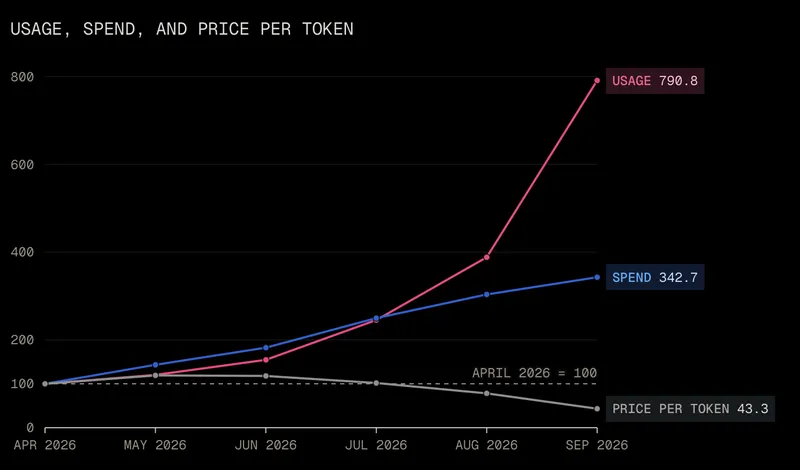
OpenAI and Anthropic cut their LLM prices by up to 80% within a few months. Why?
minimaxir.com
Source published October 25, 2026
Summary: 1 min read
66/100
Summary
OpenAI and Anthropic cut prices for several leading language models between June and September 2026, with reductions reaching 80% for some services. OpenAI lowered GPT-5.6 Luna from $1/$6/$0.10 to $0.20/$1.20/$0.02 per million input, output, and cache-read tokens on July 30, then launched GPT-6 Luna at $0.10/$0.50/$0.01 on September 22. GPT-6.1 Sol, released September 29 after GPT-6 Sol drew weak performance feedback, cost $2/$10/$0.10 and was described as comparable in performance to GPT-6 Astra. Anthropic made Claude Sonnet 5’s $2/$10/$0.20 launch pricing permanent and priced Claude Opus 5.5 at $4/$20/$0.20, saying the model requires less compute to serve than Opus 5. The source attributes the cuts partly to direct competition and pressure from open-weight models and numerous inference hosts. DeepSeek Flash V4.1 was priced by DeepSeek at $0.15/$0.60/$0.003, while OpenRouter listed 29 providers for the model’s updated variant. The source says cache-read charges dominate token spending in coding-agent workloads, estimating that cache reads account for 96% to 99% of expenditure; Anthropic’s 75% cache-read reduction for Fable 5.1 could therefore reduce total usage costs by roughly 70% to 75%. It also cites improved inference efficiency as a possible contributor to lower prices.
Key Takeaways
- OpenAI cut GPT-5.6 Luna’s listed prices by 80% on July 30, 2026, to $0.20 per million input tokens, $1.20 per million output tokens, and $0.02 per million cache-read tokens.
- Anthropic priced Claude Opus 5.5 at $4/$20/$0.20 per million input, output, and cache-read tokens and said it requires less compute to serve than Claude Opus 5.
- The source estimates that cache-read tokens represent 96% to 99% of token expenditure in coding-agent workloads, making cache-read pricing a major determinant of effective cost.
- DeepSeek priced Flash V4.1 at $0.15/$0.60/$0.003 per million input, output, and cache-read tokens, and 29 providers hosted its updated variant through OpenRouter.
- The source characterizes price cuts by OpenAI and Anthropic as competitive responses to each other, open-weight models, and third-party inference providers.
What the discussion said
The thread treats the cuts less as a mysterious act of generosity than as a collision between competition and rapidly improving inference economics. Several commenters point to Chinese and open-weight alternatives, especially options that are cheaper and less prone to refusing cybersecurity-adjacent work, as pressure on OpenAI and Anthropic. Others add that better hardware, separate training and inference chips, KV-cache improvements, smaller deployed models, and higher serving efficiency can create real room to lower prices without necessarily selling every token at a loss. One participant cites throughput-and-revenue estimates from a competing provider as evidence that profitable inference is at least plausible. The larger argument is about whether cheaper tokens signal healthy commoditization or a market headed for a wreck. Optimists expect LLM access to resemble cheap, abundant connectivity: lower prices unlock automated agents, hobby projects, and broader adoption, while providers recover costs through volume and efficient infrastructure. Skeptics say token generation retains an unavoidable energy and hardware cost, so unlimited plans and repeated price cuts cannot work like mobile data. They distinguish belief in useful LLMs from belief that today’s frontier labs have viable economics, warning that price competition may destroy vendors before it benefits users. A secondary concern is that regulation could be used to exclude Chinese or open models rather than improve AI safety.
Where opinion split
The sharp dispute is whether the price collapse reflects sustainable efficiency gains or a financially desperate race to the bottom. The bullish side argues that optimized inference, improving chips, and enough utilization can make low prices profitable; the bearish side argues that costly compute scales with usage, while frontier labs still face enormous capital bills and increasingly capable low-cost rivals.
Coverage & discussions
Hacker News · minimaxir.com
Community discussions
Community Sentiment
Positives
- Cheaper Chinese and open-weight alternatives are forcing frontier vendors to lower barriers, giving developers practical choices when closed models reject legitimate security-related work.
- KV-cache improvements, smaller serving models, and faster inference hardware suggest token prices can fall because the underlying cost curve is genuinely improving.
- If efficient providers can keep accelerators saturated, cheap inference could expand agentic automation and experiments that were previously too expensive for small teams.
- The emerging commodity market may break the assumption that only a few well-funded labs can offer capable language models at usable scale.
Concerns
- Price cuts do not erase the enormous training and infrastructure bill, and commenters doubt that frontier labs have yet demonstrated a durable profit model.
- Inference consumes real energy and compute on every request, making unlimited-token subscriptions far less credible than unlimited mobile-data plans.
- A no-moat price war against Chinese and open models could bankrupt early leaders before investors see returns, even if LLMs remain broadly useful.
- Some fear incumbent-backed regulation will be used to fence out open or Chinese models, trading competition and access for a protected AI oligopoly.
Related Articles
GLM 5.2 and the coming AI margin collapse
Jul 6, 2026
You are going to get priced out of the best AI coding tools (2025)
Mar 3, 2026

I think Anthropic and OpenAI have found product-market fit
May 27, 2026

The mysterious Hy3 LLM is topping OpenRouter Model Rankings by a large margin
May 29, 2026

Outsourcing plus local AI will soon become more economical vs. frontier labs
May 26, 2026