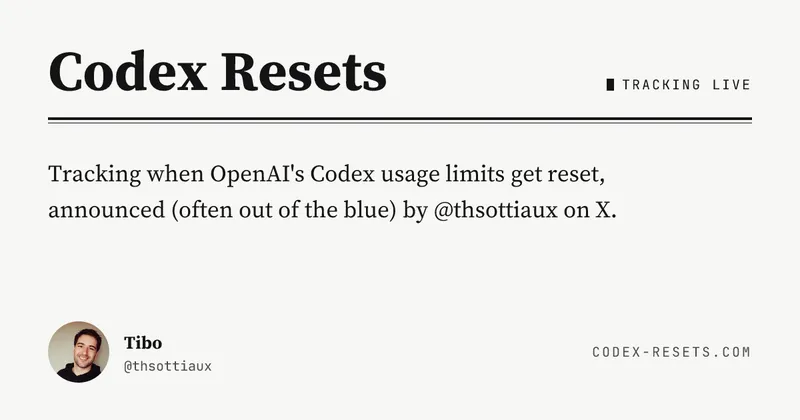
OpenAI restores 5-hour Codex and Work limits for ChatGPT Plus users

9to5mac.com
August 25, 2026
2 min read
52/100
Summary
OpenAI will restore a five-hour usage limit for ChatGPT Plus subscribers using Codex and ChatGPT Work on August 25. The limit returns after several weeks in which Plus users faced only a weekly usage cap across the two now-unified platforms. Users who reach either the five-hour or weekly limit can wait for the relevant usage cycle to reset or buy additional credits. OpenAI may also issue free limit resets, and users can bank resets through some promotions and referral offers. The company reset weekly usage early several times during the temporary change, including after the platforms added another million active users. Thibault Sottiaux, OpenAI’s engineering lead for Codex and ChatGPT, said the five-hour cap helps smooth demand on the company’s compute capacity while preserving relatively generous weekly allowances. He also said Plus subscribers, whom he characterized as relatively casual and new users, can accidentally consume an entire week’s allowance and find the resulting restriction confusing. The five-hour limit will remain disabled for the coming months on the $100 and $200 Pro subscriptions. Sottiaux did not announce changes to Enterprise or Edu accounts, which use a separate credit-based usage system.
Key Takeaways
- OpenAI will reinstate a five-hour Codex and ChatGPT Work usage limit for ChatGPT Plus subscribers on August 25, alongside the existing weekly cap.
- Plus users who exhaust a five-hour or weekly allowance can wait for a reset or purchase additional credits; some free and promotional resets are also available.
- OpenAI says the five-hour limit smooths compute demand and helps prevent Plus users from accidentally exhausting their weekly allowance.
- The five-hour limit will remain disabled for the coming months for OpenAI’s $100 and $200 Pro plans.
What the discussion said
Commenters treated the restored five-hour Codex and Work cap less as a routine capacity-control measure than as another sign that AI subscriptions are becoming metered, game-like utilities. The sharpest irritation is not the total weekly allowance but forced interruption: people can accept spending an entire week’s budget in one concentrated session, especially on weekends or during study, but cannot accept an unfinished coding task being frozen until a timer expires. Several noted that long agent jobs compound the damage because context or cache expiry makes resuming costly in both time and credits. A few readers grant that rate limits may protect shared compute and prevent inexperienced users from accidentally burning through their allowance. Some even like hard stopping points as a work-life boundary. But that sympathy is overwhelmed by suspicion that reset schedules, milestone giveaways, and recurring timers borrow too heavily from engagement mechanics rather than serving users. Price-sensitive users, including those in poorer markets, see the cap as especially punishing because higher tiers are out of reach. Others argue the lock-in threat is limited: cheaper hosted models, coding harnesses, and increasingly usable local models provide escape routes. The broader debate asks whether token metering is a temporary artifact of extreme inference costs or an enduring telecom-style business model that frontier labs will defend.
Where opinion split
The core dispute is whether a mandatory five-hour cap is sensible compute management or a deliberately disruptive upgrade funnel. Its defenders say shared frontier-model capacity is expensive, limits avert accidental overuse, and pauses can encourage healthier work habits; critics say users should choose when to consume a weekly allocation, because stopping active coding work wastes context and turns a paid tool into a timed game.
Community Sentiment
Positives
- Shared five-hour windows can smooth demand for scarce inference capacity, preserving a larger weekly allowance instead of making every Plus user pay for worst-case peak load.
- For some heavy AI users, enforced pauses act as a surprisingly useful brake on compulsive late-night prompting and make work-life boundaries easier to hold.
- Cheap hosted alternatives and workable local coding agents weaken the claim that OpenAI can indefinitely trap developers behind tighter subscription gates.
Concerns
- A timer that cuts off an active Codex task is worse than a simple weekly budget: lost context and expired caches make the restart consume even more scarce model usage.
- Reset countdowns, celebratory quota gifts, and recurring caps make AI access feel engineered like a casino or daily-quest system rather than sold as dependable productivity infrastructure.
- Users who can only afford the entry plan, particularly in lower-income countries, see the cap as an arbitrary productivity penalty rather than protection from accidental use.
- The limits make team and corporate plans less compelling against coding competitors offering one predictable monthly allowance and more generous sustained usage.