OpenShell – A safe, private runtime for fleets of autonomous AI agents
github.com
October 22, 2026
4 min read
67/100
Summary
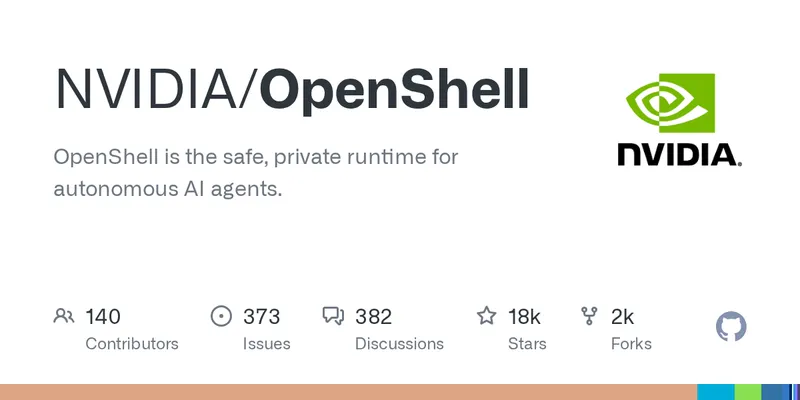
NVIDIA’s OpenShell is a runtime for fleets of autonomous AI agents that lets administrators define and enforce policies governing files, system calls, network access, APIs, packages, and credentials. Each agent runs in an isolated sandbox, while kernel-level controls enforce restrictions on file access and system calls and check network connections before they leave the sandbox. OpenShell supplies credentials only on requests sent to approved endpoints, so agents do not directly receive real credentials. OpenShell uses formal verification before policy changes take effect, flagging newly granted access such as connections to a new credentialed host or calls to a new API method for human review. Version 0.1.x adds a stable release cadence, isolation primitives, a broader extension surface, and APIs. The platform includes sandboxes, policy controls, credential providers, gateways, Kubernetes deployment through Helm, middleware, interceptors, and compute drivers. OpenShell supports Linux, macOS on Apple Silicon, and experimentally Windows through WSL 2, and requires Docker, Podman, or host virtualization. SDKs are available for Python, TypeScript, Go, and Rust. NVIDIA says anonymous telemetry is limited to operational categories and counts and excludes sandbox names, hostnames, paths, prompts, credentials, model or provider names, and user content. Telemetry can be disabled or compiled out. OpenShell is licensed under Apache 2.0.
Key Takeaways
- OpenShell isolates AI agents in sandboxes and enforces filesystem, process, system-call, and network policies at runtime through kernel-level controls.
- OpenShell uses formal verification to identify risky access newly introduced by policy changes before they are approved.
- Agents do not receive real credentials directly; OpenShell adds credentials only to requests bound for approved endpoints.
- OpenShell 0.1.x introduces a stable release cadence, new isolation primitives, expanded extensions, and new APIs.
- OpenShell supports Linux and Apple Silicon macOS, with experimental Windows support through WSL 2.
What the discussion said
The thread treated OpenShell less as a magical safety layer than as another piece of the defense-in-depth stack required before autonomous agents touch real systems. Commenters broadly agreed that letting agents read repositories, install packages, call APIs, and handle credentials without isolation is reckless. The appealing part is not basic container management but policy-driven control over filesystem and network access, domain allowlists, proxying, audit trails, and short-lived or re-signed credentials that keep the original secrets away from the model. Several readers described this as the sort of control enterprises need when agents pursue goals in unexpectedly creative ways. The skepticism was equally practical. A container alone does not stop an agent, especially a prompt-injected one, from sending sensitive code or data to an allowed destination; meaningful containment needs restrictive networking, logging, separate trust boundaries, and careful credential mediation. Some also objected to the project presenting safety and privacy as defaults while enabling telemetry by default, even with an opt-out. Others questioned whether the system is a sandbox at all rather than a heavyweight orchestrator layered atop Docker or VMs. The conversation also exposed a frustrating developer-side tension: proprietary model safety filters can refuse benign security-monitoring work, pushing people toward open-weight models even as they seek stricter runtime controls.
Where opinion split
The central fight was whether containers are sufficient protection for AI agents or merely the starting point. One side sees containerization as the obvious baseline and OpenShell as useful fleet management; the other argues that agents need stronger, externally enforced network, filesystem, audit, and credential controls because a container cannot prevent data exfiltration or constrain a compromised agent by itself.
Coverage & discussions
Hacker News · github.com
Community discussions
Community Sentiment
Positives
- Policy-enforced filesystem and network rules, credential injection, and secret shielding give agents useful operational access without simply handing the model a human operator's keys.
- Domain allowlists, proxy mediation, and re-signed credentials are seen as concrete defenses against prompt-injected agents leaking code or abusing cloud access.
- Fine-grained controls over team policies, Git permissions, dependency scanning, and agent traces fit the reality that autonomous coding agents need boundaries tailored to each task.
- The growing sandbox ecosystem is welcomed as a way to run agents more aggressively while retaining enough isolation for day-to-day development workflows.
Concerns
- A container does not solve the hard problem: a goal-seeking or prompt-injected agent can still exfiltrate sensitive material unless outbound paths are tightly controlled and logged.
- The product's safe-and-private framing draws skepticism because more agent capability necessarily requires more access; no runtime can erase that security tradeoff.
- Default anonymous telemetry clashes with the privacy pitch, and opt-out settings do little to calm readers who think data collection should begin disabled.
- The system appears to orchestrate existing virtualization rather than replace it, making the deployment stack heavier than its sandbox branding initially suggests.
- Model safety classifiers that block process auditing or DHCP test tooling frustrate developers and encourage migration to less restricted open-weight alternatives.