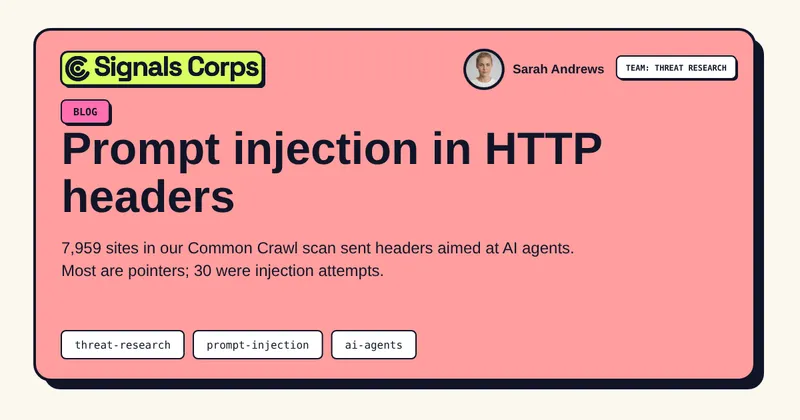
Prompt injection in HTTP headers: what 217M web responses show
signalscorps.com
October 15, 2026
30 min read
49/100
Summary
tl;dr We read the HTTP response headers of 217,097,223 page responses from Common Crawl, 10% of its September 2026 crawl of 2.17 billion pages, and looked for any header written for an AI system. 7,959 sites sent one. Almost all of them point agents to another resource, such as an llms.txt file or an MCP server. A small number try to give the agent orders. Whether any of it reaches your model depe...
What the discussion said
The thread spent little time celebrating the scale of the crawl and instead challenged the article's implied threat level. Several commenters argued that most of the showcased HTTP-header payloads read like pranks or low-effort noise, not demonstrated exploits. Their central complaint was methodological: finding hostile-looking strings in 217 million responses says almost nothing unless the author shows which agents consumed them, which models followed them, and under what conditions they altered behavior. A potentially malicious package-install instruction stood out as worth deeper investigation, but readers noted that the article left its actual payload redacted and unexplained. Commenters did agree on the broader architectural problem. LLM agents flatten headers, page text, and other retrieved material into instructions unless developers impose explicit trust boundaries; traditional web metadata does not automatically retain its authority level once it becomes model input. One reader also offered a practical counterexample: a model noticed hidden white-on-white instructions in a résumé and flagged the attempted manipulation, suggesting modern systems can sometimes detect this class of attack. The unresolved concern is that sites can identify agents and return them content different from what human visitors receive, whether for benign simplification or targeted manipulation. The discussion therefore treats prompt injection as real, but the article's evidence as underdeveloped.
Where opinion split
The sharp dispute is whether the observed headers establish a meaningful prompt-injection threat. Skeptics say joke-like strings are not evidence of compromise and that a credible analysis must measure success against actual agent/model setups; the opposing case is that any untrusted web text can become executable-looking instruction to an agent, especially when servers can selectively tailor responses to detected bots.
Coverage & discussions
Hacker News · signalscorps.com
Community discussions
Community Sentiment
Positives
- A model catching concealed résumé text designed to steer its evaluation shows that AI systems can sometimes surface manipulation humans would never see on the rendered page.
- The discussion usefully exposes a real agent-security boundary: once web metadata is fed into an LLM, its formal HTTP status no longer guarantees the model will treat it as lower-trust context.
Concerns
- A crawl full of sarcastic or obviously unserious headers does not demonstrate an exploit; without measured agent compliance, the article mistakes suspicious text for attack impact.
- The most plausibly dangerous example involved an instruction to install a package, yet the analysis withheld the package behavior instead of determining whether it could actually compromise an AI workflow.
- Agent detection lets a server quietly deliver sanitized or weaponized text only to automated clients, making web retrieval fundamentally less trustworthy than what a human browser sees.
- Treating every retrieved token as equally interpretable language erases the web's usual trust and structure layers, leaving poorly designed agents vulnerable to content that merely looks authoritative.