Rust off Rails: The opinionated web stack for the AI era
rustoffrails.org
October 21, 2026
1 min read
46/100
Summary
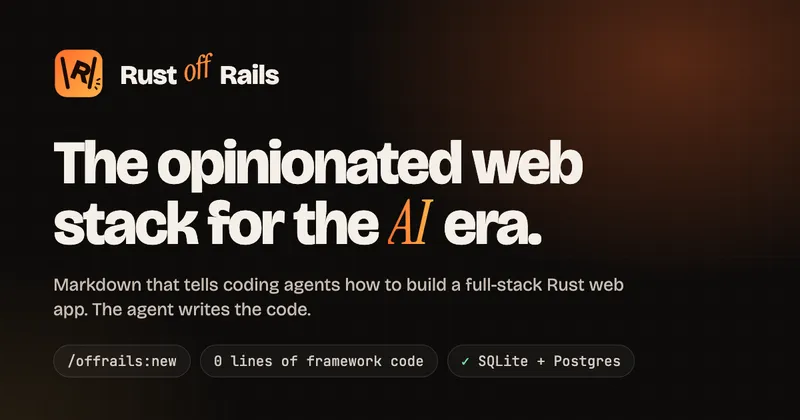
Rust off Rails is an opinionated web stack that directs AI agents to write all application code, including Rust, SQL, HTML, CSS, TypeScript and Dockerfiles. Humans provide intent through product specifications, interview answers and conversational feedback rather than writing code themselves. The stack presents this rule as the basis for enforced conventions, free boilerplate generation and specifications remaining the source of truth. Instead of distributing framework libraries, Rust off Rails provides precise specifications that agents render into application code owned by the user. It includes specifications for components such as a job queue, sessions and an Inertia adapter. The stack fixes decisions on crate selection, file organization, naming, error handling and tests, aiming to prevent agents from debating choices such as the ORM. Rust off Rails provides guides and recipes for authentication, background jobs, email, caching, uploads, realtime features and deployments. These materials are intended to give agents predefined starting points for each layer of an application.
What the discussion said
The thread treated the project less as a Rust web stack and more as a test case for whether prompt-driven software deserves the trust normally earned by code, maintainers, and real deployments. Commenters were struck by the premise: the product distributes Markdown instructions, while a coding agent is expected to turn those instructions into a conventional full-stack application. For critics, that reverses the useful part of a framework. A framework encodes and enforces decisions; prose consumes tokens and leaves correctness, consistency, and interpretation to a probabilistic agent. The dominant reaction was exhaustion with AI-branded projects that appear to substitute polished Claude-styled presentation for demonstrated engineering. Several readers argued that an AI-generated site and codebase reveal little about the author’s judgment, iteration, security work, or willingness to maintain the result. That uncertainty makes a stranger’s generated scaffold less appealing than generating a tailored one yourself. Others pushed back that implementation typing is not the only form of thinking: a strong stack specification can capture architecture and conventions, and agent-assisted work may be valuable when the human still owns the design. A smaller group also clarified that this is not a competing Rust framework like Loco, but an instruction layer for agents. Even so, the discussion found little evidence that the layer provides guarantees beyond a generic prompt.
Where opinion split
The sharp dispute is whether Markdown guidance for coding agents is a meaningful replacement for a web framework. Supporters see a reusable stack specification as a way to package architectural judgment while agents handle implementation; critics say real frameworks make conventions executable, whereas agent prompts spend tokens for variable output and no enforceable guarantees.
Coverage & discussions
Hacker News · rustoffrails.org
Community discussions
Community Sentiment
Positives
- A compact, opinionated stack brief could preserve architectural decisions and let coding agents handle repetitive implementation instead of forcing every team to rediscover conventions.
- Several readers see genuine value in treating the hard work as system design and problem-solving, with AI coding assistance serving that plan rather than replacing thought.
- The project’s agent-first approach is at least distinct from a conventional framework: it aims to give an LLM a coherent full-stack playbook rather than another runtime library.
Concerns
- Markdown as distributed software looks like a fragile substitute for executable framework conventions: the agent can reinterpret the prose, but nothing mechanically enforces the result.
- A generated project from an unknown author inspires little confidence because users cannot see the care invested in prompts, review, testing, security, or long-term maintenance.
- The familiar visual fingerprints of Claude-generated pages became evidence of disposable AI output, making polish feel detached from depth and durability.
- Critics reject the implied leap from models that can write routine code to models that can reliably make the architectural judgments needed for stable applications.
- The premise encourages a culture of registering an AI-generated idea before proving it in a real, adopted product, which commenters see as slop rather than useful tooling.