The Annotated JEPA

elonlit.com
July 10, 2026
38 min read
🔥🔥🔥🔥🔥
47/100
Summary
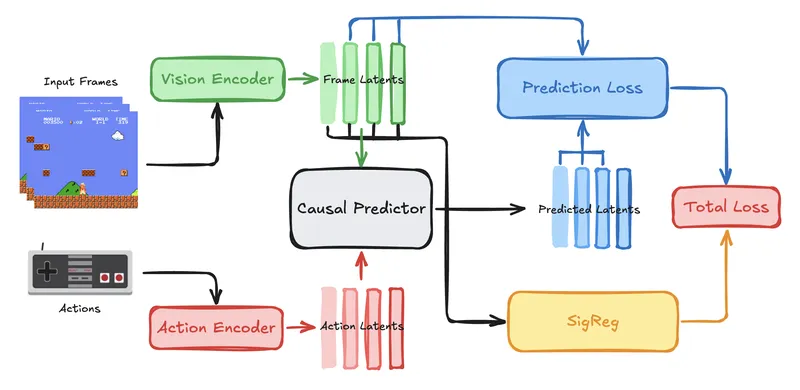
The Annotated JEPA provides a comprehensive guide to Joint Embedding Predictive Architectures, detailing each component and culminating in a functional training loop. JEPA, proposed by Yann LeCun, aims to enable models to learn about the world in a self-supervised manner without relying on labeled data.
Key Takeaways
- Joint Embedding Predictive Architectures (JEPA) is designed to train models for self-supervised learning by predicting representations in latent space rather than pixel-level reconstruction.
- I-JEPA, the image version of JEPA, learns semantic image representations by predicting masked regions from visible context without relying on hand-crafted data augmentations.
- The training process minimizes the distance between predicted and actual representations, requiring the context encoding to capture essential features for accurate predictions.
- JEPA addresses the challenge of learning useful features without labels by focusing on meaningful structure through representation prediction.
Coverage & discussions
Hacker News · elonlit.com
Community discussions
Community Sentiment
Positives
- LeCun's latest approach to JEPA streamlines the architecture, simplifying the model and potentially making it more accessible for future research and applications.
Concerns
- One commenter dismisses the discussion as '100% AI-generated,' suggesting a disconnect from genuine innovation or excitement around the topic.