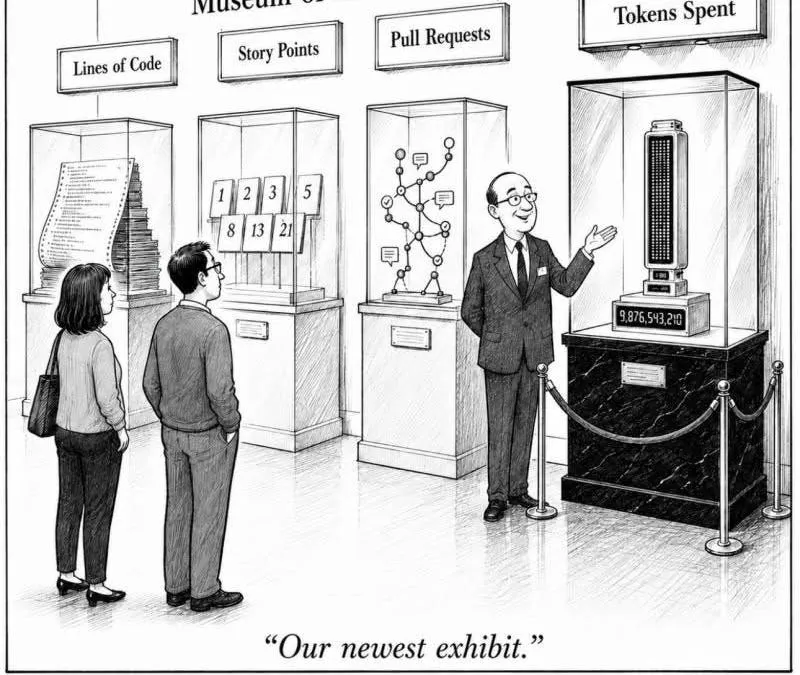
The End of Rationing

sanketsaurav.com
October 19, 2026
7 min read
44/100
Summary
Coding agents such as Claude Code have, in the author’s view, changed software economics by making feature development far cheaper while putting costly AI-model inference on the critical path of products. Claude Code launched as a research preview in February 2025 and became generally available in May 2025. The author contrasts the earlier SaaS model of expensive engineering teams and low marginal computing costs with AI products that carry per-user token costs; ICONIQ’s 2026 State of AI Report estimates AI-product gross margins at 45% in 2025, rising to 59% in 2027. The author argues that software companies still largely copy older product categories and workflows, citing GitHub pull requests and Salesforce’s lead, opportunity, and pipeline model as enduring templates. Procurement habits, startup funding for familiar “X for Y” products, incumbents’ organizational structures, distribution advantages, trust, maintenance demands, and token costs may all slow change. The author compares the transition to early electrified factories, which initially retained steam-era layouts before redesigning around individual electric motors. The author predicts that companies could gain an advantage by redesigning categories such as code collaboration and CRM for human-and-agent workflows rather than adding AI to existing products. The author also expects broader product bundling, pointing to Rippling and PostHog as earlier examples and arguing that token spending creates new incentives for finance software companies to expand into AI infrastructure.
Key Takeaways
- Claude Code became generally available in May 2025 after launching as a research preview in February 2025, and the author uses it as shorthand for coding agents generally.
- AI-enabled software can have significant marginal costs because each user may consume paid model tokens, unlike traditional SaaS products with comparatively low marginal compute costs.
- ICONIQ’s 2026 State of AI Report estimates AI-product gross margins at 45% in 2025, with projections of 53% in 2026 and 59% in 2027.
- The author argues that many AI companies are reproducing established software categories instead of redesigning products for workflows in which agents generate and humans read less code.
- Distribution, user trust, software maintenance, and per-user token costs remain constraints even if code generation becomes cheaper.
What the discussion said
Commenters mostly rejected the article’s simple story that abundant AI coding capacity will automatically produce dramatically better software. Several argued that code generation is already a real accelerator, especially for routine implementation, reverse engineering, emulation, and small personal tools. Cheaper inference could make capable assistants economically viable everywhere, lowering the threshold for bespoke software rather than forcing everyone into a few incumbent products. But the thread’s dominant caution was that implementation was never the whole constraint. Product judgment, requirements, testing, organizational coordination, and persuading actual users remain stubbornly human bottlenecks. Readers also worried that making software effortless to generate changes what gets built: more disposable, monetization-led products and more low-value content, not necessarily more thoughtful tools. Existing incentive structures matter more than token scarcity; ad-driven businesses can profit from attention extraction even when AI makes development nearly free. One workplace example sharpened the concern: AI-assisted scanning exposed a huge backlog of old-code vulnerabilities, turning apparent productivity gains into months of unglamorous remediation. The discussion therefore saw real technical leverage, but little evidence yet that it translates into faster delivery of complex, user-valued systems or a healthier software ecosystem.
Where opinion split
The sharp dispute is whether plentiful AI coding capacity meaningfully removes software’s limiting constraint. Optimists say LLMs expand what one person can hold in mind and build, enabling personalized and previously uneconomic tools; skeptics say judgment, verification, coordination, incentives, and user adoption still dominate, so faster code mostly creates more output rather than better outcomes.
Coverage & discussions
Hacker News · sanketsaurav.com
Community discussions
Community Sentiment
Positives
- LLMs are already pushing practical frontiers in reverse engineering and emulation, where rapid code exploration can unlock work that once moved at a crawl.
- Near-zero-cost access to today’s strong models could matter more than fantasies of vastly smarter AI, putting capable assistance within reach of ordinary products and individuals.
- Cheaper AI-assisted development makes bespoke tools viable for narrow needs, loosening the grip of one-size-fits-all incumbents on users with unusual workflows.
- AI can surface neglected security debt across old codebases, forcing organizations to confront vulnerable dependencies and unsafe patterns that had remained invisible.
Concerns
- Faster generation does not erase the hard work of deciding what to build, understanding a system, testing it, and earning user trust; complex projects can remain just as slow.
- AI may flood the market with shallow, disposable products optimized for quick monetization, repeating the way search incentives helped reward low-value content farms.
- Attention- and data-harvesting business models can turn abundant AI capacity into more effective exploitation rather than better user software, because improved experience may reduce revenue.
- Automated security findings can bury teams under years of maintenance backlog, consuming months of effort without producing any immediately visible improvement for users.