Report · entire.com
The Git Forge for Agent-Human Collaboration
entire.com
Source published October 26, 2026
Summary: 2 min read
44/100
Summary
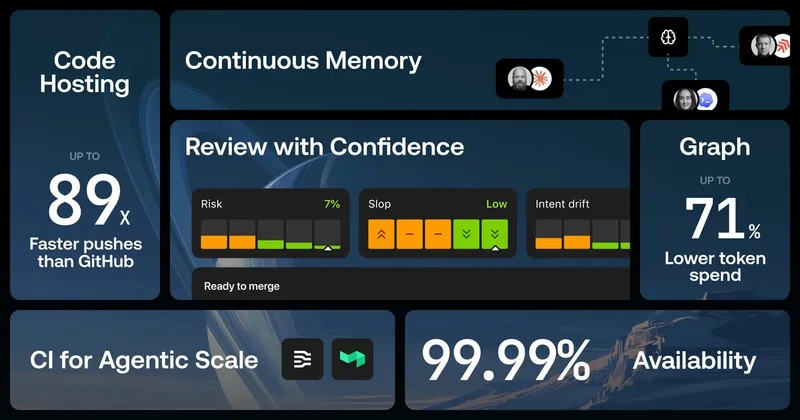
Entire has launched a Git-compatible code-hosting platform designed for teams working with coding agents. Its Trail workflow replaces conventional pull-request timelines with agent-generated evaluation scores, findings and merge gates displayed for every code push. Trails can span multiple repositories, run configurable agents for code quality, security and “slop,” and require specified agent findings, human approvals and CI checks before merges. Entire says its review agents use Claude Code and Codex models in isolated Daytona and E2B cloud sandboxes. The platform natively hosts repositories or mirrors GitHub repositories, supports replication across regions for data residency, and is available in the US, EU, Australia and India. Entire says its distributed object store and transactional ref database enable pushes up to 89 times faster than GitHub and six times faster than Cursor Origin, based on its open-source benchmarks. Buildkite and Depot integrations provide CI checks; failed builds can block merging. Entire also introduced Continuous Memory through open-source, local-first CLI plugins. entire-graph locally analyzes repositories with tree-sitter to map code definitions, callers, types, routes and change impact; Entire says testing showed token savings of up to 71%. entire-brain indexes that code map alongside agent sessions recorded in Git history, allowing agents and reviewers to retrieve prior technical context and decisions.
Key Takeaways
- Entire’s Trails run agent evaluations and surface scores, findings and merge requirements on every code push, rather than relying solely on pull-request timelines.
- Entire can natively host Git repositories or mirror GitHub repositories, with regional replication available in the US, EU, Australia and India.
- Entire claims its Git-compatible source-control server delivers pushes up to 89 times faster than GitHub and six times faster than Cursor Origin in its open-source benchmarks.
- Buildkite and Depot integrations run CI checks for Trails, and failed builds can be configured to block merges.
- The open-source entire-graph and entire-brain CLI plugins map repository code and index prior agent sessions to provide persistent context for coding agents.
What the discussion said
The thread focused far less on a new Git forge than on its underlying wager: when coding agents generate most changes, should teams review the agent’s trail of reasoning rather than a pull request diff? Several commenters grant that agent-produced diffs are cheap while their rationale evaporates quickly; preserving sessions with commits could be genuinely useful weeks later during debugging, incident response, or archaeology. The proposed graph, automated evaluations, and continuous knowledge synthesis also struck some readers as a plausible direction for AI-assisted review. But confidence is low that this warrants replacing ordinary review. Skeptics argue that a PR is already the compressed, inspectable result of work, and replaying a long agent session resembles asking reviewers to watch hours of a developer’s screen recording. That creates more noise, not better judgment, especially for teams unwilling to trust AI-generated code without reading it closely. Proprietary-context exposure is another hard blocker: organizations need a compelling reason to hand over agent prompts, transcripts, and internal reasoning when they can store them themselves. Readers also pushed back on the startup’s sweeping claim that humans will soon write little code, seeing it as marketing rather than a settled technical future. The product has enthusiastic early users, but the conversation remains cautiously skeptical about the workflow shift and its trust model.
Where opinion split
The core dispute is whether agent session history should displace the pull request as the main review artifact. Supporters say agent-written code loses its why almost immediately, so commit-linked context, checks, and evaluations preserve the evidence needed to understand failures later. Critics say a diff is a deliberate compression of the work; reviewing sprawling agent transcripts is an expensive, high-trust ritual that few engineers will actually perform.
Coverage & discussions
Hacker News · entire.com
Community discussions
Community Sentiment
Positives
- Commit-linked agent sessions could preserve the reasoning behind AI-generated changes long after a terse automated commit message becomes useless during an incident.
- Automated review signals, evaluations, and a continuously assembled code knowledge graph look like a credible next layer for supervising high-volume agent output.
- Early adopters praise checkpointing and the Trails workflow, suggesting the product already removes enough friction to win committed users.
- The tool builds on Git references rather than an opaque separate store, which makes AI-work provenance feel closer to normal version-control history.
Concerns
- Replacing diffs with agent trails demands unusually high trust in AI code, while many teams still need humans to inspect the actual change before merging.
- An agent transcript can be the AI-era equivalent of hours of screen recording: abundant process data that burdens reviewers without improving understanding.
- Organizations have little incentive to export proprietary prompts, context, and agent reasoning when they can retain that sensitive material under their own control.
- The premise that agents will write most software was treated as an unsupported marketing assertion, not a demonstrated reason to rebuild code review around them.
Related Articles
There are now 5 inference providers for abliterated DeepSeek
Oct 27, 2026

How OpenAI turned its coding tools into dots, an always-on personal assistant
Oct 27, 2026
Anthropic’s IPO filing reveals its strategy for keeping enterprise customers hooked
Oct 26, 2026

Anthropic S-1
Oct 26, 2026
Fixing Tool-Call Accuracy in vLLM
Oct 26, 2026