There isn't an easy exploit for this PHP vulnerability

eliastaylor.com
October 21, 2026
4 min read
65/100
Summary
A newly disclosed PHP vulnerability has prompted thousands of purported proof-of-concept exploits, but security researcher Elias Taylor says none he examined worked against an unmodified, vulnerable PHP installation. Writing about the issue on October 21, 2026, Taylor said many circulating demonstrations either are nonfunctional, work only in laboratory conditions, or modify the target server in ways that introduce a separate weakness. Taylor said many of the claimed exploit chains depend on local file inclusion (LFI), requiring a server to read and execute a user-selected file. He argued that this prerequisite amounts to relying on an existing server-side vulnerability and therefore does not demonstrate easy compromise of arbitrary PHP instances. Taylor contrasted the situation with vulnerabilities such as Log4Shell, Heartbleed, Shellshock, and Ruby on Rails YAML deserialization, which enabled straightforward attack payloads and quickly drew botnet activity. He attributed the volume of flawed proofs of concept partly to developers relying on large language models to infer exploit chains from a patch diff, saying LLMs can reproduce the same incorrect assumptions across independent-looking projects. A PHP core team member had reportedly warned that exploits could emerge within 15 minutes of a patch release, but Taylor said no broadly working exploit had appeared about 10 hours after disclosure.
Key Takeaways
- Elias Taylor says purported exploits for the newly disclosed PHP flaw do not work against a vanilla vulnerable PHP instance.
- Many circulating proof-of-concept chains rely on local file inclusion, which requires a separate pre-existing server weakness to read and execute an attacker-selected file.
- Taylor says the PHP flaw is harder to exploit than mass-impact vulnerabilities such as Log4Shell, Heartbleed, Shellshock, and Ruby on Rails YAML deserialization.
- Taylor attributes repeated flaws in public exploit repositories to developers relying on LLM-generated exploit reasoning rather than independently validating the code.
What the discussion said
The AI angle in the thread was less about whether PHP is broken than about how quickly an AI-shaped story can outrun the evidence. Several commenters suspected that the initial panic was amplified by a lazy chain of reasoning: an LLM allegedly identified a severe flaw, social posts repeated the claim, and organizations treated a maximum severity label as proof that mass exploitation was imminent. Others pushed back that attributing the discovery to Claude was simply misinformation; detailed independent technical analyses and working exploits existed, even if public proof-of-concepts were uneven and often flawed. Commenters also recognized a more nuanced reality for AI-assisted offensive security. One security firm reported that experienced researchers, aided by an LLM, built functional exploits against an ordinary MediaWiki deployment in hours. That undercuts the idea that no public one-click exploit means no serious risk, while still rejecting the fantasy that a chatbot turns anyone into a reliable exploit developer. The broader anxiety was that AI use in workplaces encourages people to pass along narrow, overconfident outputs instead of validating them, creating expensive false alarms and muddled incident response. A side discussion mocked an LLM that minimized a certificate problem by assuming IoT devices would be patched, an assumption commenters found detached from reality.
Where opinion split
The sharp dispute was whether AI had materially inflated an unverified PHP panic or merely helped experts move faster on a genuine critical flaw. Skeptics argued that chatbot-led summaries, social-media repetition, and broken proof-of-concepts made the urgency look larger than the demonstrated risk; the opposing view was that skilled researchers produced real exploits rapidly with LLM assistance, so lack of a turnkey public script was no reason to dismiss the threat.
Coverage & discussions
Hacker News · eliastaylor.com
Community discussions
Community Sentiment
Positives
- LLM assistance appears to compress expert exploit research from days to hours, making serious flaws easier for capable security teams to validate and patch.
- Commenters reject the caricature that an AI declaration alone established the flaw, pointing instead to independent technical research and real exploit work as the meaningful evidence.
- The thread treats AI as an amplifier for skilled practitioners rather than magic automation, a framing that preserves room for responsible expert-led security testing.
Concerns
- Chatbot-shaped security narratives can metastasize into a panic before anyone has checked the exploit path, turning severity labels and viral posts into counterfeit evidence.
- Workplace AI use is criticized as a relay system for narrow, overconfident outputs that offloads verification work onto others and wastes incident-response time.
- An LLM reportedly downplayed a certificate compromise by assuming IoT fleets had patched, exposing how plausible-sounding AI advice can ignore the grim operational reality of unmanaged devices.
- AI-assisted exploitation lowers the time required for experts to weaponize bugs, shrinking the window defenders have to distinguish a theoretical issue from an active threat.
Related Articles
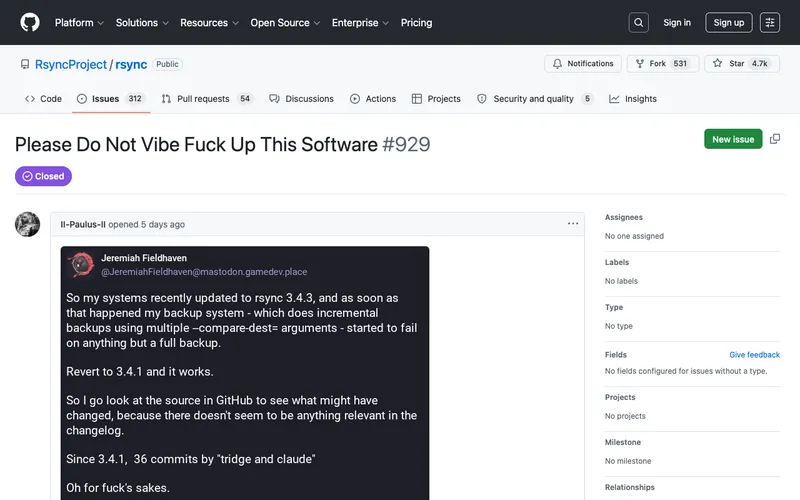
Did Claude increase bugs in rsync?
Jun 5, 2026
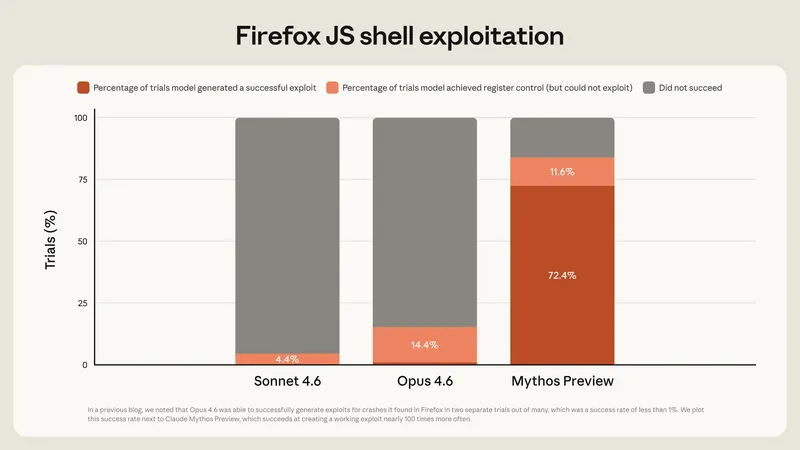
Assessing Claude Mythos Preview's cybersecurity capabilities
Apr 7, 2026

Vulnerability research is cooked
Mar 30, 2026

AI-assisted php2shell exploit chain hits PHP runtime, forces coordinated defense across 70% of web
Oct 21, 2026

Google fixed more Chrome bugs in June than over the past two years, thanks to AI
Jul 31, 2026