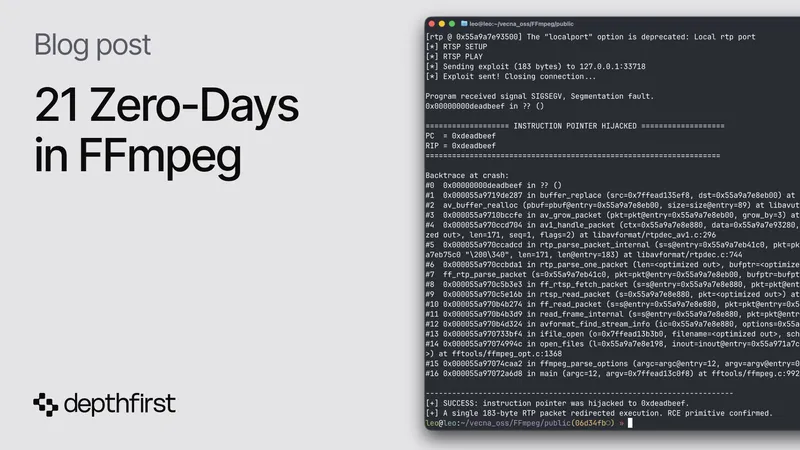
Twenty One Zero-Days in FFmpeg
depthfirst.com
June 12, 2026
12 min read
🔥🔥🔥🔥🔥
61/100
Summary
Depthfirst's autonomous security agent identified 21 zero-day vulnerabilities in FFmpeg through extensive security analysis conducted by Google and Anthropic. The agent produces concrete, reproducible proof-of-concept inputs to validate findings at a significantly lower cost, with some vulnerabilities remaining undiscovered for 15 to 20 years.
Key Takeaways
- Depthfirst's autonomous security agent discovered 21 zero-day vulnerabilities in FFmpeg, a widely used media processing library.
- The vulnerabilities had been latent for 15 to 20 years and were confirmed through concrete, reproducible proof-of-concept inputs.
- The security agent operates by threat modeling the codebase and auditing the attack surface to identify exploitable security issues.
- Depthfirst's system ensures that each identified vulnerability is real, reachable, and actionable, moving beyond theoretical analysis.
Coverage & discussions
Hacker News · depthfirst.com
Community discussions
Community Sentiment
Positives
- FFmpeg's capabilities in handling complex video and audio codecs have made it an invaluable tool for many developers, enhancing the richness of digital media.
- The initiative to publish vulnerabilities, despite the risks, is crucial for the community to address security issues and improve software safety.
Concerns
- FFmpeg has a long-standing reputation for security vulnerabilities, with a history of memory corruption bugs that raise serious concerns about its reliability in production environments.
- The development team's hostility towards security researchers reporting issues indicates a troubling culture that may hinder improvements in software security.