Report · spectrum.ieee.org
Wikipedia's Cleanup of AI-Generated Content
spectrum.ieee.org
Source published October 27, 2026
Summary: 2 min read
68/100
Summary
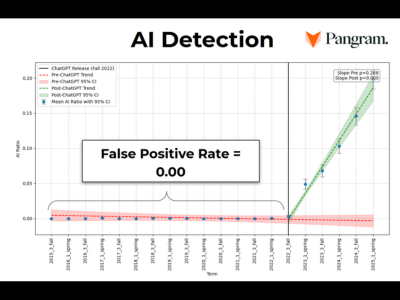
WikiProject AI Cleanup, a volunteer Wikipedia initiative launched in 2023, identifies and removes AI-generated material that violates Wikipedia guidelines. Founding member Ellia Lebleu said editors first noticed conspicuous ChatGPT-like phrases and unusual article structures in late 2023. By 2025, volunteers were looking for subtler patterns such as repeated rhetorical structures, while also examining suspicious editing behavior, including accounts producing several thousand-word articles within minutes. Misleading citations are a major concern: AI systems may invent sources or, more commonly, cite real sources that do not support the surrounding claims. English Wikipedia has prohibited editors from using large language models to generate articles. Lebleu said testing with AI-detection company Pangram flagged about 20 percent of new articles and drafts as AI-generated in late 2025, falling to roughly 15 or 16 percent in early 2026; the cause of the decline remains unclear. Wikipedia editors and the Wikimedia Foundation are also deploying AI-related tools, including an AI source verifier and Paste Check, which can flag text pasted from certain chatbots. The Wikimedia Foundation is developing an attribution framework for AI search results that could show citation users an article’s edit date, completeness, and flagged problems. Lebleu said Wikipedia may remain a human-written corpus while potentially offering AI-assisted options in the future.
Key Takeaways
- WikiProject AI Cleanup was launched in 2023 to find and remove AI-generated Wikipedia content that violates site guidelines.
- English Wikipedia prohibits editors from using large language models to generate articles.
- Pangram flagged about 20 percent of new Wikipedia articles and drafts as AI-generated in late 2025 and about 15 to 16 percent in early 2026, according to Ellia Lebleu.
- AI-generated citations often use real sources that do not support the claims they are cited for, Lebleu said.
- The Wikimedia Foundation is developing Paste Check to flag text pasted from some AI chatbots and an attribution framework for AI-cited Wikipedia content.
What the discussion said
Commenters largely welcomed Wikipedia’s push to remove machine-written material, not because every AI-assisted sentence is inherently worthless, but because cheap generation turns editorial review into a losing volume game. Readers described the familiar failure pattern: fabricated or mismatched citations, incoherent prose, broken formatting, misplaced links, and repetitive filler that looks passable until someone must verify it. The concern is less a mystical hatred of AI than protecting an authoritative reference work whose human editors cannot inspect an endless stream of plausible-looking submissions. The thread also pushed back on treating long, bloated Wikipedia articles as proof of recent AI contamination. Several readers said Wikipedia’s tendency toward accumulation, factional editing, and weak pruning predates LLMs by years; others felt the new verbosity increasingly makes articles raw input for summarizers rather than satisfying explanations for people. There was cautious interest in AI as an off-site or tightly constrained editorial tool, especially for cleanup, but little confidence that present systems can reliably author or independently verify prose. Verification was the sticking point: math and code can often be checked mechanically, while factual narrative requires judgment about sources, framing, and bias. One practical frustration surfaced when an automated anti-vandalism bot reverted a human’s attempted repair of obvious AI slop, illustrating that defense automation can obstruct the very cleanup it is meant to support.
Where opinion split
The sharpest dispute was whether AI-generated text is uniquely the problem or merely another source of ordinary bad edits. Skeptics argued that humans have always invented citations, inserted bias, and written poor material, so quality standards should target the defects rather than the authoring tool. The opposing case was that generative AI changes the scale: it can flood a volunteer-reviewed encyclopedia with low-grade plausibility faster than humans can distinguish acceptable work from polished garbage.
Coverage & discussions
Hacker News · spectrum.ieee.org
Community discussions
Reported comments: 1 · 1 saved in sample
Too few usable comments or discussion unavailable
Community Sentiment
Positives
- Wikipedia’s cleanup effort earns support because authoritative references cannot let unverified, machine-produced filler outrun the volunteer editors responsible for checking it.
- Several readers see a legitimate future for AI in encyclopedias if it is tested outside the main site first and earns trust as a stable, genuinely useful editorial aid.
- Using AI to assist cleanup rather than silently author claims is viewed as the more defensible near-term role, keeping humans accountable for source judgment and final publication.
- Higher-quality Wikipedia could improve the information ecosystem feeding AI systems, giving model providers a practical reason to support preservation and cleanup.
Concerns
- Current AI edits reportedly arrive with invented or confusing content, damaged formatting, and links attached to the wrong concepts, making them expensive to repair rather than useful drafts.
- Fluent prose is not reliably verifiable like code or mathematics; automated fact-checking risks laundering training-data bias and source-selection bias into an encyclopedia.
- The real danger is industrial-scale mediocre output: even if some AI text is acceptable, human reviewers cannot audit mountains of plausible-looking submissions.
- Automated moderation can misfire by reverting human corrections to AI-generated junk, showing that anti-slop tooling can itself become an editorial obstacle.
Related Articles
Generative AI and Wikipedia editing: What we learned in 2025
Jan 31, 2026

Wikipedia bans AI-generated content in its online encyclopedia
Mar 28, 2026

Academics have a duty to defend open knowledge systems like Wikipedia
Oct 20, 2026
Wikipedia's AI agent row likely just the beginning of the bot-ocalypse
Apr 6, 2026

An Unbothered Jimmy Wales Calls Grokipedia a 'Cartoon Imitation' of Wikipedia
Feb 22, 2026