Report · trakkr.ai
Zombie stats: Where the numbers AI quotes come from
trakkr.ai
Source published October 29, 2026
Summary: 2 min read
56/100
Summary
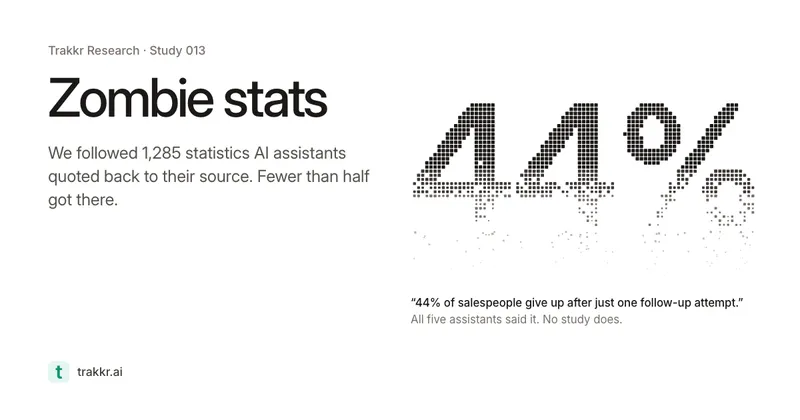
Trakkr Research traced 1,285 statistics cited by ChatGPT, Perplexity, Gemini, Claude and Google AI Overviews after asking the systems 200 everyday questions that required numerical answers. Researchers followed each citation chain for as many as five pages to find the original research. Forty percent of cited statistics led to a study supporting the same claim, while another 8% reached a study after the number or its context had changed. Forty percent ended at inaccessible, missing or nonresponsive sources, and 11% led nowhere. The systems usually cited pages that contained the quoted number rather than inventing it: 82% of first cited pages included the figure. Only 21% of those pages were original research, however, and more than half were company blogs. Citation chains beginning with government or research-firm pages reached a matching study 61% of the time, compared with 37% for company blogs and 35% for statistics roundups. Trakkr calls repeatedly cited figures without traceable studies “zombie stats.” All five systems gave 44% as the share of salespeople who stop after one follow-up, but researchers found no underlying study. On questions where all five systems gave a percentage, 28 of 71 produced four or five different figures; agreement among systems did not make a statistic more likely to be sourced.
Key Takeaways
- Trakkr found that 40% of 1,285 AI-cited statistics traced to a study supporting the same claim, while 51% ended at inaccessible sources or nowhere at all.
- Only 21% of pages cited for numerical claims were original research, although 82% contained the quoted figure.
- Seventeen percent of statistics that reached an original study had changed during citation, most often in their measurement context, year, source or surveyed population.
- All five tested AI systems repeated the claim that 44% of salespeople stop after one follow-up, but Trakkr could not locate a study supporting it.
What the discussion said
The thread largely agrees that AI-generated statistics become dangerous when fluent repetition substitutes for a traceable chain of evidence. Readers focused less on the article’s own presentation than on the feedback loop it describes: an unsupported number appears in AI-written material, gets copied by publishers, then returns through search and training data looking like consensus. A disputed claim about PHP adoption illustrated how a neat, widely repeated percentage can conceal radically different measurement populations and become impossible to audit after enough repetition. Several commenters want AI aimed at the harder, more useful job: recording source documents, extracted claims, calculations, and final conclusions so each step can be inspected. They see retrieval-backed systems and sentence-level citations as promising in principle, and argue that critical reading of model output belongs in education. But experience has made the room wary. Citation interfaces can lend unjustified authority when linked pages do not support the claim, vanish entirely, or lead to low-quality AI spam. Google’s confident explanations of invented compound words were offered as a vivid example of why polished delivery is not evidence. The core fear is not merely ordinary human error; it is AI scaling that error into a self-reinforcing, increasingly synthetic information environment.
Where opinion split
The sharpest dispute is whether citations and AI-assisted research meaningfully solve the trust problem. Optimists argue that provenance-aware tools can make verification practical and teach users the critical habits needed to use them. Skeptics counter that current citation systems routinely misrepresent or fabricate support, so visible references often deepen false confidence rather than establish truth.
Coverage & discussions
Hacker News · trakkr.ai
Community discussions
Community Sentiment
Positives
- Provenance-first AI could turn research from an opaque answer machine into an auditable trail of documents, calculations, and evidence.
- Teaching people to interrogate LLM claims could strengthen the broader critical-thinking habits needed for both machine-generated and human-written information.
- Smaller models paired with effective web retrieval may avoid some memory-driven hallucinations by grounding answers in material they can actually inspect.
Concerns
- AI turns unsupported figures into counterfeit consensus: repeated across generated posts, search results, and training data until nobody can locate the original evidence.
- Inline citations are a dangerously persuasive cosmetic when the linked page fails to support the claim, has disappeared, or is itself AI-generated spam.
- Confident hallucinations, including plausible explanations for nonsense words, show how easily polished language can pass for knowledge without any factual anchor.
- Giving learners instant LLM answers may reward accepting convenient output over building the source-checking discipline that reliable research requires.
Related Articles
Publish fake stats, get cited in LLMs
Oct 20, 2026

MIT's claim that 95% of AI pilots fail - Is this true?
Oct 30, 2026

Someone is running mass vulnerability scans, spoofing AI bots like ClaudeBot
Aug 12, 2026

Malware uses LLMs to rank victims by how much they're worth
Oct 31, 2026

Gemini 4 Carbon is the new #1 on the Artificial Analysis Intelligence Index v5
Oct 29, 2026