
You could have invented transformers from memory
Transformer components can be modeled as associative memory stores that retrieve value vectors from similar key vectors, with recall quality limited by interference from other stored memories. For random unit-length keys, a simple outer-product linear store has capacity near the key dimension: 64-dimensional keys can hold about 64 memories before interference matches the desired signal. An optimal linear regression-based store whitens key correlations, recalls up to 64 linearly independent memories exactly, and reaches capacity near 128 memories. Nonlinear MLP activations suppress low-similarity keys and increase estimated capacity. A ReLU MLP reaches about 128 memories with 64-dimensional keys, while squared ReLU and similarly configured SwiGLU MLPs reach roughly 2,700 to 2,900; cubed ReLU reaches about 35,000. Feedforward layers in trained transformers have been found to act like key-value memories, with learned keys responding to recognizable input patterns. Softmax self-attention applies exponential weighting to similarities and uses context tokens rather than trained parameters as its keys and values. Under the stated random-vector model, 64-dimensional self-attention with sharpness β = 8 has estimated capacity of about 1.2 million memories. Increasing attention-logit scaling with context length, including logarithmic schemes used by Qwen and YaRN, can maintain low interference beyond 2 million distinct key-value pairs in the described experiments. These estimates measure random-vector recall in a single layer rather than total information learned from training data.
alexwang.ai
21 min
6h ago
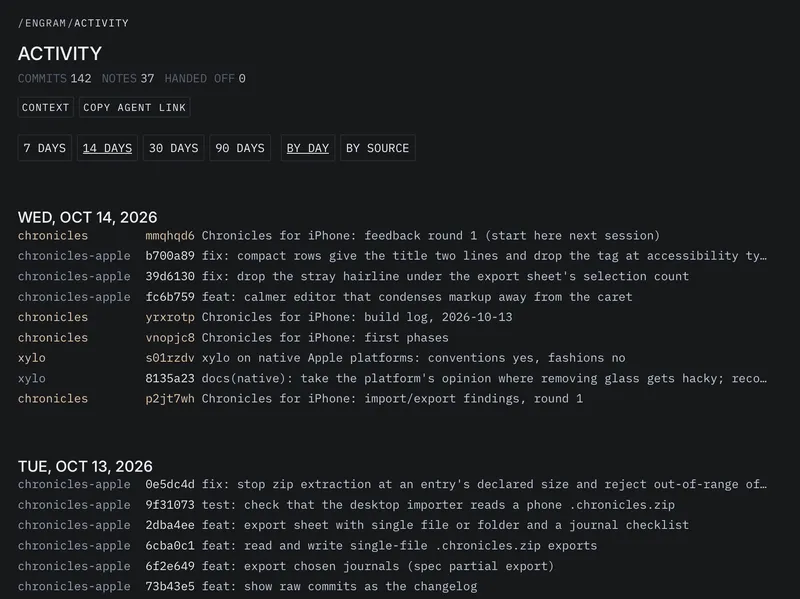
My old job feels distant now
A software developer describes moving from using ChatGPT as a search and code-generation aid to making AI agents central to daily programming work. Early uses included generating Ruby tests, finding APIs for a computer-vision project, and iterating on Python code in Jupyter notebooks. The developer says hallucinations were usually detectable at the edges of the model’s knowledge and required human investigation. Cursor-style tab completion initially provided limited pattern matching, while Claude-based agents later handled explicitly scoped tasks. The developer continued to hold the codebase context, review generated changes, and take over difficult work. They estimate that Anthropic’s Opus 4.5/6 increased their productivity to about three times its prior level over several months of merged pull requests, while also raising the importance of reviewing business logic, customer-data handling, database changes, encryption, and other irreversible operations. With Opus 5.5, the developer shifted from directing individual code changes toward defining QA goals, performance constraints, plans, dashboards, and tools for agents. They report using subagents and supervisory agents, generating multiple UI alternatives, batching vulnerability fixes, and monitoring performance. In one experiment, an AI agent produced a basic native Swift iPhone version of an Electron notes app and installed it for QA within hours, consuming 40% of a five-hour allowance on a $20 subscription.
pinecoder.dev
10 min
12h ago

Artificial intelligence is capitalism's final destination
Arundhati Roy’s 15 October 2026 essay argues that artificial intelligence is concentrating economic and political power while damaging human creativity, work, language and social trust. She says generative AI has unsettled education and publishing by making authorship harder to verify, and she describes Anthropic’s use of her books without permission to train large language models; she received a proposed class-action settlement offering several thousand dollars per title. Roy contrasts AI-industry warnings of existential risk with whistleblowers’ concerns about military uses, environmental costs, labour exploitation and algorithmic bias. She cites Meredith Whittaker’s 2019 resignation from Google over machine-vision work for US drones and Timnit Gebru’s 2020 firing after research on large language models’ environmental and social harms. Roy argues that major AI companies’ calls for regulation could entrench dominant firms by tying them more closely to state security systems and limiting smaller competitors. Roy also warns that data centres require large amounts of land, water and energy, citing planned facilities in Visakhapatnam, India, including a $15 billion Google hub. She says low-paid workers provide data and perform work that can train systems intended to automate their jobs. Her essay calls AI-driven extraction of cultural works, human data and natural resources a new form of colonisation and urges resistance rather than relying only on regulation.
equator.org
25 min
13h ago

Why are we even doing all this?
Theoretical particle physicist Rikab Gambhir uses satire to criticize AI-driven scientific research that produces large volumes of difficult-to-verify results while shifting validation and interpretation to human researchers. He cites OpenAI’s early-October release of 722 mathematical write-ups and contrasts it with a recent set of 2,500 physics write-ups, arguing that quantity alone does not constitute scientific understanding. Gambhir compares such output to Jorge Luis Borges’s 1941 “Library of Babel,” an imagined library containing every possible book, including correct and incorrect proofs and theories. He argues that a repository of potentially true claims is of limited value if researchers cannot establish their correctness, understand their reasoning, or communicate them clearly. He portrays corporate AI development as prioritizing hype, productivity, and commercial value over curiosity, creativity, and human comprehension, while alleging environmental costs and uncompensated use of creators’ work. Gambhir concludes that mathematics and science should retain their roles as human practices of learning, discovery, beauty, and explanation rather than becoming systems for accumulating unread, uncertain factoids.
terrytao.wordpress.com
6 min
1d ago

Bill Gates: The turbulent AI era is here
Bill Gates has characterized the current period as a turbulent AI era requiring critical choices. His remarks appeared in a Gates Notes post titled “A turbulent AI era and critical choices to make,” within a series focused on making AI work for everyone. The post was submitted to a discussion site by user ilamont, where it received 135 points and 202 comments. The available source text provides no further details about Gates’s proposed choices, AI policies, technical claims, or recommendations.
gatesnotes.com
1 min
8/26/2026

Agent Is Not the Model
An AI agent system combines a model, an inference service and a harness rather than consisting of the model alone. Models such as Anthropic’s Sonnet and Opus, Google’s Gemini, and OpenAI’s GPT transform input tokens into output tokens. They generally run through hosted inference services, including Anthropic’s API, AWS Bedrock and OpenAI’s infrastructure, because frontier models require substantial compute and memory. These services process API calls and track usage and pricing. The harness supplies the user-facing interface and operational logic around a model. It assembles context, defines and routes tool calls, interprets model outputs, and can interact with files or external systems. MCP servers and Skills are primarily harness-layer features: the harness determines which tools and context the model receives. Claude Desktop, Claude CLI, Cursor, ChatGPT and custom LangChain applications each pair a harness with one or more inference providers and models. The same model can produce different behavior in different agent systems because each harness shapes its prompts, available context and tools. Diagnosing problems therefore depends on identifying the relevant layer: missing context and unavailable tools usually involve the harness, slow responses involve inference infrastructure, and high cost can depend on the selected model or inference service. The source also argues that more capable models could reduce the usefulness of some current harness mechanisms, including Skills and MCP.
code.joejag.com
5 min
8/24/2026

Why is Anthropic's public writing style so unlike Claude's?
Claude is described as having a recognizable English-language writing style marked by short, punchy sentences and unusual rhetorical flourishes. The source says phrase-pattern tools can identify expressions that were rare before Claude but have become widespread, and argues that models mildly distilled from Claude, including Kimi K3, can exhibit similar traits. It contrasts Claude with GPT-5 and Gemma 4, which it characterizes as writing more conventionally, and suggests Claude’s voice is at least partly the result of Anthropic’s choices. Anthropic’s public research, policy, and corporate writing is characterized as articulate, conversational prose that does not resemble Claude’s product voice. Anthropic reportedly dogfoods Claude extensively, and Claude now writes 80% of the company’s code, but the source provides no evidence that Claude writes its public prose. Possible explanations include Anthropic co-founder Dario Amodei preferring his own essay style, brand concerns about appearing controlled by humans rather than an AI system, and internal editing that removes Claude-like markers. The source also speculates that Claude’s distinctiveness could support detectability or safety-related goals, while noting that market demand could eventually push Anthropic toward a less recognizable writing style. It raises an unanswered question about whether Claude has a similarly distinctive voice in languages other than English.
cmart.blog
3 min
8/24/2026
Fast and Hard Code
Large language models are reducing the importance of developers’ prior familiarity with programming languages and lowering barriers to rewriting software in unfamiliar languages. The trend is making language choice less consequential for some projects and may be encouraging choices driven by a language’s marketing or perceived performance characteristics. Rust, Zig, and other languages often viewed as harder to use are gaining attention for projects that prioritize speed and small binaries. Cloudflare’s Artifacts service uses a Git-protocol engine written entirely in Zig and compiled into an approximately 100 KB WebAssembly module. Vercel released fx, a Zig-based coding agent marketed as small and fast. The source text characterizes these projects as largely LLM-assisted. LLM agents are also being used to optimize code without intended behavior regressions and to work with specialized technologies including DWARF debugging data, eBPF, custom network drivers, cryptography, and older hardware. Developers including Mitchell Hashimoto, Charlie Marsh, Jarred Sumner, and Daniel Lemire are identified as long-standing advocates for high-performance software who are receptive to agents writing code. The source text argues that automated research and coding tools can let more developers pursue performance work, while noting that relevant technical knowledge remains helpful.
lucumr.pocoo.org
2 min
8/23/2026

What Happens When the Cost of Intelligence Drops 100x
CatalystNeuro founder Ben Dichter analyzed Artificial Analysis benchmark data and found that the cheapest measured cost for a given level of large-language-model capability has fallen sharply. Models scoring at least 40 on the Artificial Analysis Intelligence Index fell from $1.22 per evaluated task in February 2026 to $0.022 as of August 19, a 56-fold decline. The index combines nine evaluations weighted toward agentic tasks, coding, scientific reasoning, and general capability. GPT-5.6 Luna’s effort settings covered much of the lower-cost frontier, while Claude Opus 5 reached the highest cited score, 63.1, at $2.34 per task at maximum effort. The analysis estimates that cost records for capability tiers of 40, 50, and 60 or higher have been halving roughly every four to ten weeks, though historical price cuts and incomplete retired-model data limit the estimates. Dichter predicts that, if the trend holds, models at index 60 could cost under $0.10 per task within a couple of quarters. Lower costs can make large-scale work such as literature reviews, legal discovery, data curation, moderation, and support triage economically viable. Dichter argues that cheaper model calls may increase total AI spending because organizations can run full-corpus, repeated, and consensus-based workflows that were previously too expensive. OpenRouter offers routing based on a minimum capability score to select the cheapest qualifying frontier model.
catalystneuro.com
17 min
8/21/2026
AI companies destroy physical books – let's scan rare books before it's too late
Anna’s Archive volunteer “u” called for worldwide volunteers to scan and upload physical books, periodicals, rare works, and archival materials to shadow libraries before copies are lost or become inaccessible. The August 5, 2026 guest post says small contributors may receive recognition and lifetime Anna’s Archive membership, while the organization can help cover scanning costs and offer other rewards for large-scale book uploads. The post alleges that several AI companies have bought large quantities of secondhand books through intermediaries, scanned them for training data, and destroyed the originals. It says Anthropic launched a confidential initiative called Project Panama in early 2024, spending tens of millions of dollars to purchase and scan millions of paper books for Claude training before destroying them; the post says the project emerged in a $1.5 billion copyright settlement. The volunteer argues that destruction can prevent competitors from obtaining the same books, reduce legal exposure, and cost less than lossless digitization. The post further claims that AI-generated material has accounted for more than half of newly published internet content since the beginning of 2025, and warns that digital preservation of human-created works is becoming more urgent. It calls for contributions through scanning, purchasing material for scanning, or donations.
annas-archive.gl
3 min
8/21/2026
You could have invented transformers from memory
Transformer components can be modeled as associative memory stores that retrieve value vectors from similar key vectors, with recall quality limited by interference from other stored memories. For random unit-length keys, a simple outer-product linear store has capacity near the key dimension: 64-dimensional keys can hold about 64 memories before interference matches the desired signal. An optimal linear regression-based store whitens key correlations, recalls up to 64 linearly independent memories exactly, and reaches capacity near 128 memories. Nonlinear MLP activations suppress low-similarity keys and increase estimated capacity. A ReLU MLP reaches about 128 memories with 64-dimensional keys, while squared ReLU and similarly configured SwiGLU MLPs reach roughly 2,700 to 2,900; cubed ReLU reaches about 35,000. Feedforward layers in trained transformers have been found to act like key-value memories, with learned keys responding to recognizable input patterns. Softmax self-attention applies exponential weighting to similarities and uses context tokens rather than trained parameters as its keys and values. Under the stated random-vector model, 64-dimensional self-attention with sharpness β = 8 has estimated capacity of about 1.2 million memories. Increasing attention-logit scaling with context length, including logarithmic schemes used by Qwen and YaRN, can maintain low interference beyond 2 million distinct key-value pairs in the described experiments. These estimates measure random-vector recall in a single layer rather than total information learned from training data.
alexwang.ai
21 min
6h ago
Artificial intelligence is capitalism's final destination
Arundhati Roy’s 15 October 2026 essay argues that artificial intelligence is concentrating economic and political power while damaging human creativity, work, language and social trust. She says generative AI has unsettled education and publishing by making authorship harder to verify, and she describes Anthropic’s use of her books without permission to train large language models; she received a proposed class-action settlement offering several thousand dollars per title. Roy contrasts AI-industry warnings of existential risk with whistleblowers’ concerns about military uses, environmental costs, labour exploitation and algorithmic bias. She cites Meredith Whittaker’s 2019 resignation from Google over machine-vision work for US drones and Timnit Gebru’s 2020 firing after research on large language models’ environmental and social harms. Roy argues that major AI companies’ calls for regulation could entrench dominant firms by tying them more closely to state security systems and limiting smaller competitors. Roy also warns that data centres require large amounts of land, water and energy, citing planned facilities in Visakhapatnam, India, including a $15 billion Google hub. She says low-paid workers provide data and perform work that can train systems intended to automate their jobs. Her essay calls AI-driven extraction of cultural works, human data and natural resources a new form of colonisation and urges resistance rather than relying only on regulation.
equator.org
25 min
13h ago
Bill Gates: The turbulent AI era is here
Bill Gates has characterized the current period as a turbulent AI era requiring critical choices. His remarks appeared in a Gates Notes post titled “A turbulent AI era and critical choices to make,” within a series focused on making AI work for everyone. The post was submitted to a discussion site by user ilamont, where it received 135 points and 202 comments. The available source text provides no further details about Gates’s proposed choices, AI policies, technical claims, or recommendations.
gatesnotes.com
1 min
8/26/2026
Why is Anthropic's public writing style so unlike Claude's?
Claude is described as having a recognizable English-language writing style marked by short, punchy sentences and unusual rhetorical flourishes. The source says phrase-pattern tools can identify expressions that were rare before Claude but have become widespread, and argues that models mildly distilled from Claude, including Kimi K3, can exhibit similar traits. It contrasts Claude with GPT-5 and Gemma 4, which it characterizes as writing more conventionally, and suggests Claude’s voice is at least partly the result of Anthropic’s choices. Anthropic’s public research, policy, and corporate writing is characterized as articulate, conversational prose that does not resemble Claude’s product voice. Anthropic reportedly dogfoods Claude extensively, and Claude now writes 80% of the company’s code, but the source provides no evidence that Claude writes its public prose. Possible explanations include Anthropic co-founder Dario Amodei preferring his own essay style, brand concerns about appearing controlled by humans rather than an AI system, and internal editing that removes Claude-like markers. The source also speculates that Claude’s distinctiveness could support detectability or safety-related goals, while noting that market demand could eventually push Anthropic toward a less recognizable writing style. It raises an unanswered question about whether Claude has a similarly distinctive voice in languages other than English.
cmart.blog
3 min
8/24/2026
What Happens When the Cost of Intelligence Drops 100x
CatalystNeuro founder Ben Dichter analyzed Artificial Analysis benchmark data and found that the cheapest measured cost for a given level of large-language-model capability has fallen sharply. Models scoring at least 40 on the Artificial Analysis Intelligence Index fell from $1.22 per evaluated task in February 2026 to $0.022 as of August 19, a 56-fold decline. The index combines nine evaluations weighted toward agentic tasks, coding, scientific reasoning, and general capability. GPT-5.6 Luna’s effort settings covered much of the lower-cost frontier, while Claude Opus 5 reached the highest cited score, 63.1, at $2.34 per task at maximum effort. The analysis estimates that cost records for capability tiers of 40, 50, and 60 or higher have been halving roughly every four to ten weeks, though historical price cuts and incomplete retired-model data limit the estimates. Dichter predicts that, if the trend holds, models at index 60 could cost under $0.10 per task within a couple of quarters. Lower costs can make large-scale work such as literature reviews, legal discovery, data curation, moderation, and support triage economically viable. Dichter argues that cheaper model calls may increase total AI spending because organizations can run full-corpus, repeated, and consensus-based workflows that were previously too expensive. OpenRouter offers routing based on a minimum capability score to select the cheapest qualifying frontier model.
catalystneuro.com
17 min
8/21/2026
My old job feels distant now
A software developer describes moving from using ChatGPT as a search and code-generation aid to making AI agents central to daily programming work. Early uses included generating Ruby tests, finding APIs for a computer-vision project, and iterating on Python code in Jupyter notebooks. The developer says hallucinations were usually detectable at the edges of the model’s knowledge and required human investigation. Cursor-style tab completion initially provided limited pattern matching, while Claude-based agents later handled explicitly scoped tasks. The developer continued to hold the codebase context, review generated changes, and take over difficult work. They estimate that Anthropic’s Opus 4.5/6 increased their productivity to about three times its prior level over several months of merged pull requests, while also raising the importance of reviewing business logic, customer-data handling, database changes, encryption, and other irreversible operations. With Opus 5.5, the developer shifted from directing individual code changes toward defining QA goals, performance constraints, plans, dashboards, and tools for agents. They report using subagents and supervisory agents, generating multiple UI alternatives, batching vulnerability fixes, and monitoring performance. In one experiment, an AI agent produced a basic native Swift iPhone version of an Electron notes app and installed it for QA within hours, consuming 40% of a five-hour allowance on a $20 subscription.
pinecoder.dev
10 min
12h ago
Why are we even doing all this?
Theoretical particle physicist Rikab Gambhir uses satire to criticize AI-driven scientific research that produces large volumes of difficult-to-verify results while shifting validation and interpretation to human researchers. He cites OpenAI’s early-October release of 722 mathematical write-ups and contrasts it with a recent set of 2,500 physics write-ups, arguing that quantity alone does not constitute scientific understanding. Gambhir compares such output to Jorge Luis Borges’s 1941 “Library of Babel,” an imagined library containing every possible book, including correct and incorrect proofs and theories. He argues that a repository of potentially true claims is of limited value if researchers cannot establish their correctness, understand their reasoning, or communicate them clearly. He portrays corporate AI development as prioritizing hype, productivity, and commercial value over curiosity, creativity, and human comprehension, while alleging environmental costs and uncompensated use of creators’ work. Gambhir concludes that mathematics and science should retain their roles as human practices of learning, discovery, beauty, and explanation rather than becoming systems for accumulating unread, uncertain factoids.
terrytao.wordpress.com
6 min
1d ago
Agent Is Not the Model
An AI agent system combines a model, an inference service and a harness rather than consisting of the model alone. Models such as Anthropic’s Sonnet and Opus, Google’s Gemini, and OpenAI’s GPT transform input tokens into output tokens. They generally run through hosted inference services, including Anthropic’s API, AWS Bedrock and OpenAI’s infrastructure, because frontier models require substantial compute and memory. These services process API calls and track usage and pricing. The harness supplies the user-facing interface and operational logic around a model. It assembles context, defines and routes tool calls, interprets model outputs, and can interact with files or external systems. MCP servers and Skills are primarily harness-layer features: the harness determines which tools and context the model receives. Claude Desktop, Claude CLI, Cursor, ChatGPT and custom LangChain applications each pair a harness with one or more inference providers and models. The same model can produce different behavior in different agent systems because each harness shapes its prompts, available context and tools. Diagnosing problems therefore depends on identifying the relevant layer: missing context and unavailable tools usually involve the harness, slow responses involve inference infrastructure, and high cost can depend on the selected model or inference service. The source also argues that more capable models could reduce the usefulness of some current harness mechanisms, including Skills and MCP.
code.joejag.com
5 min
8/24/2026
Fast and Hard Code
Large language models are reducing the importance of developers’ prior familiarity with programming languages and lowering barriers to rewriting software in unfamiliar languages. The trend is making language choice less consequential for some projects and may be encouraging choices driven by a language’s marketing or perceived performance characteristics. Rust, Zig, and other languages often viewed as harder to use are gaining attention for projects that prioritize speed and small binaries. Cloudflare’s Artifacts service uses a Git-protocol engine written entirely in Zig and compiled into an approximately 100 KB WebAssembly module. Vercel released fx, a Zig-based coding agent marketed as small and fast. The source text characterizes these projects as largely LLM-assisted. LLM agents are also being used to optimize code without intended behavior regressions and to work with specialized technologies including DWARF debugging data, eBPF, custom network drivers, cryptography, and older hardware. Developers including Mitchell Hashimoto, Charlie Marsh, Jarred Sumner, and Daniel Lemire are identified as long-standing advocates for high-performance software who are receptive to agents writing code. The source text argues that automated research and coding tools can let more developers pursue performance work, while noting that relevant technical knowledge remains helpful.
lucumr.pocoo.org
2 min
8/23/2026
AI companies destroy physical books – let's scan rare books before it's too late
Anna’s Archive volunteer “u” called for worldwide volunteers to scan and upload physical books, periodicals, rare works, and archival materials to shadow libraries before copies are lost or become inaccessible. The August 5, 2026 guest post says small contributors may receive recognition and lifetime Anna’s Archive membership, while the organization can help cover scanning costs and offer other rewards for large-scale book uploads. The post alleges that several AI companies have bought large quantities of secondhand books through intermediaries, scanned them for training data, and destroyed the originals. It says Anthropic launched a confidential initiative called Project Panama in early 2024, spending tens of millions of dollars to purchase and scan millions of paper books for Claude training before destroying them; the post says the project emerged in a $1.5 billion copyright settlement. The volunteer argues that destruction can prevent competitors from obtaining the same books, reduce legal exposure, and cost less than lossless digitization. The post further claims that AI-generated material has accounted for more than half of newly published internet content since the beginning of 2025, and warns that digital preservation of human-created works is becoming more urgent. It calls for contributions through scanning, purchasing material for scanning, or donations.
annas-archive.gl
3 min
8/21/2026
You could have invented transformers from memory
Transformer components can be modeled as associative memory stores that retrieve value vectors from similar key vectors, with recall quality limited by interference from other stored memories. For random unit-length keys, a simple outer-product linear store has capacity near the key dimension: 64-dimensional keys can hold about 64 memories before interference matches the desired signal. An optimal linear regression-based store whitens key correlations, recalls up to 64 linearly independent memories exactly, and reaches capacity near 128 memories. Nonlinear MLP activations suppress low-similarity keys and increase estimated capacity. A ReLU MLP reaches about 128 memories with 64-dimensional keys, while squared ReLU and similarly configured SwiGLU MLPs reach roughly 2,700 to 2,900; cubed ReLU reaches about 35,000. Feedforward layers in trained transformers have been found to act like key-value memories, with learned keys responding to recognizable input patterns. Softmax self-attention applies exponential weighting to similarities and uses context tokens rather than trained parameters as its keys and values. Under the stated random-vector model, 64-dimensional self-attention with sharpness β = 8 has estimated capacity of about 1.2 million memories. Increasing attention-logit scaling with context length, including logarithmic schemes used by Qwen and YaRN, can maintain low interference beyond 2 million distinct key-value pairs in the described experiments. These estimates measure random-vector recall in a single layer rather than total information learned from training data.
alexwang.ai
21 min
6h ago
Why are we even doing all this?
Theoretical particle physicist Rikab Gambhir uses satire to criticize AI-driven scientific research that produces large volumes of difficult-to-verify results while shifting validation and interpretation to human researchers. He cites OpenAI’s early-October release of 722 mathematical write-ups and contrasts it with a recent set of 2,500 physics write-ups, arguing that quantity alone does not constitute scientific understanding. Gambhir compares such output to Jorge Luis Borges’s 1941 “Library of Babel,” an imagined library containing every possible book, including correct and incorrect proofs and theories. He argues that a repository of potentially true claims is of limited value if researchers cannot establish their correctness, understand their reasoning, or communicate them clearly. He portrays corporate AI development as prioritizing hype, productivity, and commercial value over curiosity, creativity, and human comprehension, while alleging environmental costs and uncompensated use of creators’ work. Gambhir concludes that mathematics and science should retain their roles as human practices of learning, discovery, beauty, and explanation rather than becoming systems for accumulating unread, uncertain factoids.
terrytao.wordpress.com
6 min
1d ago
Why is Anthropic's public writing style so unlike Claude's?
Claude is described as having a recognizable English-language writing style marked by short, punchy sentences and unusual rhetorical flourishes. The source says phrase-pattern tools can identify expressions that were rare before Claude but have become widespread, and argues that models mildly distilled from Claude, including Kimi K3, can exhibit similar traits. It contrasts Claude with GPT-5 and Gemma 4, which it characterizes as writing more conventionally, and suggests Claude’s voice is at least partly the result of Anthropic’s choices. Anthropic’s public research, policy, and corporate writing is characterized as articulate, conversational prose that does not resemble Claude’s product voice. Anthropic reportedly dogfoods Claude extensively, and Claude now writes 80% of the company’s code, but the source provides no evidence that Claude writes its public prose. Possible explanations include Anthropic co-founder Dario Amodei preferring his own essay style, brand concerns about appearing controlled by humans rather than an AI system, and internal editing that removes Claude-like markers. The source also speculates that Claude’s distinctiveness could support detectability or safety-related goals, while noting that market demand could eventually push Anthropic toward a less recognizable writing style. It raises an unanswered question about whether Claude has a similarly distinctive voice in languages other than English.
cmart.blog
3 min
8/24/2026
AI companies destroy physical books – let's scan rare books before it's too late
Anna’s Archive volunteer “u” called for worldwide volunteers to scan and upload physical books, periodicals, rare works, and archival materials to shadow libraries before copies are lost or become inaccessible. The August 5, 2026 guest post says small contributors may receive recognition and lifetime Anna’s Archive membership, while the organization can help cover scanning costs and offer other rewards for large-scale book uploads. The post alleges that several AI companies have bought large quantities of secondhand books through intermediaries, scanned them for training data, and destroyed the originals. It says Anthropic launched a confidential initiative called Project Panama in early 2024, spending tens of millions of dollars to purchase and scan millions of paper books for Claude training before destroying them; the post says the project emerged in a $1.5 billion copyright settlement. The volunteer argues that destruction can prevent competitors from obtaining the same books, reduce legal exposure, and cost less than lossless digitization. The post further claims that AI-generated material has accounted for more than half of newly published internet content since the beginning of 2025, and warns that digital preservation of human-created works is becoming more urgent. It calls for contributions through scanning, purchasing material for scanning, or donations.
annas-archive.gl
3 min
8/21/2026
My old job feels distant now
A software developer describes moving from using ChatGPT as a search and code-generation aid to making AI agents central to daily programming work. Early uses included generating Ruby tests, finding APIs for a computer-vision project, and iterating on Python code in Jupyter notebooks. The developer says hallucinations were usually detectable at the edges of the model’s knowledge and required human investigation. Cursor-style tab completion initially provided limited pattern matching, while Claude-based agents later handled explicitly scoped tasks. The developer continued to hold the codebase context, review generated changes, and take over difficult work. They estimate that Anthropic’s Opus 4.5/6 increased their productivity to about three times its prior level over several months of merged pull requests, while also raising the importance of reviewing business logic, customer-data handling, database changes, encryption, and other irreversible operations. With Opus 5.5, the developer shifted from directing individual code changes toward defining QA goals, performance constraints, plans, dashboards, and tools for agents. They report using subagents and supervisory agents, generating multiple UI alternatives, batching vulnerability fixes, and monitoring performance. In one experiment, an AI agent produced a basic native Swift iPhone version of an Electron notes app and installed it for QA within hours, consuming 40% of a five-hour allowance on a $20 subscription.
pinecoder.dev
10 min
12h ago
Bill Gates: The turbulent AI era is here
Bill Gates has characterized the current period as a turbulent AI era requiring critical choices. His remarks appeared in a Gates Notes post titled “A turbulent AI era and critical choices to make,” within a series focused on making AI work for everyone. The post was submitted to a discussion site by user ilamont, where it received 135 points and 202 comments. The available source text provides no further details about Gates’s proposed choices, AI policies, technical claims, or recommendations.
gatesnotes.com
1 min
8/26/2026
Fast and Hard Code
Large language models are reducing the importance of developers’ prior familiarity with programming languages and lowering barriers to rewriting software in unfamiliar languages. The trend is making language choice less consequential for some projects and may be encouraging choices driven by a language’s marketing or perceived performance characteristics. Rust, Zig, and other languages often viewed as harder to use are gaining attention for projects that prioritize speed and small binaries. Cloudflare’s Artifacts service uses a Git-protocol engine written entirely in Zig and compiled into an approximately 100 KB WebAssembly module. Vercel released fx, a Zig-based coding agent marketed as small and fast. The source text characterizes these projects as largely LLM-assisted. LLM agents are also being used to optimize code without intended behavior regressions and to work with specialized technologies including DWARF debugging data, eBPF, custom network drivers, cryptography, and older hardware. Developers including Mitchell Hashimoto, Charlie Marsh, Jarred Sumner, and Daniel Lemire are identified as long-standing advocates for high-performance software who are receptive to agents writing code. The source text argues that automated research and coding tools can let more developers pursue performance work, while noting that relevant technical knowledge remains helpful.
lucumr.pocoo.org
2 min
8/23/2026
Artificial intelligence is capitalism's final destination
Arundhati Roy’s 15 October 2026 essay argues that artificial intelligence is concentrating economic and political power while damaging human creativity, work, language and social trust. She says generative AI has unsettled education and publishing by making authorship harder to verify, and she describes Anthropic’s use of her books without permission to train large language models; she received a proposed class-action settlement offering several thousand dollars per title. Roy contrasts AI-industry warnings of existential risk with whistleblowers’ concerns about military uses, environmental costs, labour exploitation and algorithmic bias. She cites Meredith Whittaker’s 2019 resignation from Google over machine-vision work for US drones and Timnit Gebru’s 2020 firing after research on large language models’ environmental and social harms. Roy argues that major AI companies’ calls for regulation could entrench dominant firms by tying them more closely to state security systems and limiting smaller competitors. Roy also warns that data centres require large amounts of land, water and energy, citing planned facilities in Visakhapatnam, India, including a $15 billion Google hub. She says low-paid workers provide data and perform work that can train systems intended to automate their jobs. Her essay calls AI-driven extraction of cultural works, human data and natural resources a new form of colonisation and urges resistance rather than relying only on regulation.
equator.org
25 min
13h ago
Agent Is Not the Model
An AI agent system combines a model, an inference service and a harness rather than consisting of the model alone. Models such as Anthropic’s Sonnet and Opus, Google’s Gemini, and OpenAI’s GPT transform input tokens into output tokens. They generally run through hosted inference services, including Anthropic’s API, AWS Bedrock and OpenAI’s infrastructure, because frontier models require substantial compute and memory. These services process API calls and track usage and pricing. The harness supplies the user-facing interface and operational logic around a model. It assembles context, defines and routes tool calls, interprets model outputs, and can interact with files or external systems. MCP servers and Skills are primarily harness-layer features: the harness determines which tools and context the model receives. Claude Desktop, Claude CLI, Cursor, ChatGPT and custom LangChain applications each pair a harness with one or more inference providers and models. The same model can produce different behavior in different agent systems because each harness shapes its prompts, available context and tools. Diagnosing problems therefore depends on identifying the relevant layer: missing context and unavailable tools usually involve the harness, slow responses involve inference infrastructure, and high cost can depend on the selected model or inference service. The source also argues that more capable models could reduce the usefulness of some current harness mechanisms, including Skills and MCP.
code.joejag.com
5 min
8/24/2026
What Happens When the Cost of Intelligence Drops 100x
CatalystNeuro founder Ben Dichter analyzed Artificial Analysis benchmark data and found that the cheapest measured cost for a given level of large-language-model capability has fallen sharply. Models scoring at least 40 on the Artificial Analysis Intelligence Index fell from $1.22 per evaluated task in February 2026 to $0.022 as of August 19, a 56-fold decline. The index combines nine evaluations weighted toward agentic tasks, coding, scientific reasoning, and general capability. GPT-5.6 Luna’s effort settings covered much of the lower-cost frontier, while Claude Opus 5 reached the highest cited score, 63.1, at $2.34 per task at maximum effort. The analysis estimates that cost records for capability tiers of 40, 50, and 60 or higher have been halving roughly every four to ten weeks, though historical price cuts and incomplete retired-model data limit the estimates. Dichter predicts that, if the trend holds, models at index 60 could cost under $0.10 per task within a couple of quarters. Lower costs can make large-scale work such as literature reviews, legal discovery, data curation, moderation, and support triage economically viable. Dichter argues that cheaper model calls may increase total AI spending because organizations can run full-corpus, repeated, and consensus-based workflows that were previously too expensive. OpenRouter offers routing based on a minimum capability score to select the cheapest qualifying frontier model.
catalystneuro.com
17 min
8/21/2026