Latest stories
Story · 1 report
So I guess everyone uses LLMs to think now
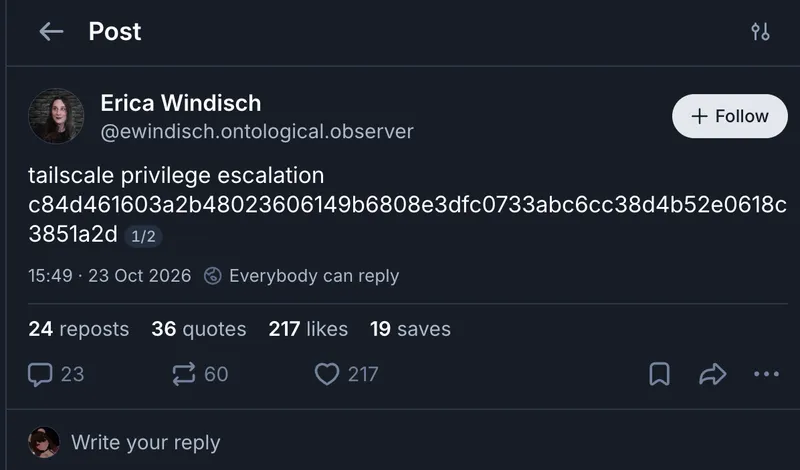
Eva, a security researcher and blogger, says she has never used AI for research published on her site and prefers manual coding, debugging, reverse engineering, source-code exploration, and vulnerability research. She says LLM output can be confidently wrong and frustrating to supervise, while acknowledging that the models are powerful. Eva argues that current LLMs still require skilled human guidance; she says an unguided model would probably not find a Linux kernel remote-code-execution vulnerability on its own. Eva criticizes AI companies’ cybersecurity marketing, citing differing accounts of the php2shell research collaboration involving Calif, OpenAI, and Wiz. She says OpenAI emphasized an agent uncovering critical vulnerabilities, while Calif described human-guided AI research. Eva also argues that publishing proof-of-concept videos, product-linked hashes, or cryptic vulnerability announcements before patches are available can create unnecessary risk and panic. She cites a publicly disclosed Tailscale SSH privilege-escalation issue that she says required existing ACL access to a machine with Tailscale SSH enabled, and alleges it was not responsibly disclosed to Tailscale before publication. Eva contrasts AI-assisted findings with the eMudhra certificate-authority private-key incident, which she says a human discovered using Google’s paranoid_crypto library. She argues that personal projects provide learning and enjoyment that AI-generated work can reduce.
eva.ac
🔥🔥🔥🔥🔥2 min summary
11/1/2026
Story · 1 report
AI text watermarking and quality loss
EU AI Act transparency guidelines have taken effect, and major AI labs are expected to watermark text output for compliance. Anthropic says watermarking does not affect Claude’s output quality, citing Google’s 2024 SynthID-Text research. SynthID-Text’s supplementary material says its single-response non-distortion guarantee does not necessarily preserve diversity across multiple responses: watermarked samples for the same prompt are more similar than unwatermarked ones. The paper says reduced diversity could be problematic where variation matters or in systems that generate many candidates and select one, potentially lowering overall system quality. The writer argues that reduced variation can affect common uses such as retrying a writing prompt for alternatives, creative work, and repeating a prompt to assess consistency. Technical consultant Natzir Turrado reproduced SynthID-Text on an open model and reported that four of five watermarked responses to a coastal-trip prompt began with near-identical phrasing, while three unwatermarked responses began differently. SynthID-Text co-author Sumanth Dathathri said there are easy fixes to the diversity issue and that repeated prompts to Gemini or Claude should produce diverse responses. Other research characterizes watermarking as a quality-diversity-power trade-off, while mitigation measures such as rotating watermark keys can weaken detection on short text and increase detection costs.
blog.keyvan.net
🔥🔥🔥🔥🔥1 min summary
10/31/2026
Story · 1 report
Ex-Meta Researcher Torrented Pirated Books, Deleted It 'Due to Litigation'
Former Meta researcher Stephen Roller testified in a deposition that he torrented The Pile, a dataset that includes the pirated Books3 collection of nearly 200,000 books, according to rightsholders suing Meta in California federal court. The plaintiffs say Roller admitted knowingly distributing the material and said Meta had copies of Books3 when he left its FAIR AI research group. Roller worked at Meta from 2017 to 2023 and later deleted his personal copy, saying litigation made it contentious to keep copies of The Pile, the plaintiffs state. Meta disputes that the testimony proves Roller downloaded the dataset for Meta or while acting for Meta. The company says Roller could not recall when he downloaded it and testified it might have been for himself or another employer. Meta also says the deleted copy was on Roller’s personal computer and was removed more than two years after he left because he no longer needed it. Meta admitted in early 2024 that it used portions of Books3 to train Llama 1 and Llama 2, without specifying how it obtained the dataset. A prior ruling found training Llama on books to be fair use, leaving alleged BitTorrent downloads as a central unresolved issue. The plaintiffs also seek records related to an internal “ML Books” folder, a possible employee book club, and missing torrent-server command histories. Entrepreneur Media’s case is scheduled for trial in spring 2027.
torrentfreak.com
🔥🔥🔥🔥🔥2 min summary
10/31/2026
Story · 1 report
Malware uses LLMs to rank victims by how much they're worth
VOLTA-AUTODOXER is a self-deleting Windows infostealer that uses large language models to turn stolen credentials and personal data into ranked assessments of victims’ monetizable assets. Identified through the CAIRN research effort, the malware steals browser passwords, cookies, payment cards, cryptocurrency wallet seed phrases, messaging and gaming sessions, Microsoft OAuth tokens, SSH and cloud-provider keys, Wi-Fi profiles, and screenshots. VOLTA further exploits stolen sessions to search Gmail for purchase receipts, retrieve Uber Eats and DoorDash order histories, enrich Discord profiles, and value Roblox inventories. It assembles data including addresses, employers, inferred birth years, Slack workspaces, document metadata, and card last four digits into Identity_Report.txt, then sends it through the victim’s network connection to OpenRouter. Its prompt requests a forensic-style target assessment, including “WHAT THEY’RE WORTH” rankings and an evaluation of the victim’s security practices. The default model is Anthropic’s Claude Opus 4.6, with Moonshot AI’s Kimi K2 and Google’s Gemini 2.5 Flash configured as fallbacks if responses contain refusal language. Results are saved as AI_Analysis.txt and exfiltrated with collected data in volta_dox.zip. The sample was first seen on October 11, 2026, and has a PE timestamp of August 17, 2026.
blog.talosintelligence.com
🔥🔥🔥🔥🔥1 min summary
10/31/2026
Story · 1 report
Prospero: A new coding harness for a more civilized age
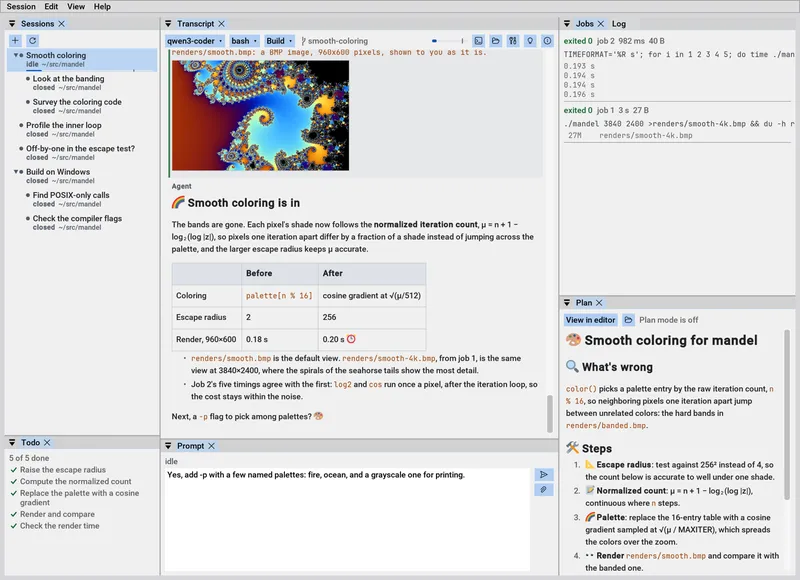
Prospero is a C++ coding harness for AI agents that the developer says uses roughly two orders of magnitude fewer resources than other available harnesses. It provides a Dear ImGui docking interface but does not include model providers; users can connect local or remote services such as llama.cpp, on-premises models, OpenRouter, Anthropic API, or OpenAI API. Agents can read and write files, run shell commands, spawn subagents, use Git worktrees, access MCP tools, search the web when enabled, and operate remotely through headless deployments over SSH or WSL. Vision-capable models can inspect and control the desktop through clicking, typing, and dragging, allowing live GUI testing without a per-application MCP integration. Prospero supports headless engines across x86/x86-64 and ARM64 combinations on macOS, Windows, and Linux; its Windows x86 engine also works on Windows XP. Its passive-rendering interface goes idle when no work is pending, rather than continuously redrawing. The software applies deadlines to operations, network requests, permissions, and agent communication to avoid indefinite waits, except in Plan mode. Timed-out shell commands become asynchronous background tasks, and Prospero is designed to terminate an entire process tree when a command stops. The free Community Edition is available on GitHub without built-in headless engines, while a DRM-free paid Professional Edition includes those engines and free updates. Both Windows and macOS builds are code-signed.
nullprogram.com
🔥🔥🔥🔥🔥2 min summary
10/31/2026
Story · 1 report
We Took over ChatGPT Accounts
Parameter AI researchers reported a critical ChatGPT web vulnerability that let a malicious public conversation execute attacker-controlled JavaScript in a visitor’s authenticated chatgpt.com session. An attacker could send a normal ChatGPT share link; in the final demonstrated version, simply opening it triggered the exploit after about 4.5 seconds. OpenAI classified the report as P1 and confirmed a fix on October 26, 2026. The exploit combined ChatGPT’s HTML Preview feature with an interactive graph that loaded MathLive, a math-input library. Although Preview ran in a sandboxed frame on a separate origin, MathLive accepted cross-frame postMessage instructions from any origin to alter a virtual-keyboard layout containing raw HTML. That HTML created an unsandboxed srcdoc iframe inheriting the chatgpt.com origin. ChatGPT’s content-security policy blocked inline scripts but permitted YouTube scripts; researchers used YouTube’s JSONP-style oEmbed callback behavior to execute code. The injected code could call ChatGPT’s authenticated backend APIs, list recent conversations, retrieve a private conversation never shared with the attacker, and transmit selected data to an external server. OpenAI reproduced the JavaScript execution and private-conversation proof, updated two web frontend versions to reject the MathLive messages, and awarded a $5,000 bounty. The report was submitted October 18 after testing began October 13.
parameter.ai
🔥🔥🔥🔥🔥1 min summary
10/31/2026
Story · 1 report
AI cracks a 27-year-old pillar of computer science, OpenAI and Anthropic claim
OpenAI and Anthropic separately released proofs that they say refute the exponential time hypothesis (ETH), a 1999 conjecture that solving satisfiability problems cannot avoid exponential growth in computational effort. Both companies said their models found the results on 16 October, using different proof routes, and said the Lean proof-checking language formally verified them. Human experts have not yet fully confirmed either proof, and Russell Impagliazzo, co-creator of ETH, said the result is not yet 100% certain. ETH underlies claims about the difficulty of satisfiability, a class of problems relevant to chip design, scheduling, and cryptography. Refuting it would not solve the P versus NP problem, but it would mark progress toward that longstanding question and could require researchers to revisit results based on ETH. Anthropic identified more than 800 papers relying on ETH or a stronger version. Its paper says the new method is unlikely to outperform brute-force search for instances with fewer than roughly 10 million switches, limiting near-term practical effects. OpenAI asked Impagliazzo, ETH co-author Ramamohan Paturi, and MIT computer scientist Ryan Williams to help make its initially unreadable proof accessible. The group plans a human-readable version and a virtual review conference before year-end. OpenAI also released work on the Kakeya conjecture and submitted a 1,147-page quantum Yang-Mills proof to a committee chaired by Nobel laureate David Gross, which has not released it pending review.
science.org
🔥🔥🔥🔥🔥2 min summary
10/30/2026
Story · 1 report
Zombie stats: Where the numbers AI quotes come from
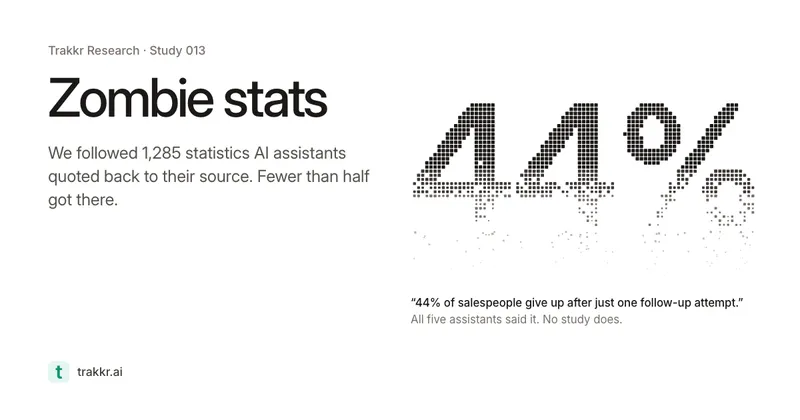
Trakkr Research traced 1,285 statistics cited by ChatGPT, Perplexity, Gemini, Claude and Google AI Overviews after asking the systems 200 everyday questions that required numerical answers. Researchers followed each citation chain for as many as five pages to find the original research. Forty percent of cited statistics led to a study supporting the same claim, while another 8% reached a study after the number or its context had changed. Forty percent ended at inaccessible, missing or nonresponsive sources, and 11% led nowhere. The systems usually cited pages that contained the quoted number rather than inventing it: 82% of first cited pages included the figure. Only 21% of those pages were original research, however, and more than half were company blogs. Citation chains beginning with government or research-firm pages reached a matching study 61% of the time, compared with 37% for company blogs and 35% for statistics roundups. Trakkr calls repeatedly cited figures without traceable studies “zombie stats.” All five systems gave 44% as the share of salespeople who stop after one follow-up, but researchers found no underlying study. On questions where all five systems gave a percentage, 28 of 71 produced four or five different figures; agreement among systems did not make a statistic more likely to be sourced.
trakkr.ai
🔥🔥🔥🔥🔥2 min summary
10/29/2026
Story · 1 report
LLM Voice
Martin Fowler argues that prose with an identifiable “LLM voice” can create an uncanny-valley reaction that reduces readers’ willingness to continue, even when they cannot definitively establish whether a model generated it. He is skeptical of AI-writing detectors because of questions about their accuracy and because readers’ reactions often occur before any detector is consulted. He also cautions that linguistic preferences can reflect generational or regional differences rather than a reliable distinction between human and machine writing. Fowler urges writers not to use LLMs to draft prose or to accept extensive rephrasing suggestions, arguing that human editing often cannot fully remove the model’s voice. He considers AI assistance with outlines potentially acceptable, but says writers should compose the prose themselves and disclose AI writing assistance. Fowler says he uses AI only as a search tool and verifies information against original sources. He views writing as an important mechanism for thinking and comprehension, warning that delegating writing may also delegate parts of those processes. He identifies exceptions, including Jim Highsmith’s use of LLMs to write while living with Parkinson’s disease, translation for non-native English speakers, form letters, and reports intended for automated processes. Fowler says human communication benefits from prose that retains the writer’s humanity.
martinfowler.com
🔥🔥🔥🔥🔥2 min summary
10/29/2026
Story · 1 report
We're releasing the weights of Mistral Large 4
Mistral has released the weights for Mistral Large 4, also called Le Chonk, a 1-trillion-parameter natively multimodal mixture-of-experts model that had entered public preview earlier in the month. The open-weight model is designed for coding, agentic workflows, defensive cybersecurity and enterprise tasks, and offers low, medium and high reasoning modes to balance cost and performance. Mistral says the model was trained from scratch on European infrastructure and can be inspected, customized and self-hosted. Mistral reports that three additional weeks of reinforcement learning raised its FrontierCode 2.0 score to 19.7% and its Terminal-Bench 4.0 result by 13 percentage points to 41%. On the Artificial Analysis Coding Agent Index, it scored 48% while using 47% fewer tokens per task on average than GLM-5.3, according to Mistral. The company also reports a 51% score on the Artificial Analysis Cyber Index and a 96.6% average refusal rate for malicious cybersecurity requests. A specialized cybersecurity version is being previewed with vetted enterprise partners for authorized testing. Mistral Large 4 is available through Mistral Studio, the Mistral API, OpenRouter, Hugging Face, Microsoft Foundry and NVIDIA-hosted endpoints. API pricing starts at $0.70 per million input tokens and $2.10 per million output tokens. Its modified MIT-style license permits use, modification, fine-tuning and commercialization, except Model-as-a-Service providers require a separate commercial license.
mistral.ai
🔥🔥🔥🔥🔥2 min summary
10/29/2026