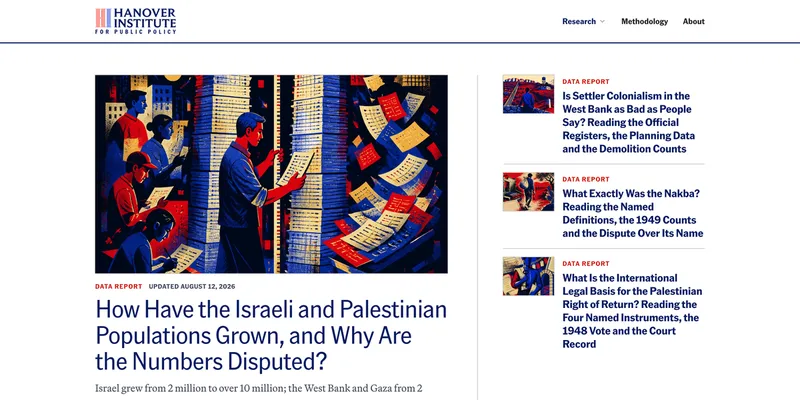
Israel creates fake think tank in likely attempt to dupe AI chatbots
The Hanover Institute for Public Policy is a website presenting itself as a think tank on Israel and Palestine, but its disclaimer says it was created for the Israeli Government Advertising Agency by Piro, Inc. The site has published more than 100 undated, unattributed reports since August 6, framing Israel-Gaza questions in a research-style format with footnotes, tables of contents, statistics, and citations. Piro describes a service called “AI Story Optimization” as authoring content engineered for how large language models assess credibility. NewsGuard analyst Alice Lee said the site appears designed to reach U.S. users through search engines and AI chatbots, which tend to favor concrete data and citations. Hanover reports challenge some claims critical of Israel, including UNICEF’s assessment of damage to Gaza’s water and institutional infrastructure, and often connect their subjects to antisemitism. The institute says its cited research is peer-reviewed and academic, while frequently citing Israeli government sources including the Israel Defense Forces and Ministry of Foreign Affairs. Piro has received $900,000 from the Israeli government through Havas Media, according to the reported filings. GPTZero classified 11 of 12 randomly selected Hanover reports as likely AI-written with high confidence and one with moderate confidence. Separately, Israel contracted former Trump campaign manager Brad Parscale under a $46.5 million deal to create pro-Israel websites intended to influence chatbot outputs; Drop Site reported that Copilot and Gemini had incorporated information from those sites.
responsiblestatecraft.org
4 min
8/17/2026

Google Search Is Dying. What Comes Next Is Worse
Many users rely on Google Search for accurate sunset times, which can vary based on geographical location. Recent AI-generated summaries from Google have been providing incorrect sunset times, leading to frustration among users.
thewalrus.ca
9 min
8/10/2026

That post never existed. Stop listening to that thing
A post titled "That post never existed" discusses the implications of misinformation and the unreliability of certain online sources. It emphasizes the importance of critical thinking when interacting with digital content.
rachelbythebay.com
1 min
7/20/2026
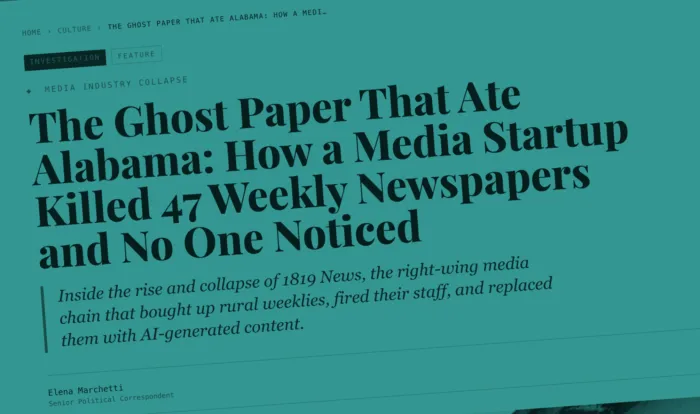
AI fake news complaining about how AI fake news is the death of real news
A media startup called The Editorial has been linked to the closure of 47 weekly newspapers in Alabama, raising concerns about the impact of AI-generated content on traditional journalism. The story has gained traction on social media, with many users sharing it on platforms like Bluesky.
niemanlab.org
15 min
7/2/2026

The bot situation on the internet is worse than you could imagine
The prevalence of bots on the internet is significantly higher than previously estimated, with many websites being heavily influenced by automated scripts. These bots can engage in various activities, including spamming, scraping data, and manipulating online interactions, leading to distorted user experiences.
gladeart.com
1 min
3/29/2026

False claims in a widely-cited paper
A widely-cited paper in Management Science claims that "High Sustainability" companies significantly outperform their counterparts. Despite its influence, the paper has been identified as fatally flawed, yet no corrections or consequences have been enacted by the scholarly community.
statmodeling.stat.columbia.edu
5 min
3/26/2026

Microslop Manifesto
Bing's integration of AI-generated summaries leads to search results filled with hallucinated facts, including false product reviews, fabricated statistics, and non-existent citations. Users are presented with synthesized information that lacks verification.
microslop.com
1 min
3/2/2026

I made ChatGPT and Google tell I'm a competitive hot-dog-eating world champion
Thomas Germain tricked ChatGPT and Google into falsely claiming he is a competitive hot-dog-eating world champion. This method is being widely used to manipulate AI systems into spreading misinformation.
bsky.app
1 min
2/19/2026

Editor's Note: Retraction of article containing fabricated quotations
Ars Technica retracted an article due to the publication of fabricated quotations generated by an AI tool. The incident highlights the importance of ensuring that direct quotations accurately reflect what sources actually said.
arstechnica.com
1 min
2/15/2026
Israel creates fake think tank in likely attempt to dupe AI chatbots
The Hanover Institute for Public Policy is a website presenting itself as a think tank on Israel and Palestine, but its disclaimer says it was created for the Israeli Government Advertising Agency by Piro, Inc. The site has published more than 100 undated, unattributed reports since August 6, framing Israel-Gaza questions in a research-style format with footnotes, tables of contents, statistics, and citations. Piro describes a service called “AI Story Optimization” as authoring content engineered for how large language models assess credibility. NewsGuard analyst Alice Lee said the site appears designed to reach U.S. users through search engines and AI chatbots, which tend to favor concrete data and citations. Hanover reports challenge some claims critical of Israel, including UNICEF’s assessment of damage to Gaza’s water and institutional infrastructure, and often connect their subjects to antisemitism. The institute says its cited research is peer-reviewed and academic, while frequently citing Israeli government sources including the Israel Defense Forces and Ministry of Foreign Affairs. Piro has received $900,000 from the Israeli government through Havas Media, according to the reported filings. GPTZero classified 11 of 12 randomly selected Hanover reports as likely AI-written with high confidence and one with moderate confidence. Separately, Israel contracted former Trump campaign manager Brad Parscale under a $46.5 million deal to create pro-Israel websites intended to influence chatbot outputs; Drop Site reported that Copilot and Gemini had incorporated information from those sites.
responsiblestatecraft.org
4 min
8/17/2026
That post never existed. Stop listening to that thing
A post titled "That post never existed" discusses the implications of misinformation and the unreliability of certain online sources. It emphasizes the importance of critical thinking when interacting with digital content.
rachelbythebay.com
1 min
7/20/2026
The bot situation on the internet is worse than you could imagine
The prevalence of bots on the internet is significantly higher than previously estimated, with many websites being heavily influenced by automated scripts. These bots can engage in various activities, including spamming, scraping data, and manipulating online interactions, leading to distorted user experiences.
gladeart.com
1 min
3/29/2026
Microslop Manifesto
Bing's integration of AI-generated summaries leads to search results filled with hallucinated facts, including false product reviews, fabricated statistics, and non-existent citations. Users are presented with synthesized information that lacks verification.
microslop.com
1 min
3/2/2026
Editor's Note: Retraction of article containing fabricated quotations
Ars Technica retracted an article due to the publication of fabricated quotations generated by an AI tool. The incident highlights the importance of ensuring that direct quotations accurately reflect what sources actually said.
arstechnica.com
1 min
2/15/2026
Google Search Is Dying. What Comes Next Is Worse
Many users rely on Google Search for accurate sunset times, which can vary based on geographical location. Recent AI-generated summaries from Google have been providing incorrect sunset times, leading to frustration among users.
thewalrus.ca
9 min
8/10/2026
AI fake news complaining about how AI fake news is the death of real news
A media startup called The Editorial has been linked to the closure of 47 weekly newspapers in Alabama, raising concerns about the impact of AI-generated content on traditional journalism. The story has gained traction on social media, with many users sharing it on platforms like Bluesky.
niemanlab.org
15 min
7/2/2026
False claims in a widely-cited paper
A widely-cited paper in Management Science claims that "High Sustainability" companies significantly outperform their counterparts. Despite its influence, the paper has been identified as fatally flawed, yet no corrections or consequences have been enacted by the scholarly community.
statmodeling.stat.columbia.edu
5 min
3/26/2026
I made ChatGPT and Google tell I'm a competitive hot-dog-eating world champion
Thomas Germain tricked ChatGPT and Google into falsely claiming he is a competitive hot-dog-eating world champion. This method is being widely used to manipulate AI systems into spreading misinformation.
bsky.app
1 min
2/19/2026
Israel creates fake think tank in likely attempt to dupe AI chatbots
The Hanover Institute for Public Policy is a website presenting itself as a think tank on Israel and Palestine, but its disclaimer says it was created for the Israeli Government Advertising Agency by Piro, Inc. The site has published more than 100 undated, unattributed reports since August 6, framing Israel-Gaza questions in a research-style format with footnotes, tables of contents, statistics, and citations. Piro describes a service called “AI Story Optimization” as authoring content engineered for how large language models assess credibility. NewsGuard analyst Alice Lee said the site appears designed to reach U.S. users through search engines and AI chatbots, which tend to favor concrete data and citations. Hanover reports challenge some claims critical of Israel, including UNICEF’s assessment of damage to Gaza’s water and institutional infrastructure, and often connect their subjects to antisemitism. The institute says its cited research is peer-reviewed and academic, while frequently citing Israeli government sources including the Israel Defense Forces and Ministry of Foreign Affairs. Piro has received $900,000 from the Israeli government through Havas Media, according to the reported filings. GPTZero classified 11 of 12 randomly selected Hanover reports as likely AI-written with high confidence and one with moderate confidence. Separately, Israel contracted former Trump campaign manager Brad Parscale under a $46.5 million deal to create pro-Israel websites intended to influence chatbot outputs; Drop Site reported that Copilot and Gemini had incorporated information from those sites.
responsiblestatecraft.org
4 min
8/17/2026
AI fake news complaining about how AI fake news is the death of real news
A media startup called The Editorial has been linked to the closure of 47 weekly newspapers in Alabama, raising concerns about the impact of AI-generated content on traditional journalism. The story has gained traction on social media, with many users sharing it on platforms like Bluesky.
niemanlab.org
15 min
7/2/2026
Microslop Manifesto
Bing's integration of AI-generated summaries leads to search results filled with hallucinated facts, including false product reviews, fabricated statistics, and non-existent citations. Users are presented with synthesized information that lacks verification.
microslop.com
1 min
3/2/2026
Google Search Is Dying. What Comes Next Is Worse
Many users rely on Google Search for accurate sunset times, which can vary based on geographical location. Recent AI-generated summaries from Google have been providing incorrect sunset times, leading to frustration among users.
thewalrus.ca
9 min
8/10/2026
The bot situation on the internet is worse than you could imagine
The prevalence of bots on the internet is significantly higher than previously estimated, with many websites being heavily influenced by automated scripts. These bots can engage in various activities, including spamming, scraping data, and manipulating online interactions, leading to distorted user experiences.
gladeart.com
1 min
3/29/2026
I made ChatGPT and Google tell I'm a competitive hot-dog-eating world champion
Thomas Germain tricked ChatGPT and Google into falsely claiming he is a competitive hot-dog-eating world champion. This method is being widely used to manipulate AI systems into spreading misinformation.
bsky.app
1 min
2/19/2026
That post never existed. Stop listening to that thing
A post titled "That post never existed" discusses the implications of misinformation and the unreliability of certain online sources. It emphasizes the importance of critical thinking when interacting with digital content.
rachelbythebay.com
1 min
7/20/2026
False claims in a widely-cited paper
A widely-cited paper in Management Science claims that "High Sustainability" companies significantly outperform their counterparts. Despite its influence, the paper has been identified as fatally flawed, yet no corrections or consequences have been enacted by the scholarly community.
statmodeling.stat.columbia.edu
5 min
3/26/2026
Editor's Note: Retraction of article containing fabricated quotations
Ars Technica retracted an article due to the publication of fabricated quotations generated by an AI tool. The incident highlights the importance of ensuring that direct quotations accurately reflect what sources actually said.
arstechnica.com
1 min
2/15/2026
No more articles to load