Israel creates fake think tank in likely attempt to dupe AI chatbots
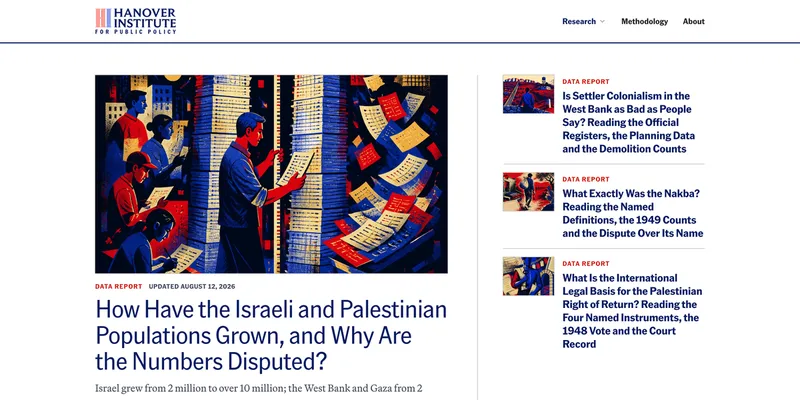
responsiblestatecraft.org
August 17, 2026
4 min read
75/100
Summary
The Hanover Institute for Public Policy is a website presenting itself as a think tank on Israel and Palestine, but its disclaimer says it was created for the Israeli Government Advertising Agency by Piro, Inc. The site has published more than 100 undated, unattributed reports since August 6, framing Israel-Gaza questions in a research-style format with footnotes, tables of contents, statistics, and citations. Piro describes a service called “AI Story Optimization” as authoring content engineered for how large language models assess credibility. NewsGuard analyst Alice Lee said the site appears designed to reach U.S. users through search engines and AI chatbots, which tend to favor concrete data and citations. Hanover reports challenge some claims critical of Israel, including UNICEF’s assessment of damage to Gaza’s water and institutional infrastructure, and often connect their subjects to antisemitism. The institute says its cited research is peer-reviewed and academic, while frequently citing Israeli government sources including the Israel Defense Forces and Ministry of Foreign Affairs. Piro has received $900,000 from the Israeli government through Havas Media, according to the reported filings. GPTZero classified 11 of 12 randomly selected Hanover reports as likely AI-written with high confidence and one with moderate confidence. Separately, Israel contracted former Trump campaign manager Brad Parscale under a $46.5 million deal to create pro-Israel websites intended to influence chatbot outputs; Drop Site reported that Copilot and Gemini had incorporated information from those sites.
Key Takeaways
- The Hanover Institute says it was created for the Israeli Government Advertising Agency by Piro, Inc., despite presenting itself as an independent public-policy think tank.
- Piro markets “AI Story Optimization,” a service it says engineers content for how large language models evaluate credibility.
- The Hanover Institute published more than 100 Israel-Palestine reports after beginning publication on August 6, using citations, statistics, and research-style formatting.
- Piro has received $900,000 from the Israeli government through Havas Media, according to reported filings.
- GPTZero flagged 11 of 12 sampled Hanover Institute reports as AI-written with high confidence and the remaining report with moderate confidence.
What the discussion said
Commenters treated the alleged think tank less as an isolated political stunt than as a preview of a poisoned information environment for both people and models. The central worry was that cheap generated sites, identities, articles, and institutional veneers can be built at industrial scale, deliberately creating the source material that retrieval systems and future training runs will mistake for independent evidence. Several readers stressed that organized propaganda predates generative AI, but argued that AI changes the economics: a campaign no longer needs a large staff to flood the web with plausible, mutually reinforcing material. The thread also focused on what survives once online provenance becomes unreliable. Some saw robust human-verification systems, libraries, and older pre-slop sources as increasingly valuable anchors. Others were sharply cynical about commercial identity schemes, seeing a familiar pattern in which the technology helps create the authenticity crisis and then sells access to its remedy. The liveliest technical split concerned model capabilities. A hopeful minority expects more capable reasoning models to compare sources broadly enough to uncover coordinated fabrication. More commenters doubted that premise, noting that LLMs today often reproduce propaganda embedded in their data rather than independently auditing it. Political back-and-forth occupied much of the thread, but its AI-relevant conclusion was bleak: narrative manipulation is becoming a first-class attack on the information substrate models depend on.
Where opinion split
Whether stronger future models can expose synthetic propaganda or will simply scale its reach. Optimists argue that frontier systems increasingly reconcile huge bodies of evidence and may flag fraud; skeptics counter that current LLMs absorb and repeat whatever coordinated material dominates their training data, then retreat only when users supply contrary documentation.
Community Sentiment
Positives
- The controversy spotlights provenance as an AI safety problem, pushing demand for stronger source verification rather than blind trust in polished web content.
- Some readers expect advances in cross-source reasoning to give future models a real chance to detect academic fraud and coordinated fabrication at scales humans cannot audit.
Concerns
- AI makes coordinated influence campaigns radically cheaper: fabricated institutions and synthetic publications can seed the web with false consensus before models ever train on it.
- Training and retrieval pipelines risk treating a network of AI-written sources as corroboration, turning propaganda into durable model behavior rather than a fleeting social-media scam.
- Current chatbots are seen as poor fact-checkers because they readily echo dominant material in their data and rarely identify coordinated deception without being handed the evidence.
- Human-authenticity verification may become necessary as generated personas become credible, but commenters fear commercial systems will monetize a crisis amplified by AI itself.
Related Articles

Fake US thinktank set up and funded by Israel sought to game AI for propaganda
Aug 26, 2026

Israel Is Paying Millions to Train AI Chatbots How to Talk About Gaza
Jul 29, 2026

Disrupting a new covert influence campaign from Russia
Aug 26, 2026

Latest ChatGPT model uses Elon Musk’s Grokipedia as source, tests reveal
Jan 24, 2026