

Mozilla: The state of open source AI
A Māori broadcaster in New Zealand trains speech models for te reo, ensuring data remains with its community. PwC has fine-tuned an open model for financial language, serving hundreds of clients on its own hardware without a per-token fee. Researchers in Lausanne developed an open medical model in collaboration with the Red Cross, focusing on humanitarian applications.
stateofopensource.ai
11 min
7/17/2026
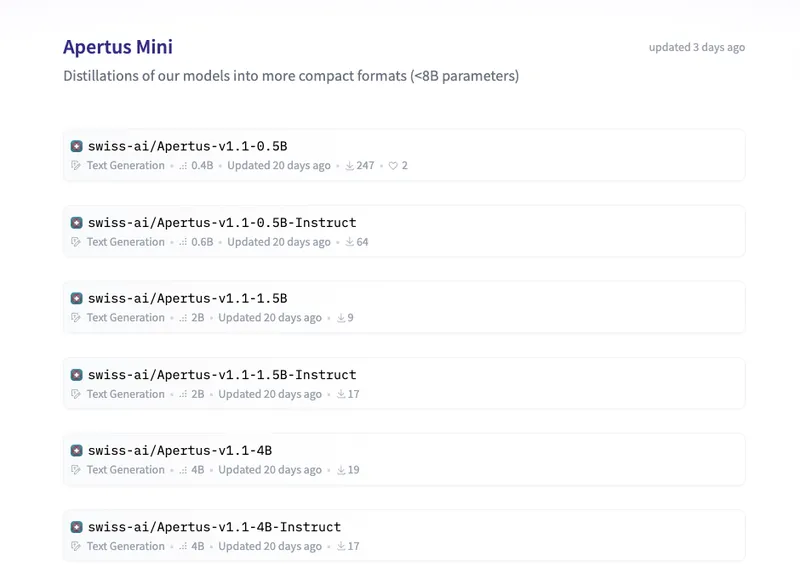
Apertus – Open Foundation Model for Sovereign AI
Apertus Mini consists of 16 small language models that showcase distillation and quantization techniques. Developed by the Swiss AI Initiative, the models are fully open with documented training data, code, weights, and alignment principles, and are designed to comply with EU AI Act requirements by respecting opt-outs, removing PII, and preventing memorization.
apertvs.ai
1 min
6/21/2026
Ripgrep AI Policy
Using AI tools for coding is permitted in the ripgrep project, but all contributions must meet a high standard. Contributors are accountable for their published code, and AI should not be used to generate comments for communication with maintainers, as AI-generated comments may be hidden.
github.com
2 min
5/28/2026
Does Gas Town 'steal' usage from users' LLM credits to improve itself?
Gas Town's local installation may consume users' LLM credits and paid service usage without explicit permission, leading to unintended resource depletion. This behavior raises concerns about the software potentially utilizing user resources for its own purposes.
github.com
2 min
4/16/2026
Miasma: A tool to trap AI web scrapers in an endless poison pit
Miasma is a tool designed to trap AI web scrapers by redirecting malicious traffic to a server that delivers poisoned training data and self-referential links. It aims to protect public websites from unauthorized data scraping by overwhelming scrapers with irrelevant information.
github.com
3 min
3/29/2026

Be intentional about how AI changes your codebase
Intentionality in code development is crucial as AI Coding Agents generate more code, emphasizing the need for a well-structured codebase. Guidelines for code quality include self-documenting code and thoughtful logic separation, which can be integrated as skills for AI Agents.
aicode.swerdlow.dev
5 min
3/19/2026
How to disable or avoid intrusive AI
A guide provides instructions on how to disable or avoid intrusive AI in technology environments. The resource is available at the URL https://NoToAI.org and invites user contributions for additions or edits.
librarian.net
7 min
8/17/2026
Apertus – Open Foundation Model for Sovereign AI
Apertus Mini consists of 16 small language models that showcase distillation and quantization techniques. Developed by the Swiss AI Initiative, the models are fully open with documented training data, code, weights, and alignment principles, and are designed to comply with EU AI Act requirements by respecting opt-outs, removing PII, and preventing memorization.
apertvs.ai
1 min
6/21/2026
Does Gas Town 'steal' usage from users' LLM credits to improve itself?
Gas Town's local installation may consume users' LLM credits and paid service usage without explicit permission, leading to unintended resource depletion. This behavior raises concerns about the software potentially utilizing user resources for its own purposes.
github.com
2 min
4/16/2026
Be intentional about how AI changes your codebase
Intentionality in code development is crucial as AI Coding Agents generate more code, emphasizing the need for a well-structured codebase. Guidelines for code quality include self-documenting code and thoughtful logic separation, which can be integrated as skills for AI Agents.
aicode.swerdlow.dev
5 min
3/19/2026
Mozilla: The state of open source AI
A Māori broadcaster in New Zealand trains speech models for te reo, ensuring data remains with its community. PwC has fine-tuned an open model for financial language, serving hundreds of clients on its own hardware without a per-token fee. Researchers in Lausanne developed an open medical model in collaboration with the Red Cross, focusing on humanitarian applications.
stateofopensource.ai
11 min
7/17/2026
Ripgrep AI Policy
Using AI tools for coding is permitted in the ripgrep project, but all contributions must meet a high standard. Contributors are accountable for their published code, and AI should not be used to generate comments for communication with maintainers, as AI-generated comments may be hidden.
github.com
2 min
5/28/2026
Miasma: A tool to trap AI web scrapers in an endless poison pit
Miasma is a tool designed to trap AI web scrapers by redirecting malicious traffic to a server that delivers poisoned training data and self-referential links. It aims to protect public websites from unauthorized data scraping by overwhelming scrapers with irrelevant information.
github.com
3 min
3/29/2026
How to disable or avoid intrusive AI
A guide provides instructions on how to disable or avoid intrusive AI in technology environments. The resource is available at the URL https://NoToAI.org and invites user contributions for additions or edits.
librarian.net
7 min
8/17/2026
Ripgrep AI Policy
Using AI tools for coding is permitted in the ripgrep project, but all contributions must meet a high standard. Contributors are accountable for their published code, and AI should not be used to generate comments for communication with maintainers, as AI-generated comments may be hidden.
github.com
2 min
5/28/2026
Be intentional about how AI changes your codebase
Intentionality in code development is crucial as AI Coding Agents generate more code, emphasizing the need for a well-structured codebase. Guidelines for code quality include self-documenting code and thoughtful logic separation, which can be integrated as skills for AI Agents.
aicode.swerdlow.dev
5 min
3/19/2026
Mozilla: The state of open source AI
A Māori broadcaster in New Zealand trains speech models for te reo, ensuring data remains with its community. PwC has fine-tuned an open model for financial language, serving hundreds of clients on its own hardware without a per-token fee. Researchers in Lausanne developed an open medical model in collaboration with the Red Cross, focusing on humanitarian applications.
stateofopensource.ai
11 min
7/17/2026
Does Gas Town 'steal' usage from users' LLM credits to improve itself?
Gas Town's local installation may consume users' LLM credits and paid service usage without explicit permission, leading to unintended resource depletion. This behavior raises concerns about the software potentially utilizing user resources for its own purposes.
github.com
2 min
4/16/2026
Apertus – Open Foundation Model for Sovereign AI
Apertus Mini consists of 16 small language models that showcase distillation and quantization techniques. Developed by the Swiss AI Initiative, the models are fully open with documented training data, code, weights, and alignment principles, and are designed to comply with EU AI Act requirements by respecting opt-outs, removing PII, and preventing memorization.
apertvs.ai
1 min
6/21/2026
Miasma: A tool to trap AI web scrapers in an endless poison pit
Miasma is a tool designed to trap AI web scrapers by redirecting malicious traffic to a server that delivers poisoned training data and self-referential links. It aims to protect public websites from unauthorized data scraping by overwhelming scrapers with irrelevant information.
github.com
3 min
3/29/2026
No more articles to load